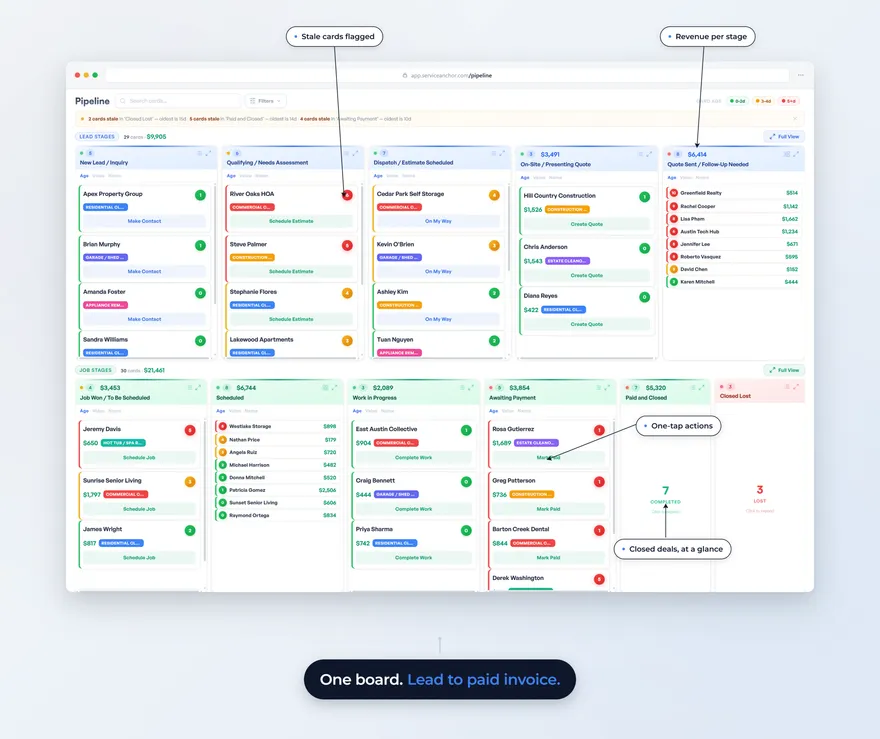
A payment reminder message is a short, friendly text that names the job, the amount and how to pay, sent the day after a job that’s still unpaid and then on a fixed schedule until the money lands.
If you finished the job, heard “I’ll Zelle you tonight,” and now have a few of those sitting in old text threads, this is for you.
The best reminder is the one you never send, and most customers carry a card: credit and debit cards made up 65% of US consumer payments by number in 2024, against 14% for cash (Federal Reserve, 2025 Diary of Consumer Payment Choice).
Below: how to avoid the reminder, what a good one says, ten texts to copy, the ladder for sending them, and the rules on texting someone who owes you.
- Collect before you leave the driveway. A pay link texted from the truck while the customer is standing in their clean garage beats any reminder you could write.
- A good payment reminder has five parts: your business name, the job, the amount, the pay link, and a way to say something’s wrong.
- The ladder: a text on day 1 (day 2 if they promised to pay) and day 3, a phone call before day 7, then texts on day 7 and day 14. Stop the moment it’s paid.
- Text to pay just means the text carries a link the customer taps to pay by card. If you pass the card fee on, say so on the invoice.
- You’re collecting your own bill, which usually doesn’t make you a “debt collector” under federal law, but some state laws reach businesses too. Keep reminders about the bill, no promotions, daytime hours, and never threaten. Not legal advice.
How do you avoid needing a payment reminder?
You avoid needing a payment reminder by asking for payment before you leave the job, with the invoice and a pay link already on the customer’s phone. Bringing up money a day later, after the customer has moved on to the rest of their week, is the awkward part. On the driveway, the work’s in front of them and the conversation is easy.
Three things do most of the work:
- Say it at booking. “We take payment when the job’s done, card or cash.” One sentence on the call or on the estimate sets the expectation before anyone lifts anything.
- Send the invoice from the truck. Before you pull away, text the invoice with a pay link. The customer pays in a minute from the same phone they booked you with. Our contractor invoice template covers what goes on the invoice itself.
- Log cash and checks on the spot. If they hand you cash, mark the invoice paid right there, so nobody gets a reminder for a job they already settled. That reminder is worse than no reminder.
The jobs that still slip are usually the big ones (a two-truck cleanout where the owner is out of town) and the commercial ones (a property manager who pays on their own schedule). Those are what the reminders below are for.
What should a payment reminder text say?
A payment reminder text should say who you are, which job it’s about, how much is owed, how to pay, and how to reach you if something’s wrong. That last part does more than it looks: a late payment from a homeowner is often a forgotten one, or a question about the bill they haven’t asked yet, and an easy way to raise it gets you a reply instead of silence.
The five parts:
- Your business name. The customer may not have your number saved.
- The job. “The garage cleanout on Friday” is easier to recognize than an invoice number.
- The amount. Exact, with cents if there are cents.
- The pay link. One tap to pay by card. If you also take Zelle, Venmo or checks, add one line with your handle or address so the customer who promised Zelle doesn’t have to ask.
- A way to flag a problem. “If anything looks off, just reply here.” It keeps the tone friendly and gets disputes out in the open early.
Leave out late fees you haven’t agreed to in writing, threats, and anything promotional. The tone is the one we use in Template 7 of our on-my-way text templates: friendly, not collections.
Payment reminder messages to copy
These follow the ladder: each step is a little more direct than the last, and none of them is rude. Swap in your name, your business and the job; the names here are made up. Paste the pay link where you see [link]. A pay link adds 40 or so characters, so most of these arrive as two message segments once it’s in; that’s fine for a bill, just don’t pad them.
Same day, with the invoice (before it’s late)
Hi Karen, it's Mike from Big Dog Junk Removal. Thanks again for today. Invoice for the garage cleanout, $485: [link]. Any questions, just reply.Day 1 (friendly reminder)
Hi Karen, Mike at Big Dog Junk Removal. Quick reminder on yesterday's cleanout, $485 still open: [link]. Thanks!Day 1, for a customer you know well
Hey Karen, Mike from Big Dog. Hope the garage is staying clear. Nudge on the $485 from Friday when you get a sec: [link]. Anything off, just say.Day 2, instead of day 1 when they promised to pay
Hi Karen, Mike at Big Dog Junk Removal. You'd mentioned sending the $485 for the cleanout, haven't seen it yet. Link to make it easy: [link]Day 3 (still friendly, more specific)
Hi Karen, Big Dog Junk Removal. The $485 for the 10/9 cleanout is still open: [link]. If anything looks off, reply and we'll fix it.Day 7, after a phone call (direct)
Hi Karen, Mike at Big Dog Junk Removal. Following up on my call: the $485 from 10/9 is a week past due. Can you take care of it today? [link]Day 14 (final text)
Hi Karen, Big Dog Junk Removal. The $485 from 10/9 is two weeks overdue. Please pay by the 27th at [link], or reply so we can set up a time to talk.Moving, day 3 on the balance (the balance terms belong in your moving contract)
Hi Dana, Luis with Northside Moving. The $1,140 balance from Saturday's move is still open: [link]. Glad everything made it in one piece.Pressure washing, day 3
Hi Sam, Clearline Washing. Hope the driveway still looks new. The $360 from Tuesday is still open: [link]. Questions? Reply here.Property manager or commercial customer
Hi Rita, Big Dog Junk Removal. Invoice 1042, unit 4B move-out cleanout, $620: [link]. Need a W-9 or a PO number on it? Just reply.Two emails for commercial customers
Some commercial customers pay from email, not text. Two short versions:
Subject: Invoice 1042, unit 4B cleanout ($620)
Hi Rita, attached is invoice 1042 for the move-out cleanout at unit 4B on October 9, $620. You can pay by card at [link] or by check to the address on the invoice. If you need a PO number or a W-9 for your files, reply and we’ll send it today. Thanks, Mike, Big Dog Junk Removal
Subject: Following up: invoice 1042 ($620), due October 23
Hi Rita, following up on invoice 1042 for the unit 4B cleanout. It shows $620 open, now a week past the due date. Can you let us know when it’s scheduled to go out, or if anything on it needs correcting? Pay link: [link]. Thanks, Mike
If the final text and a phone call both go nowhere, the next steps are a written demand letter and, for small amounts, your local small claims court. Few small jobs ever get that far.
How long should you wait between payment reminders?
Wait one day after the job before the first reminder, text again on day 3, call before day 7, and send the last two texts on day 7 and day 14. Stop the moment the invoice is paid. Faster than that reads as pushy for a homeowner job; slower and the job fades from their memory. For commercial customers on agreed terms (net 15 or net 30), start the ladder at the due date instead of the job date.
Three habits keep the ladder from backfiring:
- Stop when it’s paid. A reminder that lands after the customer paid is a quick way to lose a repeat customer. If you send reminders by hand, check before every one.
- Daytime only. Send between about 9 a.m. and 7 p.m. their time. The rules section below has the legal outer limit.
- Call after the second unanswered text. A text is easy to put off; a friendly voicemail from a person is harder to ignore. Plenty of stuck invoices are one phone call from paid.
What is text to pay?
Text to pay is a payment link sent by text that opens a secure checkout where the customer pays by card, with no app, account or login. Payment processors sell it as a product, and invoicing software builds it into the invoice text. For a home service job, it’s what makes “pay before I leave” realistic: the customer pays from the phone in their hand.
Two things to check in any text to pay setup:
- The fee, said plainly. Card processing costs money. At 3.5% + $0.30, the $485 cleanout above costs $17.28 to take by card. Know your number per transaction, and if you pass it on, put it on the invoice where the customer can see it.
- What happens when it’s paid. The invoice should flip to paid on its own and the reminders should stop on their own. If you have to remember to mark it, you’ll eventually remind someone who already paid.
What are the rules on texting a customer who owes you?
You’re generally collecting your own bill, which federal law treats differently from a collection agency collecting someone else’s, but state laws and texting rules still apply. This is a plain-language summary, not legal advice, and the rules vary by state.
Federal debt collection law mostly doesn’t cover you. The Fair Debt Collection Practices Act defines a “debt collector” and excludes “any officer or employee of a creditor while, in the name of the creditor, collecting debts for such creditor” (15 U.S.C. 1692a(6)(A)). In plain terms: your business, collecting its own invoices under its own name, is usually not a debt collector under that law. The same section pulls a creditor back in if it collects under a name that suggests a third party is doing the collecting, and a collection agency you hand the debt to is covered.
Some states reach further. California’s Rosenthal Act applies to anyone who “regularly, on behalf of that person or others, engages in debt collection” (Cal. Civ. Code 1788.2), and “that person” covers a business collecting its own bills. In California and states with similar laws, the rules on harassment, false threats, contact hours and contact frequency can apply to you directly, and a few states cap how often a creditor can contact someone in a week. Check yours before you set a ladder.
The 8 a.m. to 9 p.m. window is the outer limit. The FTC tells consumers that debt collectors “can’t contact you before 8 a.m. or after 9 p.m., unless you agree to it” (FTC Debt Collection FAQs). Where a state law brings those rules to your business, that window applies to you; everywhere else, it’s still a sensible limit.
Texting rules still apply to reminders. Federal rules treat a text as a call, and an automated message that “includes or introduces an advertisement” needs the customer’s prior express written consent (47 CFR 64.1200(a)(2)). A bill reminder to a customer’s cell phone generally needs only their prior consent, which giving you their number for the job usually covers, as long as it stays about the bill: no coupon, no “book your next pickup” line, no review ask in the same text. Honor STOP replies. Our missed call text back guide covers consent, STOP and carrier registration in more detail.
Never threaten. Don’t mention police or arrest: an unpaid bill is a civil matter. Mention small claims court only if you’re ready to file. A reminder that reads like a threat is the one most likely to end up in a complaint.
Can payment reminders send themselves?
Yes, and for a busy owner that’s the point: reminders go out on schedule whether or not you remember, and they stop when the customer pays. Most invoicing tools have some version of this. What to look for: reminders by text, not just email; a gap you set yourself; an automatic stop when the invoice is paid; a pay link in the message; daytime-only sends; and a way to send one by hand when you’re standing in front of the customer.
In Service Anchor, once card payments are connected, the invoice text goes out with a pay link when the invoice is created, so text to pay is the default. Unpaid invoices get reminders by text and email, up to four, and they stop once the invoice is paid or voided. The first goes out two days after the invoice, then at the gap you set; if you want the day 1 nudge, send it by hand. Reminders go out at the time of day the invoice did, held to between 8 a.m. and 9 p.m. your time, so send invoices during the day and set the gap in whole days. The default reminder text doesn’t include the pay link, so add it to the reminder template once and every reminder carries it. From the phone app, an admin can share the pay link, resend the invoice, or log a cash or check payment on the spot, and on the invoice itself a Send Reminder button fires one right away. The reminders repeat at one fixed gap rather than the widening ladder above, so two or three days works well. Card payments run at a flat 3.5% + $0.30 per transaction, every card type.
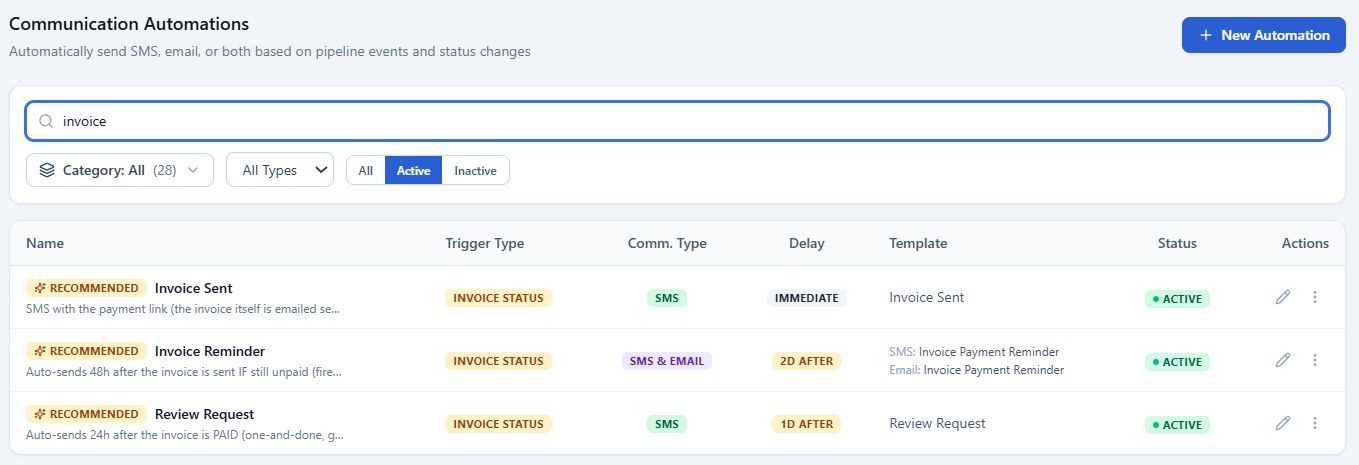
The invoice text with the pay link goes out right away; the reminder follows two days later if the invoice is still unpaid. Demo account.
What to do next
- Count what’s open. Scroll your texts and invoices for every job not yet paid. Write the total down.
- Send the day 1 or day 3 text above to each one today, with the pay link.
- Change the habit. Mention payment at booking and send the invoice from the truck before you leave.
- Let the reminders send themselves. See how Service Anchor handles the invoice, the pay link and the reminders for junk removal, moving or pressure washing.
FAQ
How do you politely remind a customer to pay? Send a short, friendly text the day after the job with your business name, the job, the amount and a pay link, plus an invitation to reply if anything looks off. For example: “Hi Karen, Mike at Big Dog Junk Removal. Quick reminder on yesterday’s cleanout, $485 still open: [link]. Thanks!”
What should a payment reminder text say? Five things: who you are, which job, the exact amount, how to pay (ideally a link), and how to reach you if there’s a problem. Leave out threats, late fees you never agreed to, and anything promotional.
How long should you wait before sending a payment reminder? One day after the job for the first reminder, then day 3, a phone call before day 7, and texts on day 7 and day 14, stopping the moment it’s paid. For commercial customers with agreed terms, start counting from the due date.
Is it legal to text customers about a late payment? Generally yes, if you’re collecting your own invoice under your own business name, the text stays about the bill, and you send it at reasonable hours. Federal debt collection law mostly covers third-party collectors, but some state laws, like California’s, apply to businesses collecting their own debts. Honor STOP replies, keep promotions out, and never threaten. This is not legal advice.
What is text to pay? A text message with a payment link: the customer taps it and pays by card from their phone, no app or account needed. It’s the simplest way to get paid before you leave a job.
Should I charge a late fee? Only if it was agreed in writing before the job, usually in your terms or service agreement, and only if your state allows it. A late fee that shows up for the first time in a reminder tends to start an argument rather than end one.
Nothing on this page is legal advice. Laws cited were read on October 14, 2026; rules change and vary by state.
Last updated: October 2026. First publish; the Federal Reserve 2025 Diary of Consumer Payment Choice, 15 U.S.C. 1692a(6), California Civil Code 1788.2, the FTC’s debt collection FAQs and 47 CFR 64.1200, read October 14, 2026.