A missed call text back is a short, automatic text to someone whose call you could not answer, sent within a minute or two from your business number, so the job does not go to whoever picks up next. This is for a 1-to-5-truck owner who spends the day on jobs, misses calls at the dump or halfway up a staircase, and calls back at lunch to hear “we already booked someone.” Speed is the whole point: in the 2007 MIT and InsideSales.com lead response study, contacting a web lead within five minutes produced 21 times more qualifications than waiting 30 minutes (InsideSales.com, October 2007). Below: what the text should say, texts to copy for junk removal, moving and pressure washing, when to send one and when not to, and what the texting rules actually say.
- A missed call text back goes out automatically when a call to your business number goes unanswered, so the caller hears from you while they are still deciding who to hire.
- A good one has five parts: who you are, sorry you missed them, a question that gets a reply, how to stop the texts, and nothing else. No coupon, no link to a promotion.
- Skip it for hang-ups of a few seconds, send it once per caller rather than once per call, and hold it overnight. A text at 11:40 p.m. costs more goodwill than the missed call did.
- The rules are real: $500 per violating text in a private suit, up to three times that if willful, and FCC penalties on top. A reply to someone who just called you looks more like a conversation than marketing, but it is not exempt, and a reply of STOP ends it.
- If software sends the text, the number has to be registered for A2P 10DLC; providers like Twilio block unregistered business traffic.
How do you respond to a missed call by text?
You respond to a missed call by text with a short message that says who you are, apologizes for missing the call, and asks one question the caller can answer in a few words. The question is the part most templates skip. “How can we help?” invites a paragraph nobody types on a phone; “Is this for a pickup, a move, or a quote?” gets a one-word reply you can act on from the truck.
Five parts, in this order:
- Who you are. Your business name, because the caller may have dialed three companies in five minutes.
- Sorry you missed them. One clause. “Sorry I missed your call, I’m on a job” is honest and reads like a person.
- One ask. A single question or request: what they need, or where and when, whichever fits your trade.
- How to stop. “Reply STOP to opt out” on the first text costs nothing and makes the message unmistakably a business text.
- Nothing else. No discount, no “book now” link, no review ask. The first text is a reply, not an ad, and keeping it that way matters for the rules covered below.
The same logic runs through the on-my-way text templates we publish for later in the job: short, from a person, one thing to answer.
Missed call texts to copy
These are written for a phone screen and a busy owner. Swap in your name and business, and keep each one under 160 characters where you can, so it arrives as a single message.
Junk removal, during the day
Hi, it's Mike with Big Dog Junk Removal. Sorry I missed your call, I'm on a job. Is this for a pickup, a cleanout, or a quote? Reply STOP to opt out.Moving
Hi, this is Dana at Northside Moving. Sorry we missed your call. What's your move date, and how many bedrooms? We'll text you a price. Reply STOP to opt out.Pressure washing
Hi, it's Luis from Clearline Washing. Sorry I missed your call, I'm on a house. Send the address and a photo and I'll price it today. Reply STOP to opt out.After hours (held until morning)
Hi, it's Mike with Big Dog Junk Removal. Sorry we missed your call earlier. Still need a hand? Text back and we'll get you booked. Reply STOP to opt out.When you are on the phone with someone else
Hi, Big Dog Junk Removal here. I'm on another call and will call you back as soon as I'm off, or reply here if text is easier. Reply STOP to opt out.The names and businesses are examples, and many tools let you set only one missed call text, so pick the one that is true most of the time. The structure is what matters: a name, an apology, one ask, an opt-out line. If you buy junk removal leads, this is the text that keeps the lead from going to the next hauler on the list.
When should a missed call text go out, and when should it not?
A missed call text should go out within a minute or two of the missed call, and once per caller rather than once per call: a callback the same afternoon does not need a second text. A second text stops looking like a reply and starts looking like a system. Speed matters because the caller is still shopping. If you pay for leads, a slow reply also wastes money: Google does not credit a Local Services Ads lead that arrived outside your business hours or whose customer didn’t respond to your return call (Google Local Services Ads Help). Our Local Services Ads guide covers the rest of the mechanics.
The times not to send one are as important:
- Hang-ups of a few seconds. Pocket dials and wrong numbers. Texting them back reads as spam.
- A second call from the same number an hour later. One text per caller is enough; the second text tells them a robot is watching.
- The middle of the night. Hold it until morning. Federal rules bar telephone solicitations to residential numbers before 8 a.m. or after 9 p.m. local time (47 CFR 64.1200(c)(1)). That rule is written for solicitations. Holding every business text to the same window is the simple habit; your state may set its own hours, so check.
- Anyone who has replied STOP. Ever. More on that below.
- Landlines. A text to a landline goes nowhere; if the caller ID shows a business line, call back instead.
And once the caller replies, the text’s job is done. The next message should come from a person, ideally with a price. Our quote follow-up email covers what to send once the quote is out.
Is missed call text back legal?
Missed call text back is an informational reply to someone who just called you, not a marketing message, but it is not a free pass, and nothing here is legal advice. This is what the rules say.
The TCPA treats texts as calls. The Telephone Consumer Protection Act bars calls to cell phones made with an autodialer or a prerecorded voice without the called party’s “prior express consent” (47 U.S.C. § 227(b)(1)(A)), and the FCC has ruled that text messages are calls under the TCPA (FCC 15-72, 2015).
Where the “$10,000 per text” fear comes from. A person can sue for $500 per violation, and a court may triple it for a willful one. The $10,000 figure is a separate, additional penalty the FCC can impose for intentional violations (47 U.S.C. § 227(b)(3) and (b)(4)(B)). Private suits can be brought as class actions, so the $500 is the number that adds up.
Why a reply is different from a blast. In the same 2015 order, the FCC looked at an app that texted back people who called its user and described it as “a reactive and tailored service; in response to a call made to the app user, YouMail simply sends a text message to that caller, and only to that caller.” That reasoning is close to a missed call text back, but read it for what it decided, which was who sends the text, not that no consent is ever needed. The same order says a number sitting in your contacts, including one captured from the Caller ID of an earlier call, is “not sufficient to prove” consent on its own.
What the wireless industry expects. The carriers’ trade group, CTIA, says that if a consumer “initiates the text message exchange” and the business “only responds with relevant information, then no verbal or written permission is expected” (CTIA Messaging Principles and Best Practices, 2023). CTIA’s guidance is written for a consumer who texts first; a missed call is a close cousin, not the same thing, and CTIA itself says its guidelines are not legal advice.
STOP means stop. A reply of “stop,” “quit,” “end,” “revoke,” “opt out,” “cancel,” or “unsubscribe” revokes consent, and the request must be honored “within a reasonable time not to exceed ten business days” (47 CFR 64.1200(a)(10)). Good texting software stops the next message automatically.
None of this settles the consent question above, but these are the habits the sources point to: reply only to people who called you, keep the first text informational with no promotion, identify your business, honor STOP, and keep texts in daytime hours. Before you automate any texting, and especially if you run marketing texts too (seasonal offers, win-back campaigns), which can fall into a category with stricter consent rules, a lawyer who knows your state is worth an hour.
What is A2P 10DLC, and why do unregistered texts disappear?
A2P 10DLC is the US carriers’ registration system for business texting from ordinary 10-digit phone numbers, and providers block unregistered texts. “A2P” is application-to-person, which is any text sent by software rather than typed on a personal phone. The business registers a brand (who you are) and a campaign (what you text and why), and the carriers approve it. Twilio’s documentation is direct: it “blocks messages to U.S. numbers when you send from a +1 10DLC number that is not associated with an approved A2P 10DLC Campaign” (Twilio error 30034).
For an owner this is the practical answer to “my texts just stopped going through.” A missed call text back from an unregistered number fails silently: you think the caller got your reply, and they never did. Whatever tool you use, ask one question before you trust it: is my number registered for A2P 10DLC, and who did the registration?
Is a text back better than an AI receptionist?
A text back and an AI receptionist solve the same problem in opposite ways: the text buys you time to answer as yourself, while the AI answers for you. Several field service platforms now sell AI call answering, and for a shop that misses dozens of calls a day it can make sense. For a 1-to-5-truck operation, the text back has two advantages. The customer hears from the actual business, in your words, and nobody calling about a basement full of furniture ends up talking to a bot. And it runs on texting software you may already pay for, instead of a per-call or per-minute answering fee. The trade-off: a text back does not take the job details for you, so you still need to reply within the hour.
The order that works for most small shops is the same order our junk removal marketing guide uses before paid: fix response speed first, then spend on more calls. A text back is the cheapest speed fix we know of. If you buy moving leads or junk removal leads, it is the difference between paying for a lead and paying for a lead you actually got to talk to.
What to do next
- Pull last month’s missed calls from your phone or carrier and count how many you never called back. That is the number this fixes.
- Write your text from the templates above: your name, an apology, one question, an opt-out line. Read it on your phone before you save it.
- Check your registration. If your business texts come from software, confirm the number is registered for A2P 10DLC.
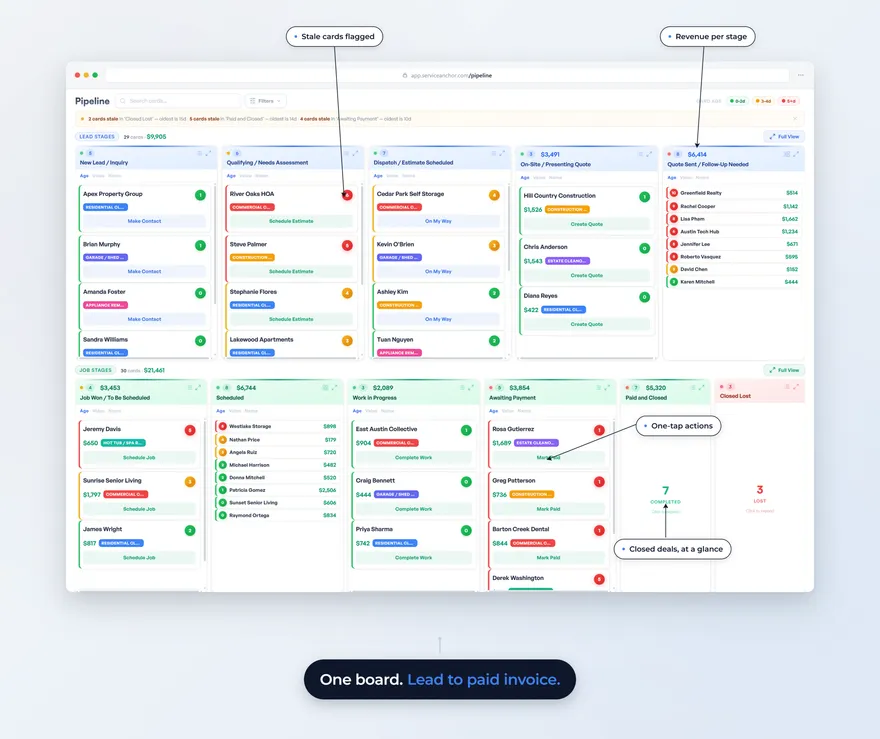
- Make it automatic. In Service Anchor, a missed call from a new number gets a text back. It skips calls under 15 seconds, sends once per caller per four hours, holds overnight texts until morning, and turns a reply into a lead on the board with the conversation attached. Texting comes with A2P 10DLC registration handled for you at setup. See how Service Anchor handles new leads.
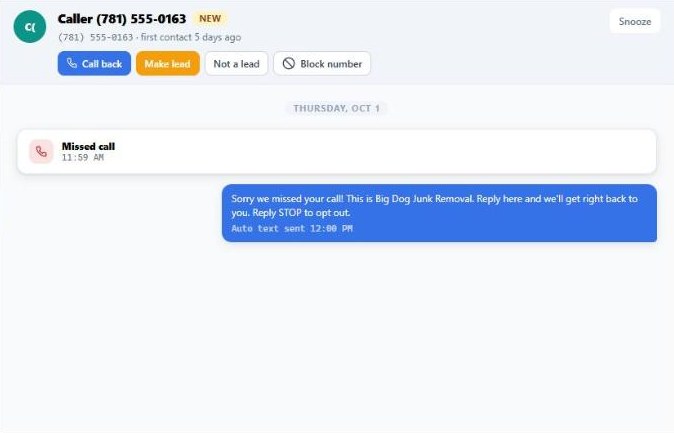
A missed call at 11:59 and the text back at 12:00: business name, apology, one ask, opt-out line. Demo account.
FAQ
How do you respond to a missed call by text? Send a short text within a minute or two that gives your business name, apologizes for missing the call, asks one thing the caller can answer in a few words (what they need, or where and when), and ends with “Reply STOP to opt out.” Keep it informational: no discount or promotion in the first text.
What should I text when I miss a customer’s call? Something like: “Hi, it’s Mike with Big Dog Junk Removal. Sorry I missed your call, I’m on a job. Is this for a pickup, a cleanout, or a quote? Reply STOP to opt out.” Name, apology, one question, opt-out line, under 160 characters.
Is missed call text back legal? An informational reply to someone who just called you is closer to a conversation than to marketing, but no rule exempts it outright. The FCC’s 2015 TCPA order called one auto-reply app “a reactive and tailored service”, but that ruling was about who sends the text, and the same order says a number in your contacts, including one captured from Caller ID, is not, on its own, proof of consent. CTIA’s guidance covers a consumer who texts first; a missed call is close to that, not the same. Honor STOP, keep the first text non-promotional, and ask a lawyer about your state. This is not legal advice.
Do I need to register for A2P 10DLC to send missed call texts? Yes, if the texts come from software on a regular 10-digit business number. Carriers block business texts from 10DLC numbers that are not tied to an approved A2P 10DLC campaign, and the failure is silent: the text simply never arrives.
How fast should a missed call text go out? Within a minute or two, while the caller is still choosing who to hire. In the 2007 MIT and InsideSales.com study, contacting a web lead within five minutes yielded 21 times more qualifications than waiting 30 minutes. Hold texts that would land overnight until the morning.
Is a text back better than an AI answering service? For a small shop, usually. A text back lets the customer hear from you, in your words, and runs on texting software rather than a per-call answering fee; an AI service answers for you and suits businesses missing dozens of calls a day. With a text back you still need to follow up within the hour.
Nothing on this page is legal advice. Rules cited were read on October 6, 2026; texting rules change, so check the current text and your state’s law.
Last updated: October 2026. First publish; 47 U.S.C. § 227, FCC 15-72, 47 CFR 64.1200, the CTIA Messaging Principles, Twilio’s 10DLC error documentation and the 2007 MIT and InsideSales.com lead response study, read October 6, 2026.