A junk removal lead costs between $12.99 and $118 in 2026, depending on who sells it and how it was generated: the cheapest published price is an exclusive organic lead from a pay-per-lead network, the most expensive a Local Services Ads lead in a competitive metro. This is for a 1 to 3 truck junk removal or hauling owner who gets pitched by a lead vendor every other week and cannot compare the offers. As of October 2, 2026, 99 Calls publishes $12.99 per organic junk removal lead and reports Google Ads leads at $38 to $85 and LSA leads at $34 to $118 across its clients (99 Calls, Junk Removal Leads pricing page, read October 2, 2026). Below: prices by provider type, what “exclusive” really means, the cost-per-booked-job formula, and when buying beats building.
- Published junk removal lead prices in 2026 run from $12.99 (99 Calls organic, exclusive) to $118 (the top of 99 Calls’ LSA range). Marketplaces like Thumbtack and Angi price per lead by market and do not publish junk removal rates.
- The number that matters is not the price per lead. It is the cost per booked job: price divided by your close rate. A $45 lead you close one time in four costs $180 per job, which is more than the gross profit on a half-truck load.
- Shared leads are sold to several haulers at once. Your close rate on a shared lead is mostly a race, and the race is won by whoever texts back first.
- Buying makes sense in three situations: a new market with no reviews yet, a gap in the calendar, and a shop that answers in minutes. It burns cash when callbacks are slow, follow-up is manual, or the lead was shared with four competitors.
- The durable answer is owning your own pipeline (Google Business Profile, Local Services Ads with the dispute button, repeat customers) and using bought leads to fill the gaps, not the other way around.
How much do junk removal leads cost?
Junk removal leads cost $12.99 to $118 each from the vendors that publish prices in 2026, and the spread is explained almost entirely by how the lead was generated. Organic leads from a vendor’s own ranking pages are cheap; leads bought with ad spend cost what the click cost plus the vendor’s margin. Here is the field by provider type, with every published figure read from the vendor’s own page on October 2, 2026.
| Provider type | Example | Published price | Exclusive? | Notes |
|---|---|---|---|---|
| Pay-per-lead network, organic | 99 Calls | $12.99 per lead on its Growth package; included on Growth Pro | Yes, per 99 Calls | The cheapest published junk removal lead we found |
| Pay-per-lead network, paid search | 99 Calls (Google Ads managed) | $38 to $85 per lead, 10th to 90th percentile over 12 months | Yes, per 99 Calls | Metro decides where you land |
| Pay-per-lead network, LSA managed | 99 Calls (Local Services Ads) | $34 to $118 per lead, same percentile basis | Yes | The widest range on the sheet; metro decides it |
| Load board | WastePlace | Free to bid; a platform fee when you get paid (percent not published); subscriptions from $40 a month, Advantage from $120 plus a $500 monthly ad minimum | Bid-based | You compete on price per job, not per lead |
| Marketplaces | Thumbtack, Angi, Yelp | Per lead or per contact, set by market; junk removal rates not published | Usually shared | Price only visible once your account is open |
| Google Local Services Ads, direct | Per lead, you set the weekly budget; invalid leads can be disputed | Exclusive per contact; homeowners often contact several | Our Local Services Ads guide covers the dispute mechanics | |
| Google Ads, 29-company benchmark | 99 Calls study | Median $36 to $70 per lead in 2026 by job type, across 29 junk companies | Yes | Yard waste about $36, appliances about $38, general junk about $58; the biggest cleanout categories sit at the top |
That last row is the useful benchmark, with one caveat: it is a vendor’s data on its own clients, so read it as a floor on click costs rather than a neutral survey. In its study of 29 junk removal companies from January 2024 to August 2026, 99 Calls reports a 2026 median Google Ads cost per lead of $36 to $70, with yard waste around $36, appliance pickups around $38, debris around $44, furniture around $49, general junk around $58 and the biggest cleanout categories at the top of the range (99 Calls, Junk Removal Ads Lead Costs, updated September 15, 2026). Those are the click costs behind a managed lead. Any vendor quoting you well above the medians is charging you for the management, and sometimes that is worth it. Know that it is what you are paying for.
Where do junk removal companies get leads?
Junk removal companies get most of their jobs from four owned channels (Google Business Profile, Local Services Ads, repeat customers and referrals) and fill gaps with bought leads from networks, marketplaces and load boards. The owned channels compound; the bought ones stop the day you stop paying.
The owned side is slow to build and cheap to run. A verified, reviewed Google Business Profile is the front door for “junk removal near me,” and verifying and building out your profile costs time rather than money. Local Services Ads sit above the map pack and charge per lead, with a dispute button for the ones that were never real. At the shops we talk to, repeat and referral work is the quiet third of the calendar, and it runs on how the last job ended.
The bought side is fast and expensive. A network like 99 Calls sells you leads it generated with its own ranking pages and ad accounts. A marketplace like Thumbtack or Angi sells you a homeowner who filled out one form that went to several pros. A load board like WastePlace lets you bid on posted jobs. Each has a place. None of them is a strategy on its own, and the junk removal marketing guide lays out the sequence most shops should run them in.
What is the difference between shared and exclusive junk removal leads?
An exclusive junk removal lead is sold to one hauler; a shared lead is sold to several at once, usually three to five, and your close rate on a shared lead depends mostly on being the first to respond. The word “exclusive” on a vendor page is worth reading twice, because it describes the vendor’s sale, not the homeowner’s behavior.
Here is the part no vendor page explains. A homeowner with a garage full of junk does not fill out one form. They often fill out the Thumbtack form, the Angi form, and the contact form on a company website or two, all within a few minutes. The lead a network sold you exclusively may still be sitting in three other inboxes, because the homeowner generated it three other times. Exclusivity is real at the vendor level and rarely real at the homeowner level.
That changes the math. A shared lead at $25 that you close one time in six costs $150 per booked job. An exclusive lead at $45 that you close one time in three costs $135. The cheaper lead is the more expensive one, and the difference is the race, which is why the fastest text back usually wins the job. The on-my-way and follow-up text templates we publish exist because the first reply, not the lowest quote, decides most of these.
How do you turn a per-lead price into a cost per booked job?
You turn a per-lead price into a cost per booked job by dividing it by your close rate, then comparing that number to the gross profit on the job it books. Cost per booked job equals price per lead divided by close rate. If the result is higher than your gross profit on an average job, the lead source loses money even when every lead is real.
Run it with your own numbers, but here is the shape. The junk removal cost guide puts a full truck at $475 to $625; our junk removal price sheet carries a half truck at $375 at the national median. At a 45 percent gross margin (the margin our price sheet’s worksheet assumes), a half-truck job leaves about $169 before overhead. The close rates below are illustrative; use your own.
- A $45 managed Google Ads lead, closed one time in four: $180 per booked job. On a $375 half truck, that is more than the $169 the job earns. You lose money on every booking and make it up nowhere.
- The same $45 lead, closed two times in five: $112.50 per booked job, leaving about $56. Thin, and it only works if the shop is fast enough to hit that close rate.
- A $12.99 organic lead, closed three times in ten: $43 per booked job, leaving about $125. This is why organic leads are the first thing a vendor runs out of.
- A $25 shared marketplace lead, closed one time in six: $150 per booked job. The low sticker price was the whole pitch.
Two things move the result more than the sticker price: the close rate, which is mostly response speed and follow-up, and the ticket size, which is why vendors love full-house cleanouts and why a $45 lead that books a $1,500 job is a bargain. Run every vendor through the same formula before you compare them, and run your own Google Ads through it too.
Are bought junk removal leads worth it?
Bought junk removal leads are worth it in three situations and a cash drain in three others, and the difference is almost never the vendor. Buy leads when you are new in a market with no reviews yet, when there is a hole in the calendar you need filled this week, or when your shop answers every lead in minutes and follows up on the ones that go quiet. Do not buy them when callbacks wait until the evening, when follow-up means “I’ll remember to call them,” or when the lead you are buying was also sold to four competitors who will answer faster.
A bought lead is a test of your speed, not the vendor’s quality. In the shops we talk to, the leads that did not convert were, more often than not, the leads that got a callback hours later.
So the fork is this. If you can answer in minutes and follow up the next day without thinking about it, buy leads to fill gaps and run them through the formula above. If you cannot, fix the response system first, because every lead source, bought or owned, loses money through the same hole.
How do I get more junk removal jobs without buying leads?
You get more junk removal jobs without buying leads by making the owned channels work harder: a complete Google Business Profile with steady reviews, a Local Services Ads budget you manage yourself, a follow-up system that texts back missed calls and chases every quote, and a price sheet that lets you answer the “how much” text in sixty seconds. Those four produce most of the jobs at the established shops we know, and none of them charges per lead.
The order matters. Reviews feed the profile, the profile feeds the map pack, the map pack feeds the phone, and the phone is only worth feeding if someone texts back. For a shop that is just getting started, the first ten reviews are worth more than the first $500 of bought leads.
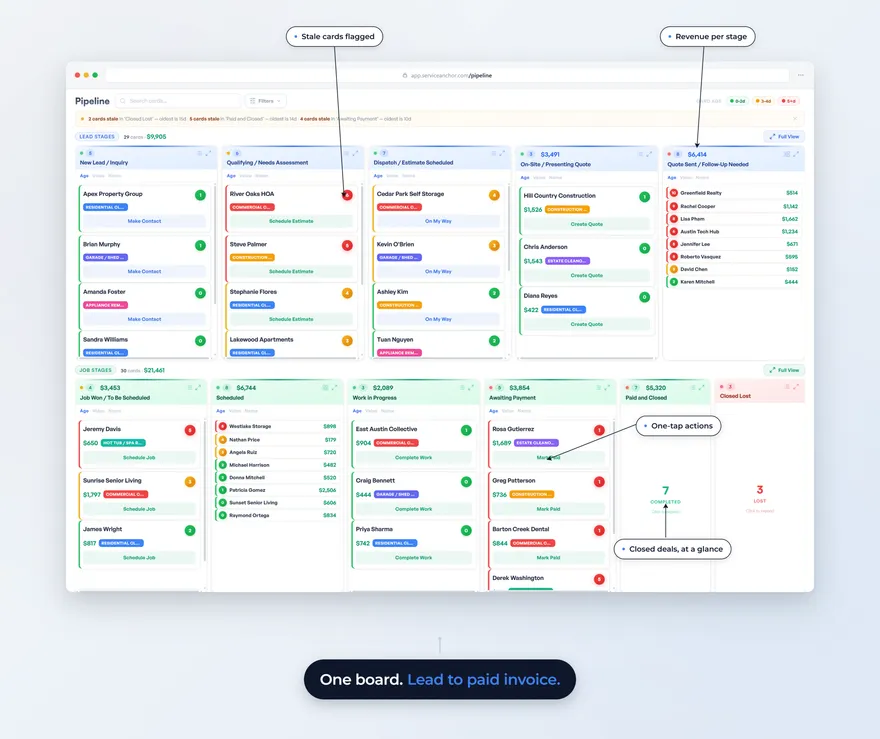
Where Service Anchor fits is after the lead lands, whoever sold it. Every lead goes on one board from the first call to the paid invoice. A missed call from a new number gets a text back. Each lead carries its source, so at the end of the month you can count booked jobs by vendor instead of guessing. We do not sell leads and we do not generate them; we make sure the ones you paid for do not die in a voicemail.
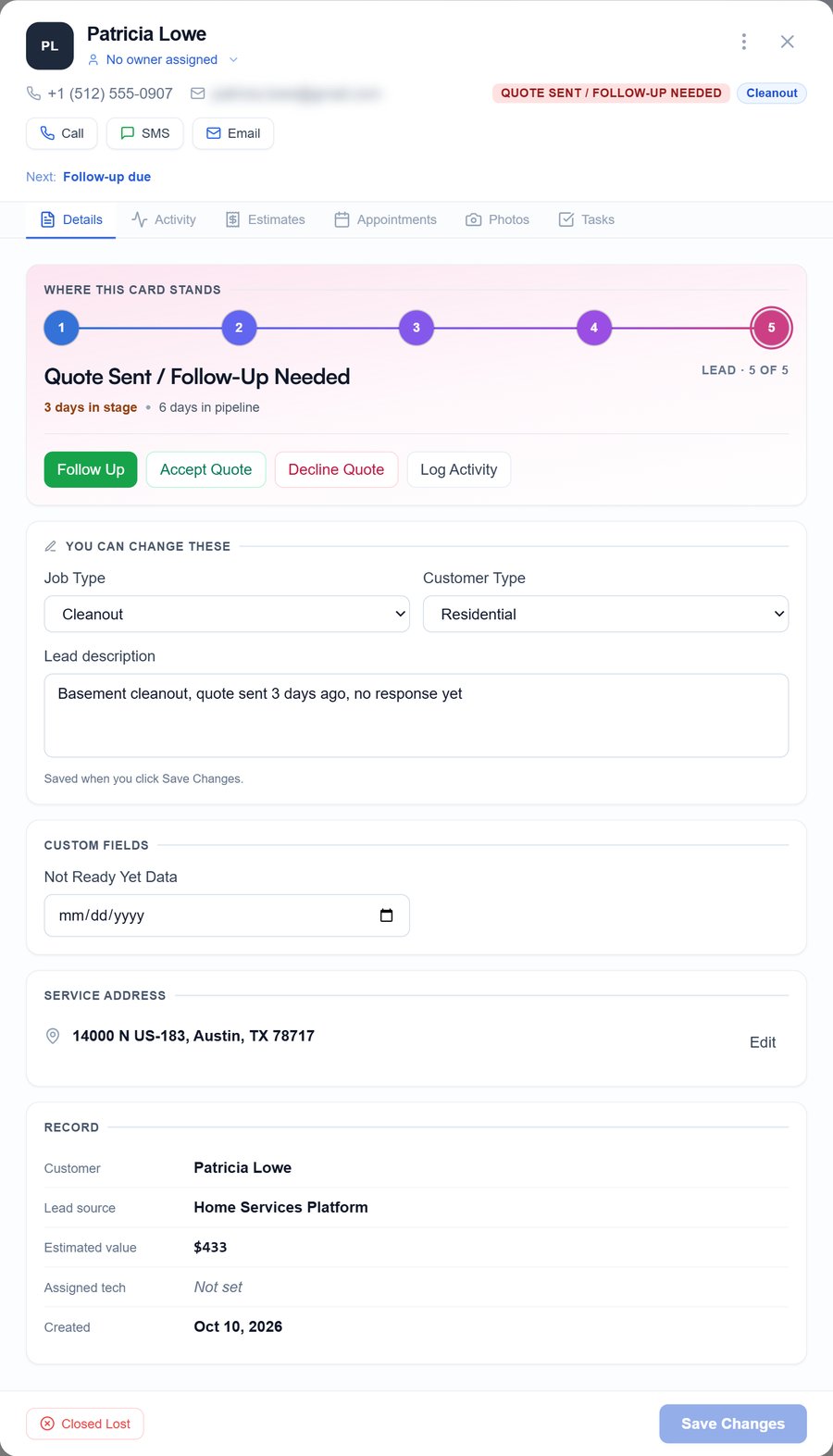
Every card keeps where the lead came from. This one came from a home services platform and has a $433 cleanout quote waiting on a reply. Demo account.
What to do next
- Write your close rate down, by source if you can. If you do not know it, track it for thirty days before you buy anything.
- Run every vendor through the formula: price per lead divided by close rate, against your gross profit per job. Put your own Google Ads in the same table.
- Fix response speed before you buy. If a lead can sit for an hour, every source loses. If you want the board and the text-back built for the trade, see how Service Anchor sets up for junk removal.
FAQ
How much do junk removal leads cost? Published prices in 2026 run from $12.99 for an exclusive organic lead from 99 Calls to $34 to $118 for a managed Local Services Ads lead, with managed Google Ads leads at $38 to $85 (99 Calls pricing page, read October 2, 2026). Marketplaces like Thumbtack and Angi set per-lead prices by market and do not publish junk removal rates.
Where do junk removal companies get leads? Most jobs at established shops come from Google Business Profile, Local Services Ads, repeat customers and referrals. Bought leads from pay-per-lead networks, marketplaces and load boards like WastePlace fill gaps. The owned channels compound over time; the bought ones stop when the spending stops.
Are bought junk removal leads worth it? Yes when you are new in a market, need a calendar gap filled, or answer every lead in minutes. No when callbacks are slow or follow-up is manual. Divide the lead price by your close rate: a $45 lead closed one time in four costs $180 per booked job, more than a half-truck load earns.
What is the difference between shared and exclusive junk removal leads? An exclusive lead is sold to one hauler; a shared lead goes to three to five at once. Exclusivity describes the vendor’s sale, not the homeowner, who often filled out several forms. On any lead, the hauler who texts back first usually wins, which is why response speed outweighs the sticker price.
How do I get more junk removal jobs without buying leads? Build the owned channels: a complete Google Business Profile with steady reviews, a self-managed Local Services Ads budget, a text-back on missed calls, follow-up on every quote, and a price sheet that answers “how much” in a minute. The first ten reviews are worth more than the first $500 of bought leads.
Lead prices in this post were read from each vendor’s live page on October 2, 2026. Vendors change pricing without notice; run the formula with the number on your own quote.
Last updated: October 2026. First publish; 99 Calls pricing and its 29-company Google Ads study, and WastePlace’s hauler terms, read live on October 2, 2026.