A foreclosure or estate cleanout is a full property clear-out for a bank-owned, REO, or inherited property, and it costs roughly $300 to $800 for a small unit, $500 to $1,500 for a standard single-family home, $1,500 to $3,000 or more for a heavily cluttered or large home, and $2,500 to $5,000 or more for a hoarder-condition property. This guide serves two readers: an executor or family member clearing a relative’s house who wants to know what happens to the contents and what a fair whole-house quote looks like, and a working hauler deciding whether to chase this niche on purpose. The number means nothing on its own, because a $1,400 job can net $450 or lose money depending entirely on the disposal-cost math, and that math is what the ranking pages skip. Below: what the job costs, what actually happens to everything inside, how the probate clock affects your timing, where the operator’s margin really goes, and how to get on the call lists that turn one cleanout into a recurring feed.
- Foreclosure and estate cleanouts are the biggest single tickets a one-truck hauler can book: $300 to $800 small, $500 to $1,500 for a standard home, $1,500 to $3,000-plus for heavily cluttered or large homes, and $2,500 to $5,000-plus for hoarder conditions.
- The pay range is not the profit. The margin is decided by disposal cost (dump tonnage), crew hours, and specialty-item surcharges, and quoting sight-unseen off photos is how a $1,400 job turns into a loss.
- The US average landfill tipping fee hit $62.28 a ton in 2024, up 10% year over year, and it is the line item that most often eats a cleanout’s margin.
- The recurring work comes from three channels: REO real estate agents, property preservation companies (national field-service networks like Safeguard and MCS that subcontract the work), and bank asset managers. Most gate you on insurance and experience.
- Walk away from biohazard, uninsured hazard, and jobs where the tonnage puts you underwater. Not every big cleanout is a good cleanout.
- For families: the contents get sorted into four outcomes, and only one of them is the truck. Donation, consignment, and keep-or-distribute all come first.
- For families: the charity’s receipt describes what you donated but cannot assign it a dollar value. That valuation is yours to make, and Form 8283 comes in above $500 of noncash deductions.
- For families: don’t book the truck before you know who has authority to dispose of the contents. Timelines vary by state, and a house in a trust may skip probate entirely. California’s courts say formal probate there typically runs 9 to 18 months.
How much does a foreclosure cleanout cost?
A foreclosure cleanout costs a property owner, bank, or estate roughly $300 to $5,000 depending on the size and condition of the property, which is also what it pays the operator who wins the job. The single biggest driver is how much is left inside and how heavy it is. Here is the 2026 market range by property size, and the estate-cleanout and house-cleanout searches land on the same job under a different label.
| Property size and condition | Typical pay | What drives it |
|---|---|---|
| Small unit (studio, one-bedroom, condo) | $300 to $800 | Low volume, single crew, one dump run |
| Standard single-family home (two to three bedrooms) | $500 to $1,500 | Full house of furniture and boxes, multiple loads |
| Heavily cluttered or large home (four-plus bedrooms) | $1,500 to $3,000+ | High volume, long crew day, appliances and specialty items |
| Hoarder-condition or biohazard | $2,500 to $5,000+ | Extreme volume, hazard handling, extra crew and disposal |
These are what the job pays, not what you keep. The number that decides your profit sits on the cost side, and our junk removal pricing framework is the foundation the operator build-up further down extends to this high-ticket job.
The next two sections are for the family or executor clearing a house. If you’re the operator, the cost math picks back up at “How do operators price a foreclosure or estate cleanout?”
What happens to everything inside during an estate cleanout?
Everything inside an estate sorts into four outcomes, and only the last one involves the truck: keep and distribute, sell or consign, donate, and haul. Work them in that order, because every item that leaves through one of the first three is weight nobody has to pay to dump.
Keep and distribute comes first and takes longest, because it is the only step nobody else can do for you. Walk the house and tag what family is taking before anyone else is scheduled. Crews clear a room in an afternoon, and an item that leaves in a truck does not come back.
Sell or consign covers the pieces with a real secondhand market: solid wood furniture, tools, jewelry, and anything with a collector following. Consignment shops typically take a percentage of the sale and hold the item for a set window, so it is a slow lane. It is worth using for a handful of pieces and not worth using for a houseful.
Donate is where most usable household goods go, and it’s also where the tax question gets muddled. If you itemize and want to claim a deduction of $250 or more, you need a written acknowledgment from the charity, and you need it before you file. The IRS is explicit that the acknowledgment contains a “description (but not value) of non-cash contribution”. The charity describes what it received. Assigning the dollar value is your job, and IRS Publication 561 sets the rules: you must file Form 8283 if your deduction for noncash contributions is more than $500, and above $5,000 you must obtain a qualified appraisal signed by a qualified appraiser. Publication 561 also states plainly that “the FMV of used household items is usually much lower than the price paid when new,” which is the sentence that resets most expectations about what a house of furniture is worth on a return. Worth asking a tax professional early about one thing in particular: an heir who already owns an item and an estate donating from the estate are treated differently.
One caution on the receipt: a junk hauler’s drop-off manifest is not a donation acknowledgment. Only the receiving charity can issue one, and only for what it actually accepted.
Haul is everything left, and it is what the quote in the table above prices. This is why a whole-house estate quote and a whole-house foreclosure quote can differ by a thousand dollars or more on identical square footage: the foreclosure property gets cleared wholesale, while the estate has been picked over three times first.
How long do you have to clear an estate?
How long you have is set by where the estate sits in probate, not by the cleanout itself, and it’s usually longer than it feels. The scheduling mistake that costs the most runs in both directions: booking the truck before anyone has authority to dispose of the contents, or waiting so long that the property carries months of avoidable utilities and insurance.
Probate timelines are set by state law and vary widely, so treat any single number as an example rather than a rule. As one published example, the California Courts Self Help Guide states that in formal probate “the entire process typically takes 9 to 18 months and can sometimes take even longer.” Other states run faster or slower, and many offer a simplified path for small estates that shortens it considerably.
Probate is also not the only route. If the house was held in a living trust, the successor trustee usually has authority without probate at all, and transfers by joint tenancy or a transfer-on-death deed can skip it too. A family in one of those situations that sits and waits for a court date is paying months of utilities, insurance, and carrying costs for nothing.
What that means practically: confirm who currently has legal authority to dispose of property before scheduling anything. In probate that’s the executor or personal representative once the court has appointed them; under a trust it’s usually the successor trustee. A hauler who clears a house on a relative’s say-so before that authority exists has created a problem for everybody. If the property is on a sale deadline, tell the hauler the date on the first call, because it changes crew sizing more than the volume does. And ask an estate attorney rather than a blog post, this one included, about anything touching authority or asset valuation.
How do operators price a foreclosure or estate cleanout?
Operators price a foreclosure cleanout by building up from real costs, not by guessing a flat number off a photo, because the disposal weight and specialty items swing the margin more than the volume does. The core equation is simple, and every line item is one you can measure:
Work a real example. A standard single-family cleanout quoted at $1,400: two crew for seven hours at a $30 loaded rate is $420 in labor; four tons of debris at the 2024 US average tipping fee of $62 a ton is $248 in disposal; a refrigerator, a mattress, four tires, and leftover paint carry roughly $180 in specialty surcharges; and two dump runs of truck and fuel add $100. That is $948 in cost against $1,400, leaving about $452 in profit, or a 32% margin. Healthy, and repeatable if you measured the load right.
Now quote it wrong. You bid the same $1,400 off three photos, but the driveway reveals a packed garage and a full attic nobody mentioned. The real load runs seven tons, eleven crew-hours, more surcharges, and three dump runs: $660 labor, $434 disposal, $280 surcharges, $150 truck. That is $1,524 in cost, and you just lost $124 on a job you thought would clear $450. This is why the operators who make money on cleanouts quote a range off photos and confirm on site, and why disposal tonnage, not square footage, is the number to respect. For the general cost math this specializes, see our junk removal cost guide.
What makes foreclosure cleanouts different from a regular junk job?
Foreclosure cleanouts differ from a normal junk pickup in three ways that all raise your risk: you often quote blind, the volume moves on you, and the property can hide hazards. Bank-owned and estate properties are frequently quoted sight-unseen or from a handful of photos an REO agent forwards, so your estimate is only as good as your on-site confirmation. The volume swings hard, because a house that looks half-empty in photos can have a basement and an attic the photos never showed.
The hazards are the part that ends a bad cleanout. Mold, biohazard, hoarding-grade clutter, and abandoned chemicals all change the price and sometimes disqualify the job entirely for a crew without the right training and insurance. Banks and preservation firms also require photo documentation at every stage, before, during, and after, plus proof of proper disposal, which is real administrative work you have to build into the price. The insurance that this work requires is not optional here; it is usually the gate that lets you bid at all.
How do you get foreclosure cleanout jobs?
You get foreclosure cleanout jobs through three channels, ranked here by how fast each one pays off for a small operator. The work is relationship-driven and recurring, which is exactly why it is worth chasing: one good relationship feeds you jobs for years.
REO real estate agents are the fastest entry. Agents who list bank-owned properties need a reliable hauler on call to clear a house before it goes to market, and a single active REO agent can send you several cleanouts a month. Introduce yourself, prove you show up, and you are on the list. Property preservation companies are the bigger, slower channel: national field-service networks like Safeguard Properties and Mortgage Contracting Services (MCS) hold the maintenance contracts for banks and subcontract the actual work to local vendors. Getting on their vendor rosters means an application, proof of general liability and errors-and-omissions insurance (often a $1 million limit), and usually a couple of years of documented experience. Bank and asset-manager relationships are the slowest to build and the most durable once you have them.
For all three, what they expect is the same: insurance on file, a W-9, fast turnaround, and photo proof of the work. Treat the REO and estate channel as a marketing lane, because that is what it is: a business-development effort, not a one-time signup.
What to do next
If you are clearing a family estate: confirm who has legal authority to dispose of property before you schedule anything, then walk the house once with family and tag what is being kept. Photograph each room before the first item moves, because that record settles disagreements later and gives haulers something real to quote from. Get two or three quotes and ask each one whether disposal is included or billed separately. If you plan to claim a donation deduction, keep the charity’s written acknowledgment and read Publication 561 before you assign values, because the valuation is yours to make and not the charity’s.
If you are the operator: decide whether this niche fits, then set up to quote it right the first time. The checklist: set your loaded labor rate, learn your transfer station’s per-ton price so your disposal math is real, build a photo-quote template that lets you bid a range and confirm on site, and make the first three calls. Those calls are a local REO listing agent, one property preservation network’s vendor line, and one estate attorney who handles probate. Cleanouts are a legitimate high-ticket niche to write into your growth plan, and our guide on how to start and grow a junk removal business puts them in context alongside your business plan numbers.
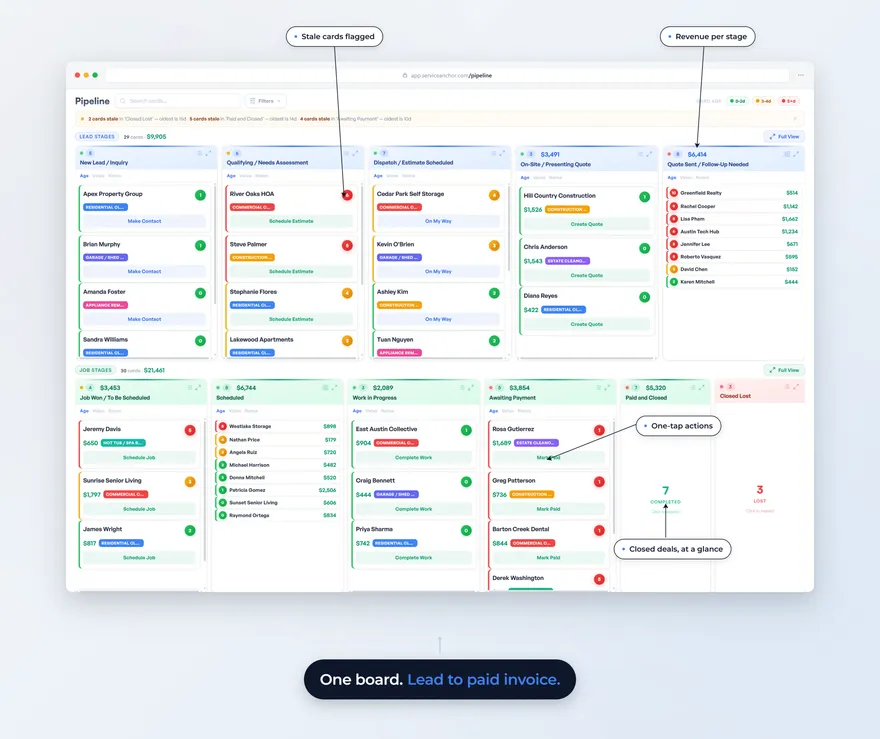
The recurring REO feed only pays if you never drop a follow-up, and that is the part that breaks when you are running the truck yourself. Service Anchor keeps the whole cleanout pipeline on one board, from the photo quote to scheduled to documented to invoiced, preloaded for junk removal, so the agent who sent you one job gets a hauler who answers, quotes, and closes the loop every time. It does not place you into bank contracts or run a preservation network; those relationships are yours to build. What it does is make sure the work you win does not leak out through a missed text.
FAQ
How much does it cost to clean out a foreclosed home?
Cleaning out a foreclosed home costs roughly $300 to $800 for a small unit, $500 to $1,500 for a standard single-family home, $1,500 to $3,000 or more for a heavily cluttered or large home, and $2,500 to $5,000 or more for a hoarder-condition property. The price is driven mostly by how much is inside and how heavy it is, because disposal is charged by weight. A house full of furniture and boxes lands in the middle of that range, while an appliance-heavy or hoarder property runs to the top.
How much do foreclosure cleanout companies make per job?
A foreclosure cleanout company commonly nets around 30% to 35% of the job price when it prices the work correctly, so a $1,400 cleanout might return roughly $450 in profit after labor, disposal, surcharges, and truck costs. The margin collapses fast on jobs quoted sight-unseen that turn out heavier than the photos suggested. The operators who make money confirm the load on site and build disposal tonnage into the quote rather than guessing a flat rate.
How do I get foreclosure cleanout contracts from banks?
You get bank cleanout work mostly through property preservation companies, the national field-service networks that hold the banks’ maintenance contracts and subcontract the labor. Getting on their vendor rosters requires an application, proof of general liability and errors-and-omissions insurance, and usually documented experience. Working with local REO listing agents is the faster on-ramp while you build toward the preservation networks and direct asset-manager relationships.
What is a property preservation company?
A property preservation company is a national field-service firm that banks and mortgage servicers hire to secure, maintain, and clear vacant, pre-foreclosure, and bank-owned properties. Companies like Safeguard Properties and MCS hold the contracts and subcontract the actual cleanout, lawn, and repair work to local vendors. For a junk removal operator, joining their vendor networks is one of the main ways to turn cleanouts into a recurring channel.
Do I need special insurance for foreclosure cleanouts?
Yes, foreclosure and REO cleanouts almost always require general liability insurance, and property preservation networks frequently require errors-and-omissions coverage with a $1 million limit before they will add you as a vendor. The insurance is the gate that lets you bid the work, and it also protects you on properties that can hide hazards like mold or abandoned chemicals. Carry it before you pursue bank-channel work, not after you win the first job.
What is an estate cleanout?
An estate cleanout is a full clear-out of a home after a death or a move to care, covering everything from furniture and appliances down to the contents of closets and the garage. It differs from a standard junk pickup in that the contents get sorted rather than simply hauled: family keeps some items, some are sold or consigned, usable goods are donated, and the remainder goes out by the truckload. That sorting is why an estate job takes longer per square foot than a foreclosure clear-out of the same house.
Do you have to wait for probate to clear out a house?
Not always. What you need is authority, not a finished probate. In probate that authority sits with the executor or personal representative once a court has appointed them, but a house held in a living trust usually passes to a successor trustee with no probate at all, and joint tenancy or a transfer-on-death deed can skip it too. Timelines vary by state and by the size of the estate, and many states offer a simplified path for small estates. As one published example, the California Courts Self Help Guide says formal probate there “typically takes 9 to 18 months and can sometimes take even longer.” Ask an estate attorney about your situation rather than relying on a general figure.
Can you write off donations from an estate cleanout?
Possibly, but the valuation is yours to make and not the charity’s. If you itemize and want to claim a deduction of $250 or more, you need a written acknowledgment from the charity before you file, and IRS guidance is explicit that the acknowledgment includes a description but not a value of a non-cash contribution. IRS Publication 561 requires Form 8283 when your deduction for noncash contributions exceeds $500, and a qualified appraisal above $5,000. A hauler’s drop-off manifest does not substitute for the charity’s acknowledgment. Publication 561 also states that the fair market value of used household items is usually much lower than the price paid when new. Talk to a tax professional before claiming anything substantial.
General information only, not legal or tax advice. Who holds authority to dispose of estate property, and what any charitable deduction is worth, both turn on your state and your own filing situation. Talk to an estate attorney and a tax professional.
Internal Revenue Service, Charitable Contributions - Written Acknowledgments: source for the $250 threshold and for the rule that a charity’s acknowledgment carries a description but not a value of a non-cash contribution. https://www.irs.gov/charities-non-profits/charitable-organizations/charitable-contributions-written-acknowledgments
Internal Revenue Service, Publication 561 (rev. 12/2025), Determining the Value of Donated Property: source for the Form 8283 threshold above $500, the qualified-appraisal requirement above $5,000, and the statement that the fair market value of used household items is usually much lower than the price paid when new. https://www.irs.gov/publications/p561
Judicial Council of California, Overview of Formal Probate, California Courts Self Help Guide: source for the 9-to-18-month formal probate timeline used as a single named example rather than a national rule. https://selfhelp.courts.ca.gov/probate/formal-probate
Environmental Research and Education Foundation (EREF), 2024 Analysis of MSW Landfill Tipping Fees: source for the US average landfill tipping fee of $62.28 per ton in 2024, up roughly 10% year over year, used in the disposal-cost build-up. https://www.wasteoptima.com/blog/eref-2024-landfill-tipping-fees
United Field Services, REO and Mortgage Field Services vendor networks: source for how property preservation companies subcontract cleanout work to local vendors and the insurance and experience requirements to join their rosters. https://www.unitedffs.com/reo-field-services/
Last updated: August 2026. Added the family and executor half of the job: what happens to the contents across the keep, sell, donate, and haul outcomes; the donation-receipt rules sourced to IRS written-acknowledgment guidance and Publication 561; and the probate-timing section using the California Courts formal-probate figure as a named example rather than a national rule. Three FAQs added and the title broadened to cover both readers. Originally published July 2026 as the operator-side guide, with 2026 pay ranges by property size, the disposal-cost margin build-up, and the REO and property-preservation acquisition playbook, all unchanged.