You have been quoting by feel. It works until it does not. You underprice the hoarder cleanout because the customer sounded desperate. You overprice the single-item pickup because you drove 40 minutes to get there. And at the end of the month, you are not sure if you actually made money.
This post gives you a repeatable framework for junk removal pricing. Four models, a cost-plus worksheet, and three worked examples with real numbers. Pick the model that fits your market, plug in your costs, and stop guessing. If the business itself is still coming together, our guide to starting a junk removal business walks the whole setup before you get to pricing.
- There are four junk removal pricing models: volume-based, weight-based, time-and-materials, and flat-rate by category. Most operators use a hybrid.
- Use the cost-plus formula to set your floor price: (Variable Costs + Overhead) / (1 - Target Margin).
- A half-truck garage cleanout should land between $325 and $475 in most metros. If you are consistently below $400, run the worksheet. You are likely under your margin target.
- If your win rate is above 60%, raise your prices. You are leaving money on the table.
The four pricing models (and when each one works)
There is no single “right” way to price junk removal. The right model depends on your market, your truck size, and how your customers buy.
Volume-based pricing is the most common model in junk removal. You charge based on how much space the load takes up in your truck: 1/8 truck, 1/4 truck, 1/2 truck, full truck. Customers understand it because they can see the truck. You understand it because your cost scales roughly with volume. This works for most residential cleanouts and is the default starting point if you are new.
Weight-based pricing makes sense when dump fees dominate your cost structure. If your local transfer station charges by the ton (and some charge $80 to $120 per ton), a light but bulky load costs you far less than a heavy one. Charging by weight protects your margin on concrete, dirt, roofing, and construction debris. The downside: most residential customers do not know what their stuff weighs, so you need to estimate on-site. If your operation handles a lot of heavy debris, this model has more in common with dumpster rental pricing than traditional junk hauling, and some operators run both services side by side for that reason.
Time-and-materials pricing is for the jobs where you cannot predict volume or weight upfront. Hoarder cleanouts, estate cleanouts, multi-room jobs where the scope keeps changing. Our foreclosure and estate cleanout guide works the full margin build-up on these high-ticket jobs. You charge a labor rate per hour plus actual dump fees and disposal costs. This protects you from scope creep. Set a minimum (two hours, for example) so you are never losing money on the trip.
Flat-rate by category works when you do a high volume of the same job types. Single-item pickups, appliance haul-away, mattress removal. You publish a price list, the customer picks the item, and nobody negotiates. This is the fastest quoting model and works well for repeat-customer verticals like property managers and realtors. The trade-off: you eat the variance on hard-to-access items (third-floor refrigerator, for example).
| Model | Best for | Quote speed | Margin protection |
|---|---|---|---|
| Volume-based | General residential cleanouts | Fast (visual estimate) | Good |
| Weight-based | Heavy debris, construction waste | Medium (need to estimate weight) | Best for heavy loads |
| Time-and-materials | Hoarder/estate cleanouts, unknown scope | Slow (hourly + actuals) | Best for unpredictable jobs |
| Flat-rate by category | Single-item pickups, repeat customers | Fastest (published price list) | Lowest (you eat variance) |
Most operators use a hybrid. Volume-based for standard jobs, time-and-materials for anything that looks unpredictable on the walkthrough, and flat rates for single items. That is a fine approach. The important thing is knowing which model you are using on each job and why.
The cost-plus worksheet
Whatever pricing model you use, your price needs to cover four things: variable costs, fixed overhead, and a margin that makes the risk worth it. Here is how to calculate your floor price for any job. The cost stack below is downstream of where leads come from in the first place: your GBP listing is the front door, the pricing math behind it is the work.
Variable costs per job:
Fuel is your round-trip mileage at your actual cost per mile. For a truck getting 10 MPG at $3.50/gallon, that is $0.35 per mile. A 30-mile round trip costs you $10.50 in fuel.
Dump fees vary wildly by region. A municipal transfer station might charge $30 for a small load. A private landfill in a metro area might charge $95 to $120 per ton. Call your three closest disposal options and write down their rates. This is the single biggest variable in your cost structure.
Labor is what you pay your crew (or what your time is worth if you are solo). If you pay a helper $20/hour and a job takes 90 minutes on-site plus 30 minutes of drive time, that is $40 in labor. If you are solo, assign yourself a labor rate. $40 to $60/hour is reasonable for a working owner in most markets.
Disposal and specialty fees cover anything unusual: mattress recycling surcharges, e-waste disposal, hazmat items. Know these before you quote.
Fixed overhead allocation:
Your truck payment, insurance, phone, software, marketing, and everything else that costs you money whether or not you run a job that day. Add up your monthly overhead, divide by the number of jobs you run per month, and that is your overhead cost per job. For the five coverages, the buying order, and the 2026 dollar ranges that belong on the insurance line, see the insurance line every operator forgets to cost in. The truck and the bigger dollies are where most of this comes from; the equipment that becomes your fixed and capital costs lays out which purchases land here and when each one pays back.
Example: $4,200/month in fixed costs, 60 jobs per month = $70 overhead per job.
Target margin:
After covering variable costs and overhead, what do you want to keep? Public FDDs from the largest junk removal franchises and operator benchmarks we see in our beta network point to 40% to 50% gross margin as a healthy target for a mature single-truck operation. Below 30%, you are working too hard for too little. Above 60%, you are probably losing bids unless you have zero competition.
The formula:
If your variable costs are $85 and your overhead allocation is $70, and you want a 45% margin:
Price = ($85 + $70) / (1 - 0.45) = $155 / 0.55 = $282
That is your floor. Anything below $282 on that job and you are not hitting your margin target.
If you want to skip the math and start from a populated rate card, grab the fillable junk removal price sheet. It plugs every line above into a printable template plus a Service Anchor price book CSV. If you also rent dumpsters, the same cost-plus formula applies to dumpster rental pricing with two extra surcharge lines (overage tonnage and extra days). And if you run a moving crew alongside junk removal, the same cost-stack approach applies to residential moving pricing with hourly-rate-per-crew-size and FMCSA tariff math layered on top. Pressure-washing operators face the same structural math; the surface-difficulty multiplier replaces the volume multiplier, and the pressure washing pricing guide walks through the per-surface rate stack.
Three pricing examples with real numbers
These use typical costs for a mid-size metro market. Adjust the dump fees and labor rates for your area.
Single-item pickup (appliance haul-away)
Variable costs: $8 fuel (short trip) + $25 dump fee + $20 labor (30 min) = $53. Overhead: $70. Floor at 45% margin: $224. But the market will not pay $224 for a single appliance. This is where flat-rate pricing kicks in. Most operators charge $85 to $150 for a single-item pickup and make it work by routing multiple pickups into one trip.
Here is the routed math. Three appliance pickups on one loop at $125 each bring in $375 in revenue. Your costs for that route are not three times the solo job, because you are consolidating. One longer driving loop runs $18 in fuel. One dump drop at the end handles all three appliances for a combined $75 tipping fee. Total on-site labor across the three stops comes to 90 minutes at $40 per hour for a working owner, which is $60. You count the whole route as one job for overhead allocation, so that is $70 in overhead. Total cost: $223. Gross on the route: $152, or a 40% margin. The per-pickup price looks too low in isolation, but the routing unit economics work because fuel, the dump trip, and overhead only hit you once.
Garage cleanout (1/2 truck)
Variable costs: $12 fuel + $75 dump fee + $80 labor (2 hours, two-person crew) = $167. Overhead: $70. Floor at 45% margin: $431. Market rate for a half-truck load runs $325 to $475 depending on your metro. That means your 45% floor sits at the top end of the market. If you are consistently quoting below $400, you are either cutting margin below 45% on purpose (to win share in a competitive market) or doing it by accident (and leaving money on the table). Run the worksheet with your actual costs before you decide which one it is. If you are consistently above $450 and winning, your market can bear the full 45% and you should be at target.
Full house cleanout (2+ trucks, full day)
Variable costs: $25 fuel + $190 dump fees (two loads) + $480 labor (full day, three-person crew) = $695. Overhead: $140 (two-job allocation for a full day). Floor at 45% margin: $1,518. Market rate for a full house cleanout runs $1,200 to $2,400 depending on the scope, the metro, and how much sorting is involved. Estate cleanouts with donate-and-sort requirements run higher. If you are quoting full cleanouts below $1,200, run the worksheet and see if you are actually making money.
When to raise your prices
Most operators wait too long to raise prices. Here are the signals that you are underpriced.
Your win rate is above 60%. If you are closing more than 6 out of 10 quotes, your price is not the reason people say no. You have room to raise. A healthy win rate for residential junk removal sits in the 40% to 55% range based on operator conversations and industry benchmarks we track. Below 40%, you might be quoting too high or your follow-up is too slow.
You are getting same-day inbound. When customers call and want you today, they are not price shopping. They need it gone. Same-day and emergency calls should carry a premium ($50 to $100 surcharge is standard in most markets).
Your competitors have a wait list. If the other junk removal companies in your area are booked out 3 to 5 days, you can raise prices and still be the fastest option. Check their Google profiles. If they are not answering the phone, that is your signal.
You have not raised prices in 12 months. Dump fees go up. Gas goes up. Insurance goes up. If your prices have not moved in a year, your margin has shrunk even if your revenue looks the same.
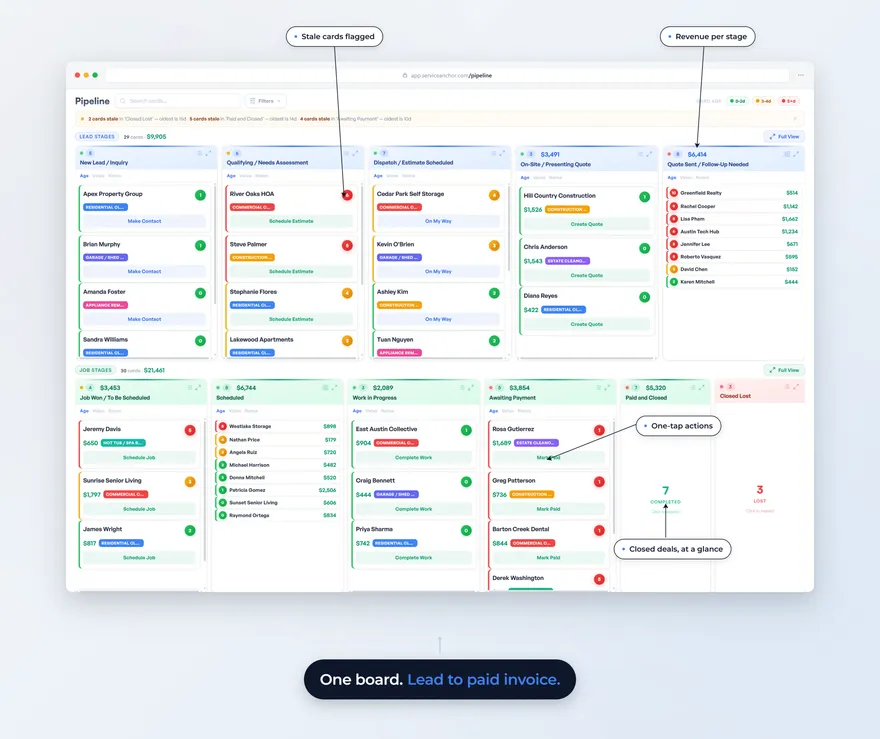
You are tracking win rate by feel instead of by data. This is the part most operators miss. If you are not logging every quote and every outcome, you do not actually know your win rate. You just think you do. A junk removal CRM with a built-in pipeline shows you exactly how many quotes turned into jobs last month, which pricing model produced the best close rate, and where your follow-up dropped.
What to do next
Stop quoting from memory. Build a price book with your actual line items, your actual costs, and your actual margins. When a customer calls, you pull from the book instead of guessing. You quote faster, you quote more consistently, and you stop leaving money on the table.
Your price book should include every common job type you run, with your floor price already calculated. Single-item pickups, partial loads, full loads, specialty items (hot tubs, pianos, construction debris), and any add-on services you offer. The high-ticket ones are worth working out in full: we walk the whole cost stack for a hot tub, including the transfer-station weight fee that decides the margin, in the hot tub removal cost guide. When it lives in a spreadsheet or a notes app, it gets stale and nobody updates it. When it lives inside your CRM, it is part of every quote you send.
Pricing integrity and customer communication compound. Once your numbers are right, the on-my-way text templates that protect your review rate are the next lever. For operators who run dumpster rental alongside junk removal, the same cost-plus discipline applies, but the sizing question is where the margin gets won or lost first.
Service Anchor ships with a junk removal price book pre-loaded with the line items operators actually use. Edit the numbers to match your market, and your crew can quote from it on-site. The whole system is $29 a month for founding members, everything included.