Standard dumpster sizes in 2026 run from 10 yards (small home cleanout, holds about 3 pickup truck loads) to 40 yards (full house gut or roofing tear-off, holds about 16 pickup truck loads), with 20-yard and 30-yard boxes being the most common residential rentals. This guide is written from the operator side: how to size a customer correctly on the first quote call, what specific item counts fit each yardage, and where the weight cap quietly overrides the volume cap on heavy debris. The dollar cost of getting the size wrong (typically a $75 to $200 swap fee that you usually eat) is what makes sizing the highest-impact minute on every dumpster rental call.
- The five standard sizes are 10, 15, 20, 30, and 40 cubic yards. Footprint stays similar across the four largest sizes; the box gets taller as the yard count goes up. A 20-yard fits in a residential driveway. A 30 or 40-yard usually needs a long driveway or street placement.
- Weight cap usually overrides volume cap on heavy debris. Concrete, dirt, asphalt, and shingles fill the weight allowance at roughly half the volume of household debris. Use a 10 or 15-yard for any concrete or roofing tear-off job, even when the volume would suggest 20.
- Item counts that fit each box: a 20-yard typically holds 6 to 8 pickup truck loads, 40 to 50 contractor bags, 30 to 40 mattresses, or 70 to 90 drywall sheets. Use whichever unit the customer described on the call.
- The operator move that prevents the most swap fees: when the customer says “I think a 10 will do it” and then names two rooms instead of one, prompt the upgrade to 20 on the first call. The “I think a 10” phrasing is the single highest-correlation tell in our beta operator conversations.
What are the standard dumpster sizes?
Standard dumpster sizes are 10, 15, 20, 30, and 40 cubic yards, measured by interior volume. The four most common residential pulls are 10, 20, 30, and 40-yard; the 15-yard sits between as a regional preference (more common in the Northeast and Mountain West than the South and Midwest).
The yard number describes volume only. Footprint stays roughly constant across the four largest sizes (about 22 ft long by 8 ft wide); the box grows vertically as the yard count rises. That matters for two operator-side reasons. First, a 20-yard fits in a standard residential driveway; a 30-yard usually fits but blocks the garage; a 40-yard typically needs a long driveway or street placement with a city permit. Second, the load height changes how customers fill the box. Taller boxes (30 and 40) commonly hit the weight cap before they look “full” because customers keep loading high-density items above the natural fill line.
| Yard size | Typical exterior | Typical max load | Best fit |
|---|---|---|---|
| 10 yard | 12 to 14 ft long, 8 ft wide, 3.5 ft tall | 1 to 1.5 tons | Small home cleanout, one-room remodel, concrete or heavy debris |
| 15 yard | 16 ft long, 8 ft wide, 4 ft tall | 1.5 to 2 tons | Garage cleanout, single-room renovation, small roof tear-off |
| 20 yard | 22 ft long, 8 ft wide, 4.5 ft tall | 2 to 3 tons | Full garage cleanout, kitchen or bathroom remodel, mid-size yard waste |
| 30 yard | 22 ft long, 8 ft wide, 6 ft tall | 3 to 4 tons | Full home cleanout, large remodel, residential roof tear-off |
| 40 yard | 22 ft long, 8 ft wide, 8 ft tall | 4 to 6 tons | Full house gut, commercial demo, large construction project |
For the related rate-card view of these sizes, see our dumpster rental pricing breakdown, which works backward from cost basis to retail per yard size.
How do I know what dumpster size I need?
The fastest sizing decision is to map the customer’s project description to one of eight common archetypes, then upgrade one size if the customer mentions a second room, attic, basement, or garage during the same call.
| Project | Recommended size | Common upgrade trigger |
|---|---|---|
| Single-room cleanout (bedroom, basement room) | 10 yard | Adds attic or garage during the call: bump to 20 |
| Garage cleanout (full single-car) | 10 to 15 yard | Adds yard waste or basement: bump to 20 |
| Kitchen remodel (cabinets, countertops, flooring) | 20 yard | Adds appliances or full appliance haul: bump to 30 |
| Full home cleanout (estate or move-out) | 30 yard | Heavy furniture mix or basement included: bump to 40 |
| Roof tear-off (residential, 1 to 2 layers) | 15 yard | Adds tear-off of decking too: bump to 20, but watch the weight cap |
| Deck demo (12 by 16 ft typical) | 15 to 20 yard | Adds concrete footings: drop to 10 for the concrete, second box for the wood |
| Yard waste or land clearing | 20 to 30 yard | Adds dirt or stumps: drop to 15 because of the weight cap |
| Concrete or heavy debris only | 10 yard | Never larger; you will hit the weight cap before half the volume is gone |
Two operator notes embedded in this table. First, the “second item” upgrade trigger almost always shows up in the same phone call: the customer starts with one room, then realizes they want to do the basement at the same time. Listening for the “oh, and” phrasing on the first call saves the swap fee on the second. Second, the heavy-debris rows recommend smaller sizes because the weight cap, not the volume cap, is the binding constraint. We cover that in detail below.
Dumpster size chart by load type
A dumpster size chart by load type translates yardage into the units customers actually describe on the phone (pickup truck loads, contractor bags, mattresses, drywall sheets). Customers rarely think in cubic yards; they think in “how much fits in my truck” or “how many bags of debris.”
| Yard size | Pickup truck loads | Contractor bags (40-gal) | Mattresses | Drywall sheets (4 by 8 ft) | Typical weight cap |
|---|---|---|---|---|---|
| 10 yard | 3 to 4 | 20 to 25 | 15 to 20 | 35 to 45 | 1 to 1.5 tons |
| 15 yard | 4 to 5 | 30 to 35 | 25 to 30 | 50 to 65 | 1.5 to 2 tons |
| 20 yard | 6 to 8 | 40 to 50 | 30 to 40 | 70 to 90 | 2 to 3 tons |
| 30 yard | 9 to 12 | 60 to 75 | 45 to 60 | 100 to 130 | 3 to 4 tons |
| 40 yard | 12 to 16 | 80 to 100 | 65 to 80 | 140 to 175 | 4 to 6 tons |
The ranges in each column reflect how tightly the load gets packed. A residential cleanout with loose furniture fills the volume before the weight cap. A construction job with stacked drywall and tile fills the weight cap before the volume. The operator job on the quote call is asking enough questions to land the customer in the right column of the table, not just the right row.
For the operator-software side of running multiple containers across a route, see our breakdown of dumpster rental software, which compares how the different platforms handle the two-trip drop-off-and-pickup workflow.
How much weight can each size hold?
Every dumpster has both a volume cap (the yard size on the side of the box) and a weight cap (how heavy it can legally be when the hauler picks it up). For most residential cleanouts the volume cap binds first. For heavy debris, the weight cap binds first, often at less than half the volume.
The weight cap reflects the gross vehicle weight rating (GVWR) of the truck plus axle limits on the road. Per 23 CFR 658.17, the federal axle weight limits on the Interstate System cap a single axle at 20,000 lb and a tandem axle at 34,000 lb, with a maximum gross vehicle weight of 80,000 lb (subject to the federal Bridge Formula). Most roll-off trucks running residential routes are tandem-axle with a GVWR around 60,000 to 80,000 lb, of which 8,000 to 14,000 lb is the empty container plus truck weight, leaving roughly 4,000 to 12,000 lb (2 to 6 tons) for the load itself.
Heavy debris exception (the one operators forget on the call): concrete, dirt, asphalt shingles, brick, tile, and roofing tear-off all weigh roughly twice as much per cubic yard as mixed household debris. A cubic yard of concrete weighs about 2 tons; a cubic yard of mixed cleanout debris weighs about 0.5 tons. That means a 20-yard box filled with concrete would weigh 40 tons, which is roughly four times the legal weight cap. The practical operator rule: for any job that is more than 30 percent concrete, dirt, or roofing tear-off, drop to a 10 or 15-yard box. Two small heavy-debris pulls beat one large pull that has to be reweighed and partially offloaded at the transfer station.
When to recommend the next size up (the operator decision script)
The operator decision script is a 30-second phrasing pattern on the quote call that catches the most common undersizing mistakes before the truck rolls. The cost of getting it wrong is a swap fee (a second pickup and redelivery of a larger box) that runs $75 to $200 round-trip in most US markets, and that the operator almost always eats rather than passing through to the customer.
The five highest-correlation customer phrases that should trigger an upgrade prompt on the first call:
- “I think a 10 will do it.” Of the operators we talk to, this phrase resolves to a 20-yard need more than half the time. Prompt: “What’s the project? If it’s more than one room I’d recommend the 20 to avoid a second trip.”
- “It’s just the garage.” Then they describe the garage as also containing yard waste, holiday decorations, and old appliances. Upgrade to a 20-yard and call out the appliance haul as a separate line.
- “We’re doing the kitchen and bathroom.” Each room individually is a 15-yard. Together they exceed a 20-yard’s reasonable fill height because of cabinetry mass. Recommend the 30-yard.
- “It’s a roof tear-off, but the roof is small.” Small residential roof tear-offs still surprise customers on weight. A 15-yard typically caps out at 12 squares of asphalt shingle (about 1.5 tons). If they have 15 or more squares, two pulls beat one over-weight pull.
- “I’ll keep it until next weekend.” Default 7-day rental means a per-day extra fee starts Day 8. If the customer is already telegraphing a longer rental, quote the extended period up front so the cost is visible at the booking stage rather than as a surprise on the final invoice.
The math on swap fees: a 20-yard delivered for a 10-yard original means a pickup, a transfer-station tip on the partial load, a redelivery in the larger size, and another pickup at the end. That is two extra truck trips plus an extra tip ticket. At $80 to $100 in driver and fuel cost per round trip plus a small tip, the round-trip cost runs roughly $180 to $260, against an industry-typical swap fee charged to the customer of $0 to $100. Operators eat the difference. Sizing right the first time is the single most profitable minute on every quote call.
What costs more to dispose of?
Disposal cost varies dramatically by material type because the transfer station charges by weight, not volume, and a few prohibited or specialty materials carry per-item surcharges that can erase the margin on an otherwise profitable job. Pricing the disposal correctly on the quote means knowing both the per-ton tip fee and the per-item exceptions.
Per the US Environmental Protection Agency’s Construction and Demolition Materials Management guidance, C&D waste accounts for more than twice the volume of municipal solid waste annually, with most of it routed through C&D-specific facilities that charge tipping fees by weight. National average construction and demolition tipping fees ran roughly $66 per ton in 2024 per Environmental Research and Education Foundation data; metros like Seattle, Boston, and San Francisco exceed $130 per ton.
The categories that drive disposal cost up:
- Mattresses. Many transfer stations charge $25 to $40 per mattress as a per-item surcharge on top of the tonnage. New York, California, and Connecticut have state-mandated mattress recycling fees that get passed through.
- Tires. Almost every transfer station charges per tire ($3 to $8 per car tire, more for commercial). Some refuse car tires entirely.
- Freon appliances (refrigerators, freezers, window AC units). The Federal Clean Air Act Section 608 requires certified freon recovery before disposal. Operators either pay a $25 to $75 per-unit recovery fee or refuse the appliance from the rental.
- Hazardous waste (paint, solvents, batteries, fluorescent bulbs, electronics in some states). Most haulers refuse to take these in a roll-off dumpster. The customer needs to dispose of them separately at a household hazardous waste event or facility.
- Concrete, dirt, asphalt. Cheaper per ton than mixed waste (often $20 to $40 per ton at C&D facilities) but the weight density means a customer who loads up on these maxes the truck’s weight cap fast, triggering an overage charge that exceeds the cost savings.
The operator move is calling out the per-item surcharges on the quote sheet by name, so the customer either removes them from the box before pickup or accepts the surcharge knowing the price.
What to do next
For operators, the next steps in order of impact:
- Build a one-page sizing reference using the tables above plus your local tip fee and surcharge schedule. Keep it in the same folder as your rate card; reference it on every quote call. The same operator-side framing of our junk removal pricing framework applies: the work you do before quoting is what protects the margin after the job.
- Audit your last 30 dumpster rentals for swap fees. If more than 10 percent of jobs required a swap, your intake script is undersizing. The five phrases in the decision script above are where to start tuning.
- Publish the per-item surcharges on your quote PDF or web form so they reach the customer before the truck rolls. The conversation about a $40 mattress fee is much easier before than after.
For homeowners or contractors comparing sizes for a single project: pick the size that matches both your volume estimate (using the pickup truck or contractor bag column) and your material type (drop down a size for any job with more than 30 percent concrete, dirt, or roofing tear-off). When in doubt, the 20-yard is the most flexible residential size and has the lowest swap-fee risk if you misjudge the volume.
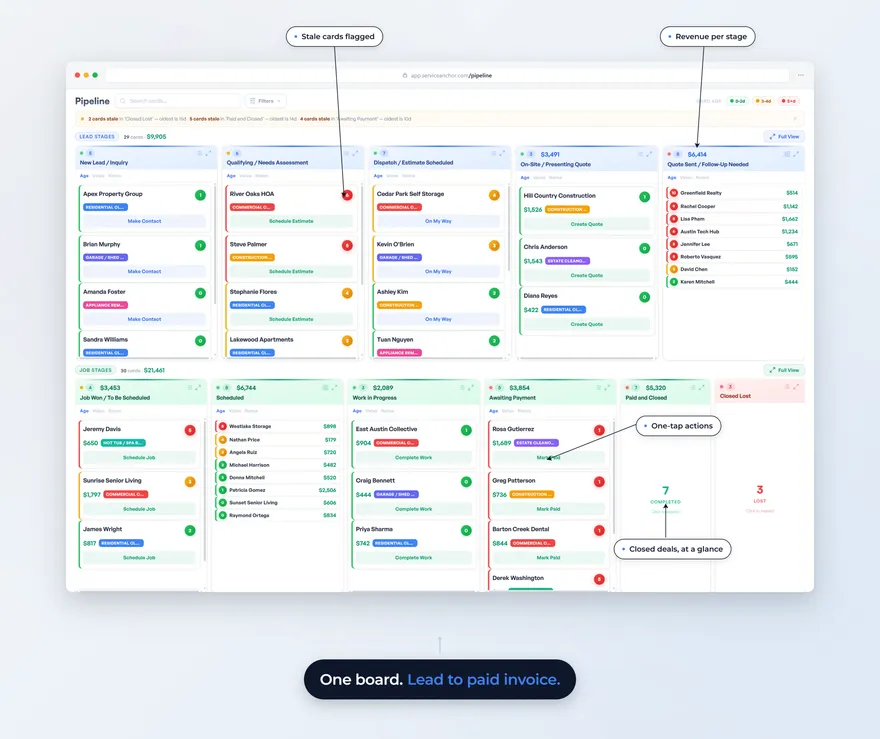
If you run a junk removal or dumpster rental operation and want to see how an operator-first CRM handles sizing, scheduling, and the pipeline from quote to paid invoice on one board, Service Anchor was built for shops your size.
FAQ
What size dumpster do I need for a kitchen remodel?
A standard residential kitchen remodel fits in a 20-yard dumpster, which holds the cabinets, countertops, and flooring from a 200 to 300 square foot kitchen plus appliance disposal as a separate haul. If the remodel includes the adjacent bathroom or extends into the dining room, upgrade to a 30-yard. The most common undersizing mistake is starting with a 10 or 15-yard for “just the cabinets,” then needing a swap when the countertops and flooring come out.
Can a 30-yard dumpster fit in my driveway?
A 30-yard dumpster typically fits in a standard residential driveway in length (about 22 ft) but is 6 ft tall, which often blocks the garage door from opening. Most operators recommend confirming driveway length and garage clearance before delivery, or placing the dumpster on the street with a city permit. Driveway weight is rarely the binding constraint; standard asphalt and concrete residential driveways handle the truck weight at delivery.
How long can I keep a dumpster?
Standard residential rental period is 7 days. Most operators charge a per-day extra fee of $25 to $50 starting on Day 8. Construction and contractor customers typically book 14 or 21-day periods up front at a discounted daily rate. If you know the project will run longer than a week, quote the extended period on the booking call rather than incurring per-day fees on the back end.
What can’t go in a dumpster?
The universal-refusal list across most US haulers includes hazardous waste (paint, solvents, motor oil, batteries, fluorescent bulbs), tires (in many markets), refrigerators and freezers without freon recovery, and asbestos-containing materials. State-specific restrictions cover electronics (e-waste laws in California, New York, and others) and mattresses (state-specific recycling fees in California, Connecticut, New York, and Rhode Island). Always confirm with your local hauler at the booking stage.
Do I need a permit for a dumpster on the street?
A dumpster placed on a public street usually requires a permit from your city or municipality. Permit cost varies from $25 to $100 in most US markets and takes a few business days to process. A dumpster placed entirely on private property (driveway, yard, parking lot) does not require a city permit, though HOA approval may be required in some communities.
What’s the difference between a 20 and 30-yard dumpster?
A 30-yard dumpster has the same length and width as a 20-yard (about 22 ft by 8 ft) but is 6 ft tall instead of 4.5 ft, adding 50 percent more volume. The weight cap also rises (typically 3 to 4 tons for a 30 vs 2 to 3 tons for a 20). The 30 is the standard upgrade for whole-home cleanouts, large kitchen plus bathroom remodels, and small construction projects. The 20 is the default for single-room remodels and garage cleanouts.
How much does a 40-yard dumpster cost to rent?
A 40-yard dumpster rental typically costs $475 to $800 in 2026 for a 7-day base period in most US metros, depending on local tipping fees, delivery distance, and included tonnage. For the full rate-card view across all five standard sizes including overweight handling and per-day extension fees, see our full dumpster rental rate-card walkthrough, and for what it costs to rent each size plus the fees that surprise people, our dumpster rental cost guide.
US Environmental Protection Agency, Sustainable Management of Construction and Demolition Materials: federal context for C&D waste handling and disposal pathways. https://www.epa.gov/smm/sustainable-management-construction-and-demolition-materials
US Federal Highway Administration, 23 CFR 658.17 (Weight): federal axle weight limits on the Interstate System (20,000 lb single axle, 34,000 lb tandem, 80,000 lb maximum gross vehicle weight) that constrain dumpster truck loads. https://www.ecfr.gov/current/title-23/chapter-I/subchapter-G/part-658/section-658.17
Last updated: May 26, 2026.