The best software for a dumpster rental business in 2026 depends on what the business actually does: pure dumpster rental at volume picks Docket or Dumpster Rental Systems, mixed dumpster + junk removal picks Workiz or Service Anchor, dumpster as a side line under a broader trades operation picks Jobber or Housecall Pro. We build Service Anchor, so we have a dog in this fight. We are honest below about which dumpster operations Service Anchor fits today and which ones we recommend a different product for. The dumpster trade overlay ships in our default setup; the dedicated dumpster pipeline (no-quote order flow, two-trip drop-off/pickup automation) is on roadmap, so an operator running 30 boxes a day in pure dumpster rental is better served by a dumpster-native product right now. Upstream of any software decision, the sizing decision drives both the quote and the route plan, so a tight intake process matters more than the platform that holds it.
- The dumpster rental software market splits into three categories: dumpster-native (Docket, Dumpster Rental Systems), trade-flexible FSM (Workiz, Service Anchor), and generalist FSM (Jobber, Housecall Pro). Pick by what fraction of your revenue comes from dumpster rental.
- Pure dumpster operators (90%+ revenue from rental) should evaluate Docket and Dumpster Rental Systems first. They model the two-trip drop-off-and-pickup workflow natively and the route planning is built around route stops, not single-visit jobs.
- Mixed operators (50-50 dumpster and junk removal) should look at Workiz and Service Anchor. Both ship trade-aware overlays and both run a unified pipeline across the two services. Workiz is more mature; Service Anchor is the lower-cost option, with founding pricing of $29/mo locked for life for the first 25 operators.
- Side-line operators (dumpster is under 30% of revenue) usually do best on whatever generalist FSM (Jobber or Housecall Pro) already runs the rest of the business. Switching costs outweigh dumpster-specific benefit at low rental volume.
- All pricing below was verified against each vendor’s public pricing page on May 8, 2026. We will update this post as vendors ship new tiers or features.
Who is this comparison for?
This comparison is for the operator running between 1 and 30 dumpsters in active rotation who is evaluating real software (not just a spreadsheet) for the first time, or switching off a tool that is not working. If you are running 50+ boxes across multiple yards with a dispatcher and a back-office team, your evaluation criteria are different and the enterprise tier of any of the products below is the conversation, not the SMB tier covered here.
If you are pre-software (Excel + Google Calendar + a notes app on your phone), the question is not which software is best. The question is whether to spend $150 to $400 per month on any of them. The honest answer is yes, the moment you cross 8 to 10 active rentals at once. Below that volume the manual workflow still works. Above it, the cost of a missed pickup, a mis-routed delivery, or a lost overage charge exceeds the monthly software bill.
What does a dumpster rental business actually need from software?
Dumpster rental software needs to handle eight things that a generic field service tool does not handle well: a no-quote order flow (customer picks size and date, gets a price, books in one screen), a two-trip job model (delivery and pickup are linked but separate dispatch events), route planning around drop-and-pickup stops on the same day, weight tracking with overage billing, a rental-period meter that automatically extends and bills, an inventory view of which boxes are out and which are in the yard, integrated payment with deposit handling, and a customer-facing portal for rental extensions.
A generalist FSM (Jobber, Housecall Pro) handles the first half of that list (booking, payment, basic dispatch) and forces workarounds for the second half (the two-trip model becomes two separate jobs, the rental period becomes a manual reminder, weight tracking becomes a notes field). The workarounds are tolerable when dumpster is 20% of your work. They are painful when dumpster is most of your work.
A dumpster-native tool (Docket, DRS) gets the second half right and is sometimes weaker on the first half, particularly on the broader CRM and customer-record side. The trade-off is real and the right answer depends on how many boxes you turn per week.
The five real options compared
| Vendor | Starting price | Dumpster-native workflow | Two-trip dispatch | Route planning | Trade flexibility | Best for |
|---|---|---|---|---|---|---|
| Docket | ~$199/mo | Yes | Yes | Native | Dumpster-only | Pure dumpster, high volume |
| Dumpster Rental Systems | $149+/mo | Yes | Yes | Native | Dumpster-only | Route-heavy dumpster ops |
| Workiz | Demo-gated | Partial | Workaround | Yes | Multi-trade | Mixed junk + dumpster |
| Jobber | $49 to $199/mo (Plus $699) | No | Two separate jobs | Optional add-on | All trades | Side-line dumpster |
| Housecall Pro | $79 to $329/mo monthly ($59 to $299 annual) | No | Two separate jobs | Yes (higher tier) | All trades | Side-line dumpster |
| Service Anchor | $29/mo founding (life) | Partial (overlay only) | Workaround today | Yes | Multi-trade (8 trades) | Mixed operations, low cost |
Pricing was checked against each vendor’s public pricing page on May 8, 2026. Workiz and Docket gate full pricing behind a demo request, so the numbers shown are the published “starting at” figures from public sources rather than confirmed list prices for a specific tier configuration.
Docket: best for dumpster-only operators
Docket is built specifically for the dumpster rental and roll-off industry, and it shows. The product models the booking flow the way a dumpster operator actually quotes (yard size + ZIP + date returns a price in seconds), it links delivery and pickup as a single rental object with two scheduled events, and the customer portal lets the renter request extensions or schedule pickup themselves.
Where it wins: dumpster-native data model (the rental is the object, not the job), strong route planning around the drop-and-pickup pattern, customer self-service portal that genuinely reduces inbound phone volume.
Where it falls short: pricing starts in the $199 range and scales up; the broader CRM is functional but not as rich as Jobber’s or HCP’s; integrations are narrower (you will not find a deep QuickBooks or Mailchimp ecosystem).
If you run 15+ active rentals on a typical day and dumpster is your primary revenue stream, Docket should be on your shortlist.
Dumpster Rental Systems: best for high-volume, route-heavy operators
Dumpster Rental Systems (DRS) is the other dumpster-native vendor in this category. It tends to compete most directly with Docket for the same customer base, with a pricing structure that publishes a starting tier around $149 per month per public sources.
Where it wins: deep operational tooling for high-volume route dispatch, weight ticket capture, and recurring contract customers. Specifically built for the operator running 20+ rentals at once across multiple drivers.
Where it falls short: like Docket, the broader marketing and CRM tooling is lighter than the generalist competitors. Onboarding has a steeper curve because the product assumes the operator already has a defined workflow.
If your dumpster operation is route-heavy with multiple trucks running drops and pickups in parallel, DRS deserves an evaluation alongside Docket.
Workiz: best if you also run junk removal or other trades
Workiz is a multi-trade FSM that has built genuine credibility in the junk removal and dumpster rental space. Their “Landfill Near Me” tool is one of the few free trade-specific utilities that any of these vendors have shipped, and it tells you something about how seriously they take this category.
Where it wins: trade-flexible (handles junk removal, dumpster, locksmith, garage door, and others), good multi-tech dispatch, mature SMS and lead-handling. The dumpster workflow is not as native as Docket or DRS, but it is more native than Jobber or HCP. Operators in adjacent service trades shopping for software, particularly residential moving, should also see our moving company software comparison for the equivalent shop-size breakdown across Movegistics, MoverBase, and the same general FSM platforms.
Where it falls short: pricing is demo-gated, which historically means $159 to $349 per user per month depending on tier per the comparison work we have done on Jobber alternatives. The two-trip dumpster workflow is closer to a workaround than a native model. No published self-serve trial.
If you run a mixed shop (junk removal + dumpster + maybe one more trade), Workiz is the credible incumbent. If your operation is more than 70% dumpster, the dumpster-native tools are usually a better fit.
Jobber and Housecall Pro: best if dumpster is a side line
Jobber and Housecall Pro are the two largest field service platforms by revenue and they cover dumpster rental as one capability inside a much broader feature set. Jobber publishes a four-tier price structure (Core $49, Connect $139, Grow $199, Plus $699 per month). Jobber’s AI Receptionist is a separate $99/month add-on; the Plus tier markets the add-on as a value-add but does not bundle it. Housecall Pro publishes three tiers (Basic, Essentials, MAX) at $79, $189, and $329 per month on month-to-month billing, or $59, $149, and $299 per month on annual billing. All three Housecall Pro tiers are publicly priced.
Where they win: the broadest feature surface, the deepest integrations, the most mature mobile apps, the largest customer support teams. If your business already runs on one of them and dumpster is a small part of revenue, the cost of switching to a dumpster-native tool exceeds the benefit.
Where they fall short: neither product has a dumpster-native data model. Each rental becomes two jobs (drop-off, pickup) that the operator manually links. Weight overages become notes fields. Rental-period billing becomes manual invoicing. The workarounds work, but they cost time per rental, and that cost compounds with volume.
For a side-line operator (under 30% of revenue from dumpster), the trade-off favors staying on whichever generalist platform already runs the rest of the business. For our deeper Jobber vs Housecall Pro comparison, see the related post.
Service Anchor: best for mixed operations that want a unified pipeline
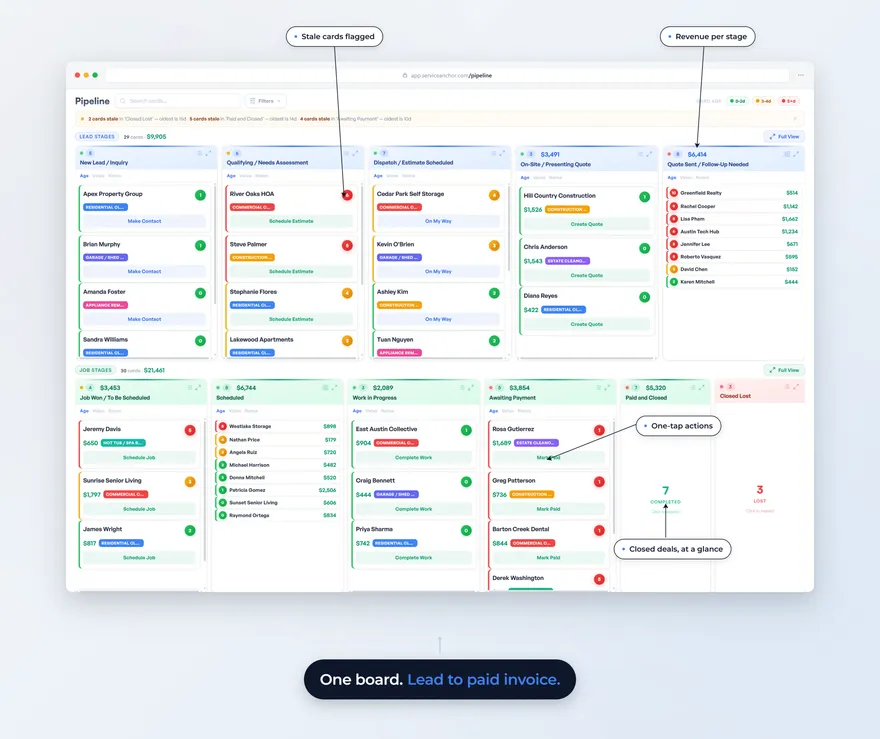
We are honest about where we fit. Service Anchor ships with a dumpster rental trade overlay (price book pre-loaded with the 10/15/20/30/40-yard tiers, customer types, lead sources, and lost reasons). The pipeline is unified across services, so an operator running junk removal + dumpster rental sees both lines of business on one board.
Where we win: founding pricing of $29/mo locked for life for the first 25 operators, a permanent rate rather than a 14-day trial. Unified pipeline that auto-advances between stages (quote accepted creates a job, job completed creates an invoice, invoice paid fires a thank-you). Pre-loaded price book matches the dumpster pricing model from our dumpster rental pricing post. Built-in SMS, voice, email, and Stripe payments. SMS and voice pass through at no markup for Founding Members; Stripe payments at a flat 3.5% + $0.30.
Where we fall short: the dumpster trade overlay ships, but the dedicated dumpster pipeline (a no-quote order flow plus two-trip drop-off/pickup automation plus rental-period metering) is on our public roadmap, not shipped. Today, dumpster rentals run on our general pipeline (the same pipeline that ships for junk removal and moving). If you are a high-volume dumpster-only operator turning 25+ boxes a day, Docket or Dumpster Rental Systems will fit your workflow more cleanly today than we will.
We are saying this in writing because positioning honesty matters more than pulling every dumpster operator into the funnel.
Recommendation matrix by operator type
A short matrix to compress the recommendations into one decision tool.
| Operator profile | First evaluate | Second look | Skip |
|---|---|---|---|
| Pure dumpster, 15+ active rentals | Docket | Dumpster Rental Systems | Jobber / HCP / Service Anchor |
| Pure dumpster, under 15 rentals | Dumpster Rental Systems | Docket | Jobber / HCP |
| 50-50 dumpster + junk | Workiz | Service Anchor | Docket / DRS |
| Junk-primary with dumpster side line | Service Anchor | Workiz | Docket / DRS |
| Multi-trade with dumpster as one of 4+ services | Jobber or HCP | Workiz | Docket / DRS |
| Pre-software (Excel today) | The product that fits the next 12 months, not today | n/a | n/a |
What to do next
Decide what fraction of your revenue comes from dumpster rental, then use that fraction to pick which side of the matrix you fall on. If dumpster is your primary line, run a side-by-side trial of Docket and DRS. If dumpster is part of a mix, evaluate Workiz and Service Anchor. If dumpster is a side line under a broader trades business, stay on or evaluate Jobber and Housecall Pro.
We will update this post as each vendor ships new features or changes pricing. The dumpster rental software category is moving faster in 2026 than it did in 2024 (Jobber launched a $699 Plus tier and now sells AI Receptionist as a $99/mo add-on, Housecall Pro deepened CSR AI, Workiz expanded route tools), and a stale comparison helps no one.
If you want to see how Service Anchor’s dumpster rental setup looks and where the gaps are, the industry page lays it out. Founding pricing is $29/mo locked for life for the first 25 operators, with every feature included.
FAQ
What is the best software for a dumpster rental business in 2026?
The best software depends on what fraction of your revenue is dumpster rental. Pure dumpster operations should evaluate Docket and Dumpster Rental Systems first. Mixed operations (dumpster + junk removal) should evaluate Workiz and Service Anchor. Operators with dumpster as a side line should usually stay on or evaluate Jobber or Housecall Pro.
How much does dumpster rental software cost?
Dumpster rental software runs from about $29 per month (Service Anchor founding pricing) to roughly $200 per month for entry tiers of dumpster-native tools (Docket, Dumpster Rental Systems). Generalist FSM tiers run $49 to $699 per month for Jobber (Core through Plus) and $79 to $329 per month for Housecall Pro (Basic through MAX), with Housecall Pro discounting to $59 to $299 on annual billing. Workiz pricing is demo-gated; published comparisons place starting tiers around $159 per month.
Does Jobber or Housecall Pro work for dumpster rental?
Both work, but neither has a dumpster-native data model. Each rental becomes two separate jobs (drop-off, pickup) that the operator links manually. The workaround is tolerable for side-line operators where dumpster is under 30 percent of revenue. It becomes painful at higher volume.
What is the difference between Docket and Dumpster Rental Systems?
Both are dumpster-native vendors targeting the same customer base. Docket leans on a stronger customer self-service portal and a published starting price near $199 per month. Dumpster Rental Systems publishes a starting tier near $149 per month and emphasizes deep operational tooling for high-volume route dispatch. Both are credible. Most operators trial both before committing.
Can I run junk removal and dumpster rental on the same software?
Yes, with two viable approaches. Workiz and Service Anchor both handle multi-trade operations on a unified workflow; Workiz is the more mature option, and Service Anchor is the lower-cost one at $29/mo founding pricing. Running two separate tools (a junk-focused FSM plus a dumpster-native tool) is also viable but adds operational overhead and double-entry risk.
Jobber public pricing page: tier pricing including the 2026 Plus tier addition. https://getjobber.com/pricing/
Housecall Pro public pricing page: Basic, Essentials, MAX tier structure and CSR AI feature availability. https://www.housecallpro.com/pricing
Last updated: May 8, 2026 (initial publish).