Renting a dumpster costs about $250 to $650 for a standard 7-day rental of a common residential size (10 to 30 yards), with the final price set by five things: the container size, the rental window, the weight allowance, the debris type, and your local landfill’s tipping fee. This guide is for homeowners and contractors who want a real number before they call, and for the operators who set those rates. The single biggest reason two quotes for the same dumpster differ is the regional landfill tipping fee, the per-ton rate haulers pay to dump your debris. The US Environmental Protection Agency reports that construction and demolition debris is generated at more than twice the volume of municipal trash and is handled by weight, so a heavy load is priced on the scale, and those per-ton rates vary widely by region. Below: the size-banded price ranges, the five price drivers, one worked example with line items, and the fees most people never see coming.
- A standard 7-day rental of a 10 to 30-yard dumpster runs about $250 to $650 in most US markets. A 40-yard runs higher, about $475 to $800. The size you need is usually a 20-yard for residential jobs.
- Five things set the price: container size (yards), rental window (days included plus the extra-day fee), weight allowance (tons included plus per-ton overage), debris type (clean fill versus mixed versus roofing), and your local landfill tipping fee.
- The tipping fee is why a 20-yard in Tampa and a 20-yard in San Francisco are not the same price. US landfill tipping fees averaged about $62 per ton in 2024, up 10 percent from the prior year, and large or high-cost-region landfills charge well above that.
- The fees that surprise people are the overage (going over the weight cap), the extra-day fee, and per-item charges for things like mattresses and freon appliances. Ask for these by name before you book.
How much does it cost to rent a dumpster?
A dumpster rental costs about $250 to $650 for a 7-day rental of a 10 to 30-yard container in most US markets, with a 40-yard running about $475 to $800. The price you are quoted bundles the delivery, a set number of rental days, a weight allowance in tons, and the pickup and disposal. It is not a flat “container rental” the way renting a tool is; you are really paying for a hauling and disposal service with the box as the visible part.
| Dumpster size | Typical 7-day price (2026) | Weight included | Best fit |
|---|---|---|---|
| 10 yard | $250 to $450 | 1 to 1.5 tons | Single-room cleanout, concrete or heavy debris |
| 15 yard | $300 to $500 | 1.5 to 2 tons | Garage cleanout, small roof tear-off |
| 20 yard | $350 to $550 | 2 to 3 tons | Kitchen or bath remodel, full garage |
| 30 yard | $400 to $650 | 3 to 4 tons | Whole-home cleanout, large remodel |
| 40 yard | $475 to $800 | 4 to 6 tons | Full house gut, commercial demo |
These are blended national ranges. Your actual quote moves up or down based on the five drivers below, and the spread within each band is mostly your local tipping fee. For the size question itself, which container actually holds your job, see our companion dumpster sizes guide for what each yard size holds. This post answers the cost half of the same decision.
What determines the price of a dumpster rental?
Five drivers set the price of a dumpster rental: size, rental window, weight allowance, debris type, and the regional tipping fee. Knowing each one is how you read a quote and tell whether it is fair.
Container size (yards). Bigger boxes cost more, but not linearly. A 40-yard does not cost four times a 10-yard, because the delivery trip and the labor are roughly fixed; you are mostly paying for the larger disposal allowance. The jump from 20 to 30 yards is usually $50 to $150.
Rental window (days included). Most quotes include 7 days. After that, expect a per-day fee of $25 to $50. If you know the project will run two weeks, ask for a 14-day rate up front; it is almost always cheaper than the daily add-on stacked on a 7-day base.
Weight allowance (tons included). Each size includes a tonnage cap. Go over it and you pay a per-ton overage, commonly $40 to $100 per ton. This is the line that surprises people on heavy jobs, and it is covered in the worked example below.
Debris type. Clean fill (concrete, dirt, brick) is heavy but cheap to dump, and some haulers offer a discounted “clean concrete only” rate. Mixed construction and demolition debris costs more per ton. Roofing tear-off is heavy and fills the weight cap fast. The same volume of shingles weighs far more than the same volume of household clutter.
Regional tipping fee. This is the driver people never see. Haulers pay the landfill or transfer station by weight, and that fee is regional. Per the EPA’s guidance on construction and demolition materials, C&D debris is generated at more than twice the volume of municipal trash and is handled by weight. US landfill tipping fees averaged about $62 per ton in 2024, up 10 percent from the prior year per the Environmental Research and Education Foundation, with private and high-cost-region landfills charging well above that. That difference flows straight into your quote.
How much does a 20-yard dumpster cost in a real example?
A 20-yard dumpster for a typical kitchen remodel runs about $450 once you account for a small weight overage, and seeing the line items is the only way to know whether your quote is honest. Here is the math an operator runs, using a mid-market 20-yard at a $375 base that includes 3 tons and 7 days, on a job that comes in at 4 tons of mixed debris.
Two things to notice. First, the base rate already buried the delivery, the 7-day window, and the first 3 tons of disposal, so the only variable that moved the price was the single ton of overage. Second, if that same box had been filled with clean concrete instead of mixed debris, the customer would have hit the weight cap at half the volume and paid more in overage despite the box looking half empty. That is the heavy-debris trap. For the operator-side view of how these rate cards get built from cost basis up, see our dumpster rental pricing breakdown, which works backward from disposal cost to retail, and our breakdown of dumpster rental software, which compares how the available platforms handle the two-trip drop-off and pickup workflow.
What fees surprise people on a dumpster rental?
The fees that surprise people are the weight overage, the extra-day fee, per-item disposal charges, prohibited-item penalties, and the trip or relocation fee. None of these are scams; they are real disposal costs that the base rate cannot cover because the hauler does not know your load until they weigh it.
- Weight overage. The big one. Go over the included tonnage and you pay $40 to $100 per ton. Heavy jobs (concrete, dirt, roofing) blow through the cap fast.
- Extra-day fee. Past the included window, $25 to $50 per day. Telegraph a long rental and book the longer period up front.
- Per-item disposal charges. Many transfer stations charge per mattress ($25 to $40), per tire ($3 to $8), and for freon appliances. The Federal Clean Air Act Section 608 requires certified freon recovery on refrigerators and freezers before disposal, so haulers either charge a $25 to $75 recovery fee or refuse the unit.
- Prohibited-item penalty. Paint, solvents, batteries, and other household hazardous waste are refused in a roll-off. If they show up at the scale, you can be charged a sorting or contamination fee.
- Trip or relocation fee. If the truck arrives and the box is blocked, or you need it moved, expect a $75 to $150 dry-run or relocation charge.
The honest move when you book is to ask the company to name these fees up front. A straight operator will tell you the tonnage cap, the overage rate, and the per-item charges before the box hits your driveway. On the operator side, those fees only hold up if they are written into the dumpster rental agreement, where the tonnage cap, overage rate, and prohibited items are spelled out.
Is it cheaper to rent a dumpster or hire junk removal?
It is usually cheaper to rent a dumpster when you can load it yourself and the job runs over several days, and cheaper to hire junk removal when the volume is small or you do not want to do the lifting. The clearest worked example of the answer flipping is a shed teardown on a concrete slab, where the broken concrete reaches a dumpster’s tonnage limit long before it fills the box: the shed removal cost breakdown shows both paths priced out. A dumpster shifts the labor to you in exchange for a lower per-yard cost; junk removal bundles the labor, hauling, and disposal into one full-service price. For a single-truckload cleanout you can handle in an afternoon, full-service junk removal often wins on total cost and effort. For a multi-day remodel where debris accumulates, the dumpster is cheaper. Our junk removal pricing framework breaks down the full-service side of that comparison if you are weighing the two.
What to do next
To get an accurate dumpster quote, give the rental company three things: the debris type (household clutter, mixed remodel debris, or heavy material like concrete and roofing), a rough volume in terms they understand (pickup-truck loads or rooms), and your ZIP code so they can price in the local tipping fee. With those three inputs, a good operator can quote you a real number on the first call instead of a range.
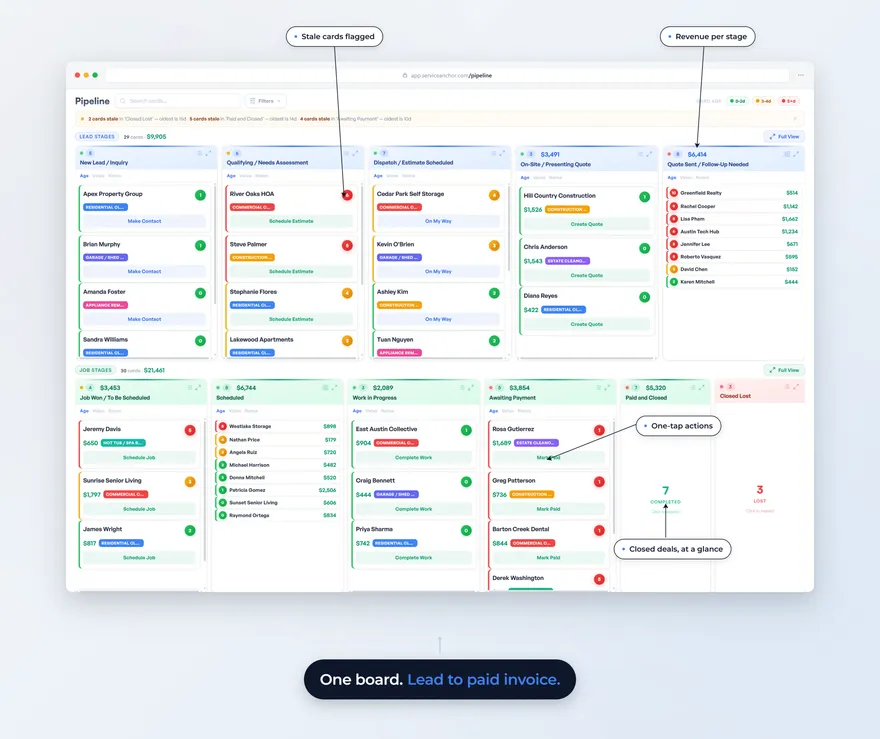
If you are choosing between a dumpster and a full-service haul, get one number for each and compare total cost against the effort you want to spend. And if you run a junk removal operation and want to see how operators price these jobs and run them from first call to paid invoice on one board, that is the problem Service Anchor was built to solve.
FAQ
How much does it cost to rent a dumpster for a week?
A one-week dumpster rental costs about $250 to $650 for a 10 to 30-yard container in most US markets, with a 40-yard running about $475 to $800. The 7-day window is the standard base period, and the price already includes delivery, a set tonnage allowance, pickup, and disposal. The two things that push your price toward the top of the range are a high local tipping fee and a heavy load that exceeds the included weight cap.
How much is a 20-yard dumpster?
A 20-yard dumpster typically costs $350 to $550 for a 7-day rental, with 2 to 3 tons of weight included. It is the most common residential size, fitting a kitchen or bathroom remodel, a full garage cleanout, or mid-size yard waste. If your job includes appliances or heavy debris, budget for a possible weight overage on top of the base rate.
Why is my dumpster quote higher than the national average?
The most common reason a quote runs above the national average is a high regional tipping fee, the per-ton rate your hauler pays to dump at the local landfill or transfer station. US landfill tipping fees averaged about $62 per ton in 2024 and rose 10 percent from the prior year, with large and high-cost-region landfills charging well above that, and the difference flows directly into your price. Distance from the hauler’s yard and a tight delivery window can also raise the quote.
What happens if I go over the weight limit?
If you exceed the included tonnage, you pay a per-ton overage fee, commonly $40 to $100 per ton, on top of the base rate. The weight cap binds first on heavy debris like concrete, dirt, and roofing shingles, which can max out the allowance at less than half the box’s volume. Ask for the tonnage cap and the overage rate before you book so a heavy load does not become a surprise.
How long can I keep a rented dumpster?
Standard rental periods are 7 days, with a per-day extra fee of $25 to $50 starting after the included window. Contractors often book 14 or 21-day periods up front at a better daily rate. If you already know the project will run longer than a week, quote the extended period at booking rather than letting the daily fees stack up on the back end.
Is it cheaper to rent a dumpster or hire junk removal?
It is usually cheaper to rent a dumpster when you can do the loading yourself and the debris accumulates over several days, and cheaper to hire junk removal for small-volume jobs or when you do not want to do the lifting. The dumpster trades a lower price for your labor; junk removal bundles labor, hauling, and disposal into one full-service number. Compare a quote for each against how much of the work you want to do yourself.
US Environmental Protection Agency, Sustainable Management of Construction and Demolition Materials: federal context for how C&D debris is disposed of by weight at construction and demolition facilities, and the tipping-fee mechanics behind dumpster pricing. https://www.epa.gov/smm/sustainable-management-construction-and-demolition-materials
Environmental Research and Education Foundation, Analysis of MSW Landfill Tipping Fees: national landfill tipping-fee data showing a 2024 average of about $62 per ton, up roughly 10 percent year over year, the per-ton disposal cost that drives dumpster pricing. https://erefdn.org/analyzing-municipal-solid-waste-landfill-tipping-fees/
Last updated: June 2026. First publication: size-banded price ranges, five price drivers, a worked 20-yard example, and the surprise-fee breakdown, sister to the dumpster sizes guide.