Pressure washing in 2026 costs $0.15 to $0.75 per square foot depending on surface type and difficulty, with the typical residential job ranging from $180 for a small driveway to $850 for a full house wash plus deck. This guide is for operators pricing their own work and for homeowners verifying a quote. The pricing math comes from a real cost stack: chemicals at $20 to $80 per job, water at near-zero where it’s not metered, labor at $40 to $55 per crew-hour, equipment depreciation at $10 to $25 per job, plus surface-difficulty multipliers ranging from 1.0x for vinyl siding to 3.0x for cedar deck restoration. The post walks through three concrete worked examples (2,000 sqft vinyl house, 600 sqft concrete driveway, 800 sqft cedar deck), shows the per-square-foot rate by surface in a quick-reference table, covers peak-season pricing, and explains what drives a quote up or down. If you are starting a pressure washing business rather than pricing one, our guide to starting a pressure washing business covers startup costs, equipment, and your first jobs.
- A 2,000 sqft single-story vinyl house wash averages $280 to $450 in 2026. A 600 sqft concrete driveway averages $180 to $280. An 800 sqft cedar deck cleaning runs $320 to $600.
- Per-square-foot pricing varies by surface: vinyl siding $0.10 to $0.20, brick $0.15 to $0.25, stucco $0.20 to $0.35, concrete $0.15 to $0.30, wood deck $0.30 to $0.75.
- Soft washing (low pressure plus chemicals) is the standard for roofs, stucco, and painted wood. Pressure washing alone is for concrete, brick, and unfinished surfaces.
- Peak season (April through September) adds 10% to 25% to a typical residential quote.
- The single largest hidden cost in pressure washing is chemical consumption. A typical full-house soft wash uses 4 to 8 gallons of sodium hypochlorite plus surfactant.
How is pressure washing priced?
Pressure washing is priced either per square foot of cleaned surface or per job, with the per-square-foot rate determined by labor (crew time per area), chemicals (gallons used and concentration), equipment depreciation, water cost where metered, and a surface-difficulty multiplier. Most established operators publish per-surface flat-rate pricing on their quote form rather than billing hourly, because the customer sees the price up front and the operator captures the time savings from being efficient.
The five operator-side line items inside a pressure-washing quote are:
- Chemicals. A typical full-house soft wash uses 4 to 8 gallons of sodium hypochlorite (“SH” or 12.5% pool-grade bleach) at $3 to $5 per gallon, plus 1 to 2 gallons of surfactant at $20 to $40 per gallon. Driveways and concrete use less SH but often need degreaser at $15 to $25 per gallon for oil and tire-mark removal.
- Water. Most residential jobs draw from the homeowner’s spigot at near-zero cost to the operator. Commercial jobs often require a metered hookup at $5 to $15 per job. Operators with their own water tank (250 to 525 gallons) pay for it at the public-fill station at $0.005 to $0.015 per gallon.
- Labor. Per Bureau of Labor Statistics data for SOC 37-3011 (Landscaping and Groundskeeping Workers, which is the closest BLS category for pressure-washing crews), the median wage is roughly $17 per hour. The customer-facing labor cost is $40 to $55 per crew-hour after the operator adds payroll burden, supervision, and margin.
- Equipment depreciation. A commercial-grade gas pressure washer runs $3,000 to $8,000 new and lasts 3 to 5 years of full-time use. Spread across roughly 800 to 1,200 jobs per year, that’s $10 to $25 per job in equipment cost.
- Surcharges. Heavy biological growth (mildew, algae, lichen) adds chemical concentration and dwell time. Second-story access adds ladder or telescoping-wand time. Oil and rust stains on concrete add specialty chemicals. EPA chemical-runoff containment is required for commercial work in many jurisdictions and adds $50 to $150 per job in plastic-sheeting and reclamation costs.
The discipline of decomposing the cost stack mirrors what we lay out in the junk removal pricing framework: labor times time, plus consumables, plus capital cost, plus surcharges. The trade-specific variable is the surface multiplier, which captures how much harder one surface is to clean than another.
How much does it cost to pressure wash a house?
A house wash costs $250 to $700 in 2026, with the spread driven by square footage of wall area, number of stories, and siding material. Most residential exterior cleaning is technically “soft washing” rather than true pressure washing: 100 to 500 PSI plus chemicals, applied through a downstream injector or 12V pump, then rinsed. Hitting vinyl or painted wood with 3,000 PSI strips finish and forces water behind seams.
Example 1: 2,000 sqft single-story vinyl siding house in Tampa.
- 2,000 sqft of wall area at $0.15 per sqft (vinyl base rate) = $300
- Chemicals (6 gal SH + 1 gal surfactant): $35
- Labor (2 hours including setup): in the per-sqft rate
- Total: $335. Efficient single-operator crews complete this in 2 hours; a 3-person crew can hit 1.5 hours.
Example 2: 2,800 sqft two-story brick house in Charlotte.
- 2,800 sqft of wall area at $0.20 per sqft (brick base rate plus minor height premium) = $560
- Chemicals (8 gal SH + 1.5 gal surfactant): $48
- Second-story access surcharge: $50
- Total: $658. Two-story brick takes 3 to 4 hours for a 2-person crew.
Example 3: 1,800 sqft single-story stucco house in Phoenix.
- 1,800 sqft of wall area at $0.30 per sqft (stucco rate, soft-wash only) = $540
- Chemicals (5 gal SH lower concentration + 2 gal stucco-safe surfactant): $58
- Total: $598. Stucco is delicate; high-pressure spray pits the finish. Soft washing is mandatory.
Surface type drives 60% to 80% of the per-square-foot price variance. Two-story height and difficult access drive most of the rest.
How much does it cost to pressure wash a driveway or concrete?
Driveway pressure washing costs $0.15 to $0.30 per square foot in 2026, with the typical 600 sqft single-bay driveway running $180 to $280. Concrete is the surface pressure washing was originally designed for: 3,000 to 4,000 PSI cold water cleans it well without chemicals, and chemicals are added only for stains and biological growth.
Worked example: 600 sqft concrete driveway with one oil stain in Houston.
- 600 sqft at $0.20 per sqft (mid-range concrete base) = $120
- Surface cleaner attachment (rotating-arm tool, mandatory for streak-free finish): no extra charge, but adds 15 minutes
- Oil-stain treatment (degreaser plus dwell time): $40
- Labor (1.5 hours including setup): in the per-sqft rate
- Total: $160. A crew with a surface cleaner can hit 1,500 to 2,000 sqft of concrete per hour after setup.
Pricing concrete by the square foot is more accurate than pricing by the bay because driveways vary wildly in shape. A 600 sqft single-bay driveway is fast. A 600 sqft U-shaped driveway with two strips of grass between the bays is slow.
Heavy stains add real time and chemical cost. Rust from sprinkler systems requires oxalic-acid based remover at $25 to $40 per gallon. Battery acid or motor oil that’s been baked in for years often requires a poultice treatment that doubles labor time. Quote these as separate line items, not folded into the base rate. The pricing logic we use in our dumpster rental pricing breakdown holds here too: surcharges for non-standard work belong on the rate card, published in advance, not absorbed silently.
How much does it cost to pressure wash a deck or wood?
Wood deck cleaning costs $0.30 to $0.75 per square foot in 2026, putting an 800 sqft cedar deck at $320 to $600 for cleaning only and $700 to $1,400 if the customer wants brightening and sealing included. Wood is the highest-difficulty surface because pressure must stay low (under 1,500 PSI), chemicals are deck-specific (sodium percarbonate plus brightener, not SH), and uneven cleaning shows visibly on the finished surface.
Worked example: 800 sqft cedar deck with cleaning plus brightening in Atlanta.
- 800 sqft at $0.50 per sqft (cedar mid-range, cleaning plus brightening) = $400
- Chemicals (deck cleaner 2 gal at $25/gal plus brightener 1 gal at $30/gal): $80
- Furniture move (off-deck and back): $40
- Total: $520. A 2-person crew completes this in 3.5 to 4 hours.
The full restore-and-seal package (clean, brighten, sand any rough spots, apply two coats of stain or sealer) is typically priced as a separate line at $1.50 to $3.50 per square foot on top of the cleaning. That’s not pressure washing anymore, it’s deck refinishing.
Pressure washing prices by surface (quick reference)
Per-square-foot pressure washing rates in 2026 by surface type, mid-cost-of-living US metros:
| Surface | Per sqft rate | Method | Typical job size | Typical total |
|---|---|---|---|---|
| Vinyl siding | $0.10 to $0.20 | Soft wash | 1,500 to 2,500 sqft wall | $180 to $450 |
| Brick | $0.15 to $0.25 | Pressure plus chemical | 1,800 to 3,000 sqft wall | $280 to $650 |
| Stucco | $0.20 to $0.35 | Soft wash only | 1,500 to 2,500 sqft wall | $325 to $750 |
| Concrete driveway | $0.15 to $0.30 | Pressure plus surface cleaner | 400 to 1,000 sqft | $80 to $260 |
| Concrete patio | $0.15 to $0.30 | Pressure plus surface cleaner | 200 to 600 sqft | $50 to $160 |
| Wood deck (clean) | $0.30 to $0.50 | Low pressure plus deck cleaner | 400 to 1,200 sqft | $140 to $550 |
| Wood deck (clean plus brighten) | $0.40 to $0.75 | Low pressure plus brightener | 400 to 1,200 sqft | $200 to $800 |
| Roof (asphalt shingle) | $0.30 to $0.60 | Soft wash only (NEVER pressure) | 1,500 to 3,000 sqft | $500 to $1,500 |
| Fence (wood) | $1.50 to $3.50 per linear foot | Soft wash plus brightener | 100 to 300 linear feet | $200 to $800 |
Adjust these numbers up 20% to 35% in high-cost-of-living metros (LA, NYC, Boston, Seattle, San Francisco) and down 10% to 15% in rural markets. The shape of the rate card stays the same.
What drives pressure washing cost up or down?
Pressure washing cost is driven up by access difficulty, biological growth severity, water-access constraints, and EPA chemical-runoff containment requirements, and driven down by easy access, dry climate (less biological growth), free water hookup, and bundling multiple services.
Access difficulty. Two-story houses, fenced backyards with no truck access, hillside lots, and long driveways where the operator can’t pull a truck close all add real labor time. Expect a 15% to 30% premium on jobs where the operator has to drag hose 100+ feet.
Biological growth severity. Light gray streaking is fast. Heavy black mold, green algae, or red lichen requires higher chemical concentration and longer dwell time. Expect $50 to $150 extra on heavily-affected surfaces.
Water access. No-spigot or low-flow spigot jobs require the operator to bring water (250 to 525 gallon tank). Commercial jobs requiring metered hookup add $5 to $15. Some operators charge a flat $25 “no-water surcharge” rather than itemizing.
EPA chemical-runoff containment. Commercial pressure washing in many jurisdictions falls under EPA Clean Water Act stormwater discharge rules. Containment requires plastic sheeting, vacuum reclamation, and proper disposal. Add $50 to $150 per commercial job.
Peak season. April through September is the busy window in most US markets. Operators charge 10% to 25% more during peak, and even with the premium, demand often exceeds supply for high-quality crews. The off-peak savings logic we cover in our residential moving cost guide applies here: October through March is cheaper for the customer and easier scheduling for the crew.
Bundling. Booking a house wash plus driveway plus deck in one visit typically saves 10% to 15% versus three separate jobs. The operator saves on setup, teardown, and travel time; the customer captures part of that savings.
What to do next
If you’re a homeowner getting quotes, ask each company three questions: (1) Are you using soft washing or pressure washing for the surfaces being cleaned? (2) Are you licensed and insured at the state level? (3) What’s the per-square-foot rate, and what surcharges apply to my specific job? A reputable operator answers all three in under five minutes.
If you’re a pressure-washing operator pricing your own jobs, the same cost-stack thinking applies whether you’re quoting a single house wash or a multi-surface bundle. Track your actual cost per job-hour (wages, chemicals, equipment, fuel) every quarter and benchmark it against what you charge. Most operators we talk to under-track chemical consumption specifically and undercharge by 5% to 10% on heavy-growth jobs as a result. Liability insurance is the cost-stack line operators most often forget to allocate; we walk through the comparable structure in our guide to junk removal insurance, and most of the methodology transfers directly.
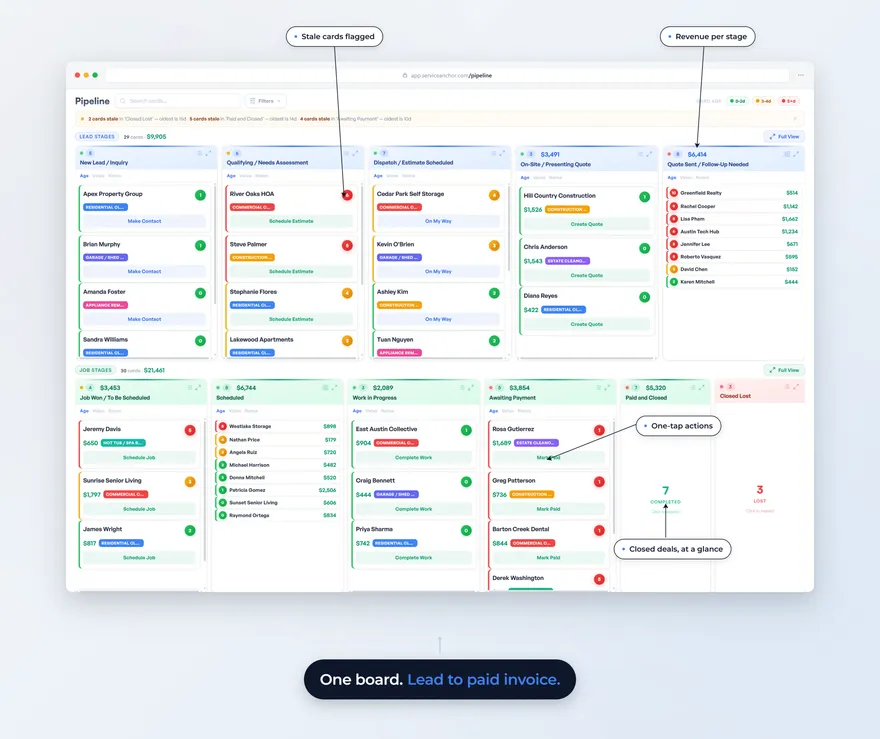
For pressure-washing operators running 1-to-3 trucks, the bigger leak isn’t pricing per job, it’s scheduling lost time between jobs and follow-up after the quote. We built Service Anchor as a pipeline-driven CRM and field service tool for home service operators, with a pressure-washing setup that pre-loads price book line items, surface types, and standard surcharges out of the box. See the pressure washing industry page for the specifics, and if you are comparing tools, the best pressure washing software in 2026 ranks the real options for a 1-to-5-truck shop. And before you compete on price, get your GBP foundation right, since most pressure-washing operators get their first 20 customers through local search before they ever run a paid lead channel.
FAQ
Is pressure washing worth the cost? Pressure washing is typically worth the cost when biological growth is visible, when a home is being prepared for sale or paint, or when concrete has accumulated stains that affect curb appeal. The typical $300 to $700 house wash adds $5,000 to $15,000 to perceived home value during a sale per real-estate agent surveys, which is a strong return on a single-day service.
How long does pressure washing take? A single-story 2,000 sqft house wash takes a 2-person crew 1.5 to 2 hours. A 600 sqft driveway takes 1 to 1.5 hours including setup. An 800 sqft cedar deck cleaning takes 3.5 to 4 hours for a 2-person crew. Total time including travel is usually 2 to 5 hours per residential job.
Is soft washing cheaper than pressure washing? Soft washing is typically the same price or slightly more expensive than pressure washing per square foot because chemical cost is higher. The customer-facing rate is similar; the operator’s chemical line is the variable. Soft washing is mandatory for stucco, painted wood, and asphalt shingle roofs.
Should I pressure wash my own house? DIY pressure washing saves money on labor but carries real damage risks: stripping paint, forcing water behind vinyl seams, etching brick mortar, and pitting stucco. Renting a commercial-grade unit costs $80 to $150 per day. Buying a quality residential unit runs $400 to $1,200. For a single annual house wash, hiring a pro is usually the better economics.
What’s a fair price per hour for pressure washing? Fair hourly rates for residential pressure washing in 2026 run $100 to $180 per hour for a 1-person operation and $180 to $300 per hour for a 2-person crew. These rates assume the operator is bringing equipment, chemicals, and insurance. Below $80 per hour for a 2-person crew should raise a flag about underinsured operators.
Do pressure washers use a lot of water? A residential pressure washer uses 2 to 4 gallons per minute, or roughly 120 to 240 gallons per hour. A typical full-house wash uses 200 to 400 gallons of water. By comparison, a 20-minute shower uses about 50 gallons. Soft washing actually uses less water than pressure washing because the chemicals do more of the work.
Last updated: May 2026. First publish; rates reflect 2026 mid-cost-of-living US metro averages and current EPA Clean Water Act stormwater requirements.