Starting a pressure washing business takes six steps: register the business, get insured, buy a pro-grade setup (not the most expensive one), set pricing that protects your margin, land your first jobs, and rebook them. Realistic startup costs run about $2,000 to $5,000 part-time with a prosumer setup, and $8,000 to $15,000 or more full-time with a trailer rig. This is the cheapest of the home service trades to enter, which is exactly why it’s crowded, and why the operators who last win on pricing and repeat customers rather than on having the biggest machine. This guide is written for the operator deciding whether the trade is as easy as it looks, and what actually separates the shops that survive from the ones that fold in a season.
- Startup cost is roughly $2,000 to $5,000 part-time (prosumer washer, surface cleaner, hoses) and $8,000 to $15,000+ full-time (pro unit, soft-wash setup, trailer). The low entry cost is the trade’s blessing and its curse.
- You need a business entity, general liability insurance (median around $75 a month, per Insureon), and an honest plan for where your wash water goes. The EPA treats wash water running into a storm drain as an illegal discharge.
- Margins per job are high because the materials (water, a little sodium hypochlorite, surfactant) are cheap. A $400 house wash can leave most of the ticket as gross profit.
- High margin does not equal a surviving business. About half of new US businesses are gone within five years (BLS). In a crowded, low-barrier trade, the survivors are the ones who price for profit and rebook customers, not the ones who chase the cheapest job.
How much does it cost to start a pressure washing business?
Starting a pressure washing business costs about $2,000 to $5,000 part-time and $8,000 to $15,000 or more full-time, making it the lowest-cost entry of any home service trade. There’s no truck loan required to begin: a prosumer setup fits in the bed of a pickup you already own. That low barrier is why so many people start, and why your pricing discipline matters more here than in junk removal or moving.
Typical 2026 cost ranges look like this (equipment prices are current street ranges, not a fixed schedule):
| Line item | Part-time start | Full-time start | Note |
|---|---|---|---|
| Business registration (LLC) | $35 to $520 | $35 to $520 | One-time state filing fee; varies by state |
| EIN | $0 | $0 | Free from the IRS |
| Gas pressure washer | $1,000 to $3,000 | $3,000 to $8,000+ | Prosumer vs commercial 4-GPM class |
| Surface cleaner, hose, reel, nozzles | $300 to $1,500 | $1,500 to $3,000 | The accessory kit that does the real work |
| Soft-wash setup (house exteriors) | optional | $1,500 to $4,000 | Needed for siding and roofs you can’t blast |
| General liability insurance | ~$895 / year | ~$895 / year | Insureon median for the trade |
| Basic marketing | $300 to $1,500 | $1,000 to $3,000 | Google Business Profile is free; ads and a site cost more |
The single most common money mistake new operators make is buying machine before buying customers. A $5,000 setup does not book jobs; a verified Google Business Profile and a sharp price do. Start with a setup that matches the work you can actually sell, and upgrade when the job volume justifies it.
What equipment do you need to start a pressure washing business?
The equipment that matters is a gas pressure washer with the right flow rate, a surface cleaner, and a soft-wash capability for house exteriors. Flow rate (gallons per minute, or GPM) matters more than raw pressure (PSI), because GPM is what determines how fast you finish a job, and job speed is your real hourly rate.
What to buy:
- A gas washer in the 3.5 to 4+ GPM range. Electric and low-GPM prosumer units are fine for a driveway side hustle, but professional flatwork moves on GPM. More gallons per minute means you rinse a driveway in half the time.
- A surface cleaner. The flat spinning attachment that turns a four-hour driveway into a one-hour driveway. This is the single highest-impact accessory you can own.
- Soft-wash capability. House siding, painted surfaces, and roofs cannot take high pressure. Soft washing uses low pressure and a cleaning solution. If you want to wash houses (where the money is), you need this.
What’s a trap: over-buying PSI you’ll never safely use, and buying a full trailer rig before you have the job volume to keep it busy. A trailer rig is a great year-two purchase and a terrible week-one purchase. The gear does not earn until the calendar is full.
Do you need a license or insurance to pressure wash?
You need a business entity and general liability insurance, and you need a real plan for your wash water. Pressure washing has a lighter licensing burden than moving or even junk removal in most places, but two things are non-negotiable: liability coverage and Clean Water Act compliance.
On insurance, the numbers are manageable. General liability for a pressure washing business runs a median of about $75 a month, or roughly $895 a year, with a Business Owner’s Policy closer to $160 a month (Insureon, Pressure Washing Insurance Costs, 2025). Liability is not optional when you’re spraying chemicals and high-pressure water a few feet from a customer’s windows, landscaping, and siding. One cracked window or killed flower bed without coverage erases a month of profit.
The part most “how to start” guides skip: where does the dirty water go? The EPA treats wash water that runs into a storm drain as an illicit, non-stormwater discharge, because storm drains flow untreated to local waterways (US EPA, Stormwater BMP: Vehicle Maintenance and Washing). For most residential driveway work this is a low risk, but for commercial lots, gas stations, and anything involving degreasers, you may need to capture and reclaim the water. Discharging pollutants to waters of the US without a permit can trigger Clean Water Act penalties. Check your local stormwater rules before you take commercial work, and treat everything here as directional, not legal advice.
How do you price pressure washing jobs?
Pressure washing is priced per square foot or as a flat per-job rate, with most operators landing around $0.10 to $0.50 per square foot depending on the surface. Driveways commonly run $0.25 to $0.55 per square foot (a typical driveway job lands around $155 to $210), and house washes run $0.10 to $0.50 per square foot, or roughly $250 to $700 per house (Angi, Cost to Pressure Wash a House).
Here’s the discipline that separates the survivors: set a minimum and hold your price. In a crowded trade, there’s always someone with a $300 Home Depot washer willing to do it for less. You cannot win the race to the bottom, so don’t enter it. Price for the margin that lets you carry insurance, replace gear, and still pay yourself. For the full customer-side and operator-side pricing picture, see our pressure washing cost guide, which breaks down rates by surface and job type.
Is a pressure washing business profitable?
Pressure washing is highly profitable per job, because the consumable costs are tiny: water, a little sodium hypochlorite, and surfactant. The honest catch is that the low barrier to entry creates real pricing pressure, so the trade rewards margin discipline and repeat customers over raw job count.
Look at the math on a single house wash:
That’s a strong number. The problem is never the per-job margin in this trade; it’s keeping the calendar full at a price that holds. Two things decide that. First, route density: washing five houses in one neighborhood beats one house across town, because your drive time is dead time. Second, rebooking: an annual house wash, a recurring commercial contract, or a “we’ll see you next spring” beats chasing a new discount customer every week.
Here’s the reality check the hustle videos skip. According to the Bureau of Labor Statistics, about three-quarters of new US businesses survive year one, but only about half are still open after five years (BLS Business Employment Dynamics). In pressure washing, the ones that fold rarely fail on margin. They fail because they competed on price until there was no profit left, or because every job was a one-time stranger instead of a customer who books again. Which is the whole point of the last step.
How do you get your first pressure washing jobs?
You get your first pressure washing jobs from a verified Google Business Profile, local pay-per-lead ads, and route-based neighborhood marketing. The cheapest reliable channel is free: a fully verified Google Business Profile puts you in the local map results where “pressure washing near me” searches land.
Three channels to start:
- Google Business Profile. Free and essential. Get it verified before you spend on ads, and watch the traps that suspend new service-area businesses. Our step-by-step Google Business Profile guide covers them.
- Local Services Ads. Pay-per-lead at the top of Google. We worked the operator payback math (what a good cost-per-lead looks like) in our guide to Local Services Ads for home service.
- Route-based neighborhood marketing. Before-and-after photos on social, door hangers on the same street after a job, and the yard sign while you work. Pressure washing is uniquely visual: one clean driveway sells the three dirty ones next to it. Use it.
Want the fastest path to a full week? Do great work on one street, photograph it, and knock on the four nearest doors. Route density and visual proof are this trade’s free marketing engine. Some operators also add junk hauling as a second service line for the same customer base; if that’s you, our junk removal hub covers that trade.
What to do next
If you’re starting out, the action this week is simple: form the LLC, get the free EIN, get an insurance quote, and set up your Google Business Profile. Then buy the setup that matches the work you can sell, not the most expensive rig on the shelf.
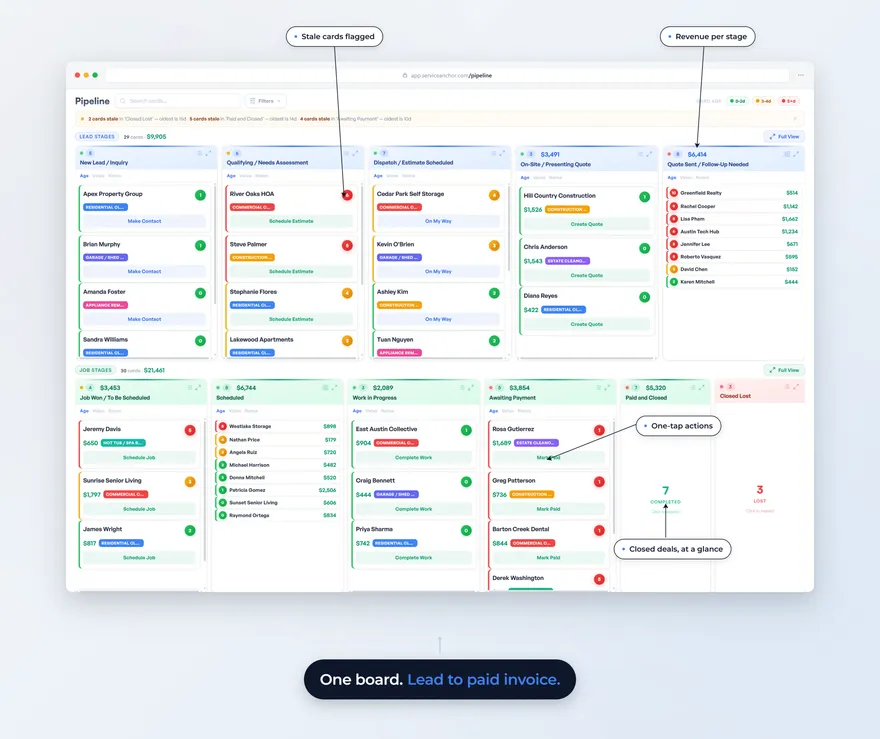
The thing to set up before the calls start is a way to keep track of them. In a crowded trade, the operators who last are the ones who rebook customers and never drop a lead. That’s what Service Anchor is built for: one pipeline from the first call to the paid invoice, pre-configured for pressure washing so your price book loads in about 90 seconds, with the customer texts (on the way, job done, invoice, review request) firing automatically as you work. Founding pricing is $29 a month, locked for life for the first 25 operators. For the operator-side view of the trade, start with our pressure washing hub.
Frequently asked questions
How much does it cost to start a pressure washing business?
About $2,000 to $5,000 to start part-time with a prosumer setup, and $8,000 to $15,000 or more to go full-time with a commercial unit, soft-wash system, and trailer. It’s the lowest-cost entry of the home service trades because no truck loan is required to begin. General liability insurance adds roughly $895 a year (Insureon median).
Is a pressure washing business profitable?
Yes, and the per-job margins are high because the consumables (water, sodium hypochlorite, surfactant) cost very little. A $400 house wash can leave around $300 in contribution margin. The catch is the low barrier to entry, which creates pricing pressure, so profitability over time depends on holding your price and rebooking customers rather than chasing the cheapest job.
Do you need a license to start a pressure washing business?
In most places you need a business entity (usually an LLC) and general liability insurance, but pressure washing has a lighter licensing burden than moving or junk removal. The one compliance area to watch is wash-water runoff: the EPA treats water entering storm drains as an illegal discharge, so commercial work may require water reclamation. Confirm local rules before taking commercial jobs.
What equipment do I need to start pressure washing?
A gas pressure washer in the 3.5 to 4+ GPM range, a surface cleaner for flatwork, quality hose and a reel, and soft-wash capability if you want to wash house exteriors. Flow rate (GPM) matters more than raw pressure (PSI) because it determines how fast you finish, which is your real hourly rate. Skip the trailer rig until job volume justifies it.
How much can you make pressure washing?
Per-job margins are high (often 70% or more on a house wash, as operators commonly report), but annual income depends on keeping the calendar full at a price that holds. Route density and repeat customers are the difference between a busy season and a profitable business. The trap is competing on price until there’s no margin left.
Can you start a pressure washing business part-time?
Yes, and it’s one of the most common ways in. A prosumer setup runs out of an existing pickup, so you can start on weekends for $2,000 to $5,000 and prove the demand before going full-time or buying a trailer rig. Part-time also lets you build a base of repeat customers before you depend on the income.
Do you need insurance to pressure wash houses?
Yes. General liability is essential because you’re using high-pressure water and cleaning chemicals near windows, siding, and landscaping. A single cracked window or damaged surface without coverage can erase a month of profit. The trade median is about $75 a month for general liability (Insureon, 2025).
US Environmental Protection Agency, Stormwater Best Management Practice: Vehicle Maintenance and Washing (EPA-832-F-21-032F): EPA guidance that wash water from washing activities is a non-stormwater discharge and must not enter the storm drain system untreated. https://www.epa.gov/system/files/documents/2023-01/bmp-vehicle-maintenance-and-washing.pdf
Insureon, Pressure Washing Insurance Costs: median small-operator insurance costs, including general liability around $75 a month and a Business Owner’s Policy around $160 a month (2025 policyholder data). https://www.insureon.com/cleaning-business-insurance/pressure-washing/cost
Angi, How Much Does It Cost to Pressure Wash a House: consumer-side pricing data showing house washes commonly run $250 to $700 and per-square-foot rates of $0.10 to $0.50. https://www.angi.com/articles/how-much-does-it-cost-pressure-wash-house.htm
US Bureau of Labor Statistics, Business Employment Dynamics, Survival of Private Sector Establishments: about three-quarters of new establishments survive year one and roughly half survive five years. https://www.bls.gov/bdm/bdmage.htm
Last updated: May 2026 (first version).