Starting a junk removal business takes six steps: register the business, get licensed and insured, line up a truck and basic hauling gear, set your pricing, land your first 30 jobs, and put a system in place so you stop dropping leads. Realistic startup costs run about $8,000 to $12,000 if you start as a side hustle with a truck or trailer you already own, and $25,000 to $40,000 if you go full-time and buy a dedicated truck. This guide is written for the operator who is in the first 60 days (or seriously considering the jump), and it shows the real numbers at each step instead of a “get a truck, get insurance, get customers” checklist. The demand is real: the EPA’s latest national figures put construction and demolition debris alone at about 600 million tons a year, more than double municipal trash.
- Startup cost is roughly $8,000 to $12,000 as a side hustle (using a truck or trailer you already have) and $25,000 to $40,000 full-time with a bought truck. The single biggest variable is the truck.
- You need an LLC (state filing fees run $35 to $520), a free EIN from the IRS, general liability insurance (around $1,100 a year for a small operator), and commercial auto. You usually do not need a CDL to start.
- A full-truck job in most markets runs about $475, with roughly $190 in variable cost per job (dump fees, fuel, a helper), leaving close to $280 of contribution margin. That is a healthy per-job number.
- Per-job profit is not the same as a surviving business. About half of new US businesses are gone within five years (BLS). The ones that last keep a steady lead flow and never drop a quote.
How much does it cost to start a junk removal business?
Starting a junk removal business costs about $8,000 to $12,000 as a side hustle and $25,000 to $40,000 full-time, and the gap between those two numbers is almost entirely the truck. Everything else (registration, insurance, gear, a dump account, basic marketing) lands in a similar range whether you run one truck part-time or full-time. The truck is the decision that moves the total by tens of thousands of dollars.
Here is what the line items actually look like:
| Line item | Side-hustle start | Full-time start | Note |
|---|---|---|---|
| Business registration (LLC) | $35 to $520 | $35 to $520 | One-time state filing fee; varies by state |
| EIN | $0 | $0 | Free from the IRS, always |
| General liability insurance | ~$1,100 / year | ~$1,100 / year | Small-operator average |
| Commercial auto insurance | $1,500 to $3,000 / year | $2,000 to $4,000 / year | Scales with truck class and your record |
| Truck | $0 to $4,000 (use what you own, or a used trailer) | $15,000 to $45,000 (used box or dump truck) | The big variable |
| Dollies, straps, tarps, bins | $500 to $1,500 | $800 to $2,000 | The starter gear kit |
| Dump / transfer-station account | $200 to $500 to open | $200 to $500 to open | Plus per-load tipping fees (see below) |
| Basic marketing | $500 to $2,000 | $1,500 to $4,000 | Google Business Profile is free; ads and a simple site cost more |
A note that trips up new operators: the dump is a recurring cost, not a startup cost. The national average landfill tipping fee hit $62.28 per ton in 2024, up about 10% year over year (Environmental Research and Education Foundation, 2024 Analysis of MSW Landfill Tipping Fees). A full truck of mixed household junk often weighs a ton or two, so budget roughly $80 to $150 in dump fees on every full load before you count fuel or labor. That number goes straight into your pricing, which we cover below.
If you already own a pickup and a trailer, you can genuinely start for well under $10,000. If you are buying a box truck or a dump truck, you are in the $25,000-plus range before your first job. Both are legitimate ways in. The side-hustle path just means your first 20 jobs prove the demand before you sign a truck loan. For the gear beyond the truck, the full first-year equipment buy-sequence sorts what to buy on day one from what to defer until the job volume justifies it.
How do you register and license a junk removal business?
Registering a junk removal business means forming a legal entity, getting a free federal tax ID, and checking your local hauling and dump requirements, in that order. Most junk haulers form an LLC because it separates your personal assets from the business, which matters the first time a customer claims you scratched their floor or a load shifts on the road.
The sequence is short:
- Form your LLC. File with your state’s Secretary of State. Filing fees range from about $35 (Montana, Kentucky) to roughly $520 (Massachusetts), depending on the state. For the exact number, check your own state’s filing fee schedule, not a national average.
- Get an EIN. Apply directly on the IRS website. It is free and takes a few minutes. If a site charges you for an EIN, you are on the wrong site: the IRS states plainly that the EIN application is free of cost (IRS, Get an Employer Identification Number).
- Open a business bank account. Keep the money separate from day one. It makes taxes and the profitability math below far easier to read.
- Check local hauling rules and dump accounts. This is the part generic guides skip. Some cities and counties require a hauler or waste-transport registration, and your local transfer station or landfill will want a commercial account set up before you show up with a full truck. Call them before your first job, not during it.
One common question: do you need a CDL? For most one-truck junk removal operations using a pickup, a trailer, or a smaller box truck under the commercial weight thresholds, no. Once you move into larger trucks, confirm the weight class against your state’s CDL rules. Treat everything in this section as directional and confirm with your state and county, because the specifics vary.
What insurance does a junk removal business need?
A junk removal business needs general liability and commercial auto insurance at a minimum, and the truck is what drives the premium. General liability covers the damage you might do to a customer’s property; commercial auto covers the truck on the road and is non-negotiable the moment you are hauling for money.
The numbers are manageable for a small operator. General liability for debris and junk removal work averages around $93 a month, or roughly $1,100 a year (Insureon, Debris and Junk Removal Insurance Costs). Commercial auto is usually the larger line, often $1,500 to $4,000 a year depending on the truck, your driving record, and your state. Once you hire a helper, you will also need workers’ compensation in most states.
This is a short section on purpose, because we already wrote the full picture. For what each coverage type actually pays out, how the truck class changes your premium, and the policy limits customers and commercial clients tend to ask for, see our breakdown of junk removal insurance costs and coverage.
How do you price junk removal jobs?
Junk removal is priced by volume, not by the hour: you charge for how much of the truck the job fills, with a minimum that covers a small pickup. A typical full-truck job in most markets runs about $475, with quarter-, half-, and three-quarter-truck tiers priced down from there and a minimum charge (often $125 to $175) that protects you on the small single-item calls.
Here is a quick worked example so this section stands on its own. Say your truck holds 15 cubic yards and your full-load price is $475. A customer with a garage cleanout that fills about half the truck pays around $250. A single-item couch removal hits your $150 minimum. The skill is reading the volume correctly on the phone before you drive, so you quote a number you can hold to on the driveway.
That is the short version. The full method (how to set your tiers from your actual cost basis, how to handle the “oh, and the basement” scope creep, and a copy-ready rate structure) lives in two companion pieces: our junk removal pricing framework walks the math from cost to retail, and our junk removal price sheet gives you a rate template you can adapt. If you also field dumpster questions, the dumpster rental side prices differently, by rental window rather than by load.
Is a junk removal business profitable?
Junk removal is profitable on a per-job basis, with healthy margins, because the variable costs are low relative to the ticket. The honest catch is that strong per-job margins do not automatically make a surviving business. Let’s do the math, then the reality check.
Take that $475 full-truck job. Your variable costs on that load look roughly like this:
That $280 is the money left over to cover your fixed costs and pay you. Now the volume question. Suppose your monthly fixed costs (insurance, a truck payment, phone, fuel base, basic marketing, software) come to about $2,500, and you want to clear $6,000 a month for yourself. You need to cover $8,500 at $280 a job, which is roughly 30 full-truck-equivalent jobs a month, or about seven to eight a week. That is a real but reachable target for a focused one-truck operator. To turn that target into a full plan a lender will actually read, our junk removal business plan template walks the financial projection line by line.
Here is the part the hustle videos skip. Per-job profit is not survival. According to the Bureau of Labor Statistics, about 78% of new US businesses make it through year one, but only about half are still open after five years (BLS Business Employment Dynamics). The junk removal operators who fold rarely fail because the margin was bad. They fail because the lead flow was lumpy and they dropped quotes, forgot follow-ups, or lost the thread on who owed them money. Which is exactly the problem the last step solves.
How do you get your first junk removal jobs?
You get your first junk removal jobs from a verified Google Business Profile, local pay-per-lead ads, and old-fashioned neighborhood and referral work, in that order of cost-efficiency. The cheapest reliable channel is also free: a fully verified Google Business Profile gets you into the local map results where ready-to-buy customers search “junk removal near me.”
Three channels to start with:
- Google Business Profile. Free, and the single highest-impact thing a new local operator can set up. Get it verified before you spend a dollar on ads. The verification process has traps that suspend new service-area businesses, so follow our step-by-step guide to verifying your Google Business Profile to avoid them.
- Local Services Ads. Pay-per-lead, sits at the top of Google, and the payback math is friendly for a $475 average ticket. We worked the operator economics (what a good cost-per-lead looks like and when to walk away) in our guide to Local Services Ads for home service.
- Neighborhood and referral. Truck signage, door hangers after a job, and asking every happy customer for a review and a referral. Free or near-free, and it compounds.
Would you rather pay $40 for a lead or get the next one free because the last customer told their neighbor? Both, in order. Start with the free channels, layer paid on once you can handle the volume.
What to do next
If you are starting out, the action today is simple: form the LLC, get the free EIN, line up insurance quotes, and set up your Google Business Profile this week. None of those require a truck loan, and together they make you a real, bookable business. If you are weighing buying into a national brand instead of building your own, our junk removal franchise versus independent cost breakdown runs the real royalty math first.
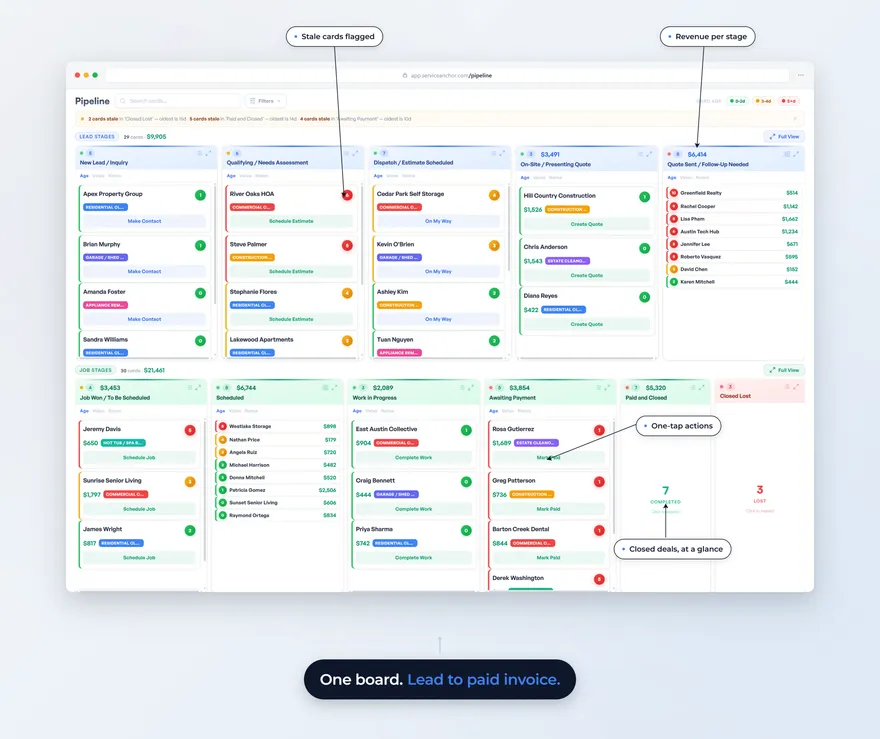
The one thing to set up before the calls start coming is a way to keep track of them. The operators who survive past year five are not the ones with the biggest trucks; they are the ones who never drop a lead. That is the whole reason Service Anchor exists: one pipeline from the first call to the paid invoice, pre-configured for junk removal so your price book and job types load in about 90 seconds, with the customer texts (on the way, job done, invoice, review request) firing automatically as you work. Founding pricing is $29 a month, locked for life for the first 25 operators. If you want the operator-side view of the trade, start with our junk removal hub.
Frequently asked questions
How much does it cost to start a junk removal business?
About $8,000 to $12,000 if you start as a side hustle using a truck or trailer you already own, and $25,000 to $40,000 if you go full-time and buy a dedicated truck. The truck is the biggest variable; registration, insurance, gear, and a dump account land in a similar range either way. General liability insurance alone runs around $1,100 a year for a small operator.
Do you need a license to start a junk removal business?
You need a business entity (usually an LLC), a free EIN from the IRS, and, in many places, a local hauling or waste-transport registration plus a commercial account at your dump or transfer station. Requirements vary by city and county, so confirm with your local government before your first job. Most one-truck operations do not need a CDL.
Is junk removal a profitable business?
Yes, on a per-job basis. A typical $475 full-truck job carries roughly $190 in variable cost (dump fees, fuel, a helper), leaving close to $280 of contribution margin, about 59%. The harder question is survival: only about half of new US businesses last five years, and the junk removal ones that fail usually do so from lumpy lead flow and dropped jobs, not thin margins.
Can you start a junk removal business with one truck?
Yes. The vast majority of junk removal businesses start with a single truck or even a pickup and trailer. Starting with one truck part-time also lets your first 20 to 30 jobs prove the demand before you commit to a truck payment or a second vehicle.
How much can a junk removal business make a year?
It depends on volume and pricing, but the per-job math gives you a floor. At about $280 contribution margin per full-truck job and seven to eight jobs a week, a focused one-truck operator can clear well into five figures of monthly gross before fixed costs. Scaling past that means a second truck and crew, which changes the math (and the management).
Do I need a CDL for junk removal?
Usually not to start. Most one-truck junk removal operations run a pickup, a trailer, or a smaller box truck that falls under commercial weight thresholds. If you move up to a larger truck, check the gross vehicle weight rating against your state’s CDL rules before you buy.
How do junk removal companies get customers?
The most cost-efficient first channels are a verified Google Business Profile (free), Local Services Ads (pay-per-lead), and neighborhood and referral work (truck signage, door hangers, review requests). New operators should set up and verify the Google Business Profile before spending on ads, because it feeds the local map results where “junk removal near me” searches land.
US Environmental Protection Agency, Construction and Demolition Debris: Material-Specific Data (latest national figures, 2018): the official source establishing C&D debris generation at about 600 million tons a year, more than double municipal solid waste. https://www.epa.gov/facts-and-figures-about-materials-waste-and-recycling/construction-and-demolition-debris-material
Environmental Research and Education Foundation, 2024 Analysis of Municipal Solid Waste (MSW) Landfill Tipping Fees: national average tipping fee of $62.28 per ton in 2024, an increase of about 10% year over year. https://erefdn.org/product/2024-analysis-of-municipal-solid-waste-msw-landfill-tipping-fees/
US Internal Revenue Service, Get an Employer Identification Number: the IRS confirmation that an EIN is free to obtain. https://www.irs.gov/businesses/small-businesses-self-employed/get-an-employer-identification-number
Insureon, Debris and Junk Removal Insurance Costs: small-operator general liability cost data (average around $93 a month). https://www.insureon.com/construction-contracting-business-insurance/debris-removal/cost
US Bureau of Labor Statistics, Business Employment Dynamics, Survival of Private Sector Establishments: roughly 78% of new establishments survive year one and about half survive five years. https://www.bls.gov/bdm/entrepreneurship/bdm_chart3.htm
Last updated: May 2026 (first version).