A junk removal business plan is a short, honest document that covers nine things: what your company does, the market you serve, your services and prices, how you will get customers, who runs the business, and a first-year financial projection with real numbers in it. This template is for the owner-operator starting with one truck who needs a plan that a bank, the SBA, or just their own decision-making can take seriously, not a forty-page document nobody reads. The structure here follows the U.S. Small Business Administration’s nine-section traditional plan, and every dollar figure below is filled in from real junk removal startup costs and pricing rather than left as a blank to guess at. Below is the whole plan, section by section, with the numbers already in place for you to adjust.
- A junk removal business plan does not need to be long. It needs nine sections (per the SBA) and real numbers, not placeholders.
- The startup cost section is the one most plans fudge. A realistic one-truck startup runs roughly $12,000 to $40,000 depending on a used or new truck.
- The financial projection is where a plan earns its keep. A conservative first year of about 6 jobs a week at a $400 average ticket pencils to roughly $120,000 in revenue and $75,000 in owner take-home before taxes.
- The market section is in your favor. The U.S. junk removal industry is estimated above $10 billion and is highly fragmented, with the largest player holding under 5 percent, so a local one-truck operator competes on speed and service, not scale.
What should a junk removal business plan include?
A junk removal business plan should include the nine sections the SBA recommends for a traditional plan: an executive summary, company description, market analysis, organization and management, service and product line, marketing and sales, funding request, financial projections, and an appendix. You do not need to write them in that order, and for a one-truck startup most sections are a few honest paragraphs, not pages. The two that decide whether the plan is useful are the financial projections and the startup costs, because those are the numbers a lender checks and the numbers that tell you whether the business works.
Here is the structure mapped to a junk removal operation:
| Section | What goes in it for a junk hauler |
|---|---|
| Executive summary | One paragraph: your trade, your service area, your one-truck start, your year-one revenue target |
| Company description | Sole proprietor or LLC, where you operate, what makes you the fast local option |
| Market analysis | Local demand, your competition, why a fragmented market favors a responsive operator |
| Organization and management | You, your role, any helper or future hire |
| Service and product line | Full-truck, partial loads, single-item, appliance and debris hauling, your price tiers |
| Marketing and sales | Google Business Profile, reviews, referrals, paid leads, response speed |
| Funding request | Only if you are borrowing: how much, for what, how you repay it |
| Financial projections | Startup costs, first-year revenue, first-year expenses, owner take-home |
| Appendix | Insurance quote, truck quote, your price sheet, any permits |
Write the executive summary last, after the numbers are in. It is a summary, so it cannot be honest until the sections it summarizes exist.
How much does it cost to start a junk removal business?
It costs roughly $12,000 to $40,000 to start a junk removal business, and that range is your startup cost section. The spread comes almost entirely from the truck: a used dump trailer behind a pickup you already own sits at the low end, and a used or new box truck with a dump bed sits at the high end. Our full breakdown of the equipment a junk removal business needs itemizes the gear, and these are the line items to put in your plan:
| Startup line item | Realistic range |
|---|---|
| Truck or dump trailer | $4,000 to $30,000 |
| Hauling equipment (dollies, straps, tarps, tools) | $500 to $1,500 |
| Insurance (first payment) | $400 to $1,200 |
| LLC, licenses, permits | $200 to $800 |
| Initial marketing (profile, basic site, first leads) | $500 to $2,000 |
| Working capital (fuel, dump fees, buffer) | $2,000 to $5,000 |
The honest version of this section shows the range and then states which end you are starting at and why. A lender does not want a single optimistic number; they want to see you understand the spread. The insurance a junk hauler carries is its own recurring line, so quote it for real and put the annual figure in your projection, not a guess.
How much revenue can a junk removal business make in the first year?
A one-truck junk removal business can realistically make around $120,000 in revenue in a conservative first year, which is roughly 6 jobs a week at a $400 average ticket across 50 weeks. That is the projection to put in your plan, and it is deliberately conservative because a plan built on optimistic volume falls apart the first slow month. Your junk removal pricing sets the average ticket, and a $400 blended average across full-truck, partial, and single-item jobs is defensible for a mid-market operator. Our junk removal cost guide shows what customers actually pay by load size, the demand-side check on that average.
Here is a worked first-year projection a one-truck owner-operator can adapt:
| Line | Year one (conservative) |
|---|---|
| Revenue (6 jobs/wk x $400 x 50 wks) | $120,000 |
| Disposal and dump fees (about 20%) | ($24,000) |
| Fuel and truck maintenance | ($8,000) |
| Insurance | ($4,000) |
| Marketing and lead costs | ($6,000) |
| Software and CRM | ($1,000) |
| Permits, fees, misc | ($2,000) |
| Owner take-home (pre-tax) | $75,000 |
That $75,000 is before taxes and before you pay yourself a wage separate from profit, and it assumes you are running the truck yourself with no full-time employee. Add a part-time helper and labor comes out of that number; add a second truck in year two and both revenue and costs roughly scale. The point of the projection is not to be exactly right. It is to be honestly built, so you can see at a glance how many jobs a week the business needs to clear your personal break-even.
How do you write the market analysis for a junk removal business?
You write the junk removal market analysis by describing local demand, naming your real competitors, and explaining why a fragmented market favors a fast, local one-truck operator. Industry research firm IBISWorld estimates U.S. junk removal and waste-collection revenue at more than $10 billion a year, in a highly fragmented market where the largest national player holds under 5 percent. That fragmentation is the most important sentence in your market section, because it means you are not trying to beat a dominant incumbent. You are competing for local jobs against a handful of other small operators, and the one who answers the phone fastest and shows up when promised wins.
Make this section local and specific. Name the two or three other haulers in your area and one honest thing each does well. Describe the demand drivers you actually see: move-outs, estate cleanouts, garage and basement clears, contractor debris, and renovation waste. Then state your edge in one line, the way you would tell a customer. The franchises in your market carry a recognized name; your edge as an independent is speed, a real human answering, and not eating a 15 percent royalty, which means you can price competitively and still keep your margin. How you actually win those local jobs is its own section, and our guide on junk removal marketing is the playbook for it.
What to do next
Fill in the nine sections in any order, but build the financial projection first, because every other section gets sharper once you know the numbers. Quote your real truck and insurance costs this week rather than using the ranges above, drop them into the startup table, and set your average ticket from your own price list. Then write the one-paragraph executive summary last. The whole plan for a one-truck start should fit on a few pages, and if it runs longer than that, you are writing to impress instead of to decide. When the plan is done, the next step is execution, and our guide on how to start a junk removal business is the action sequel to this planning stage.
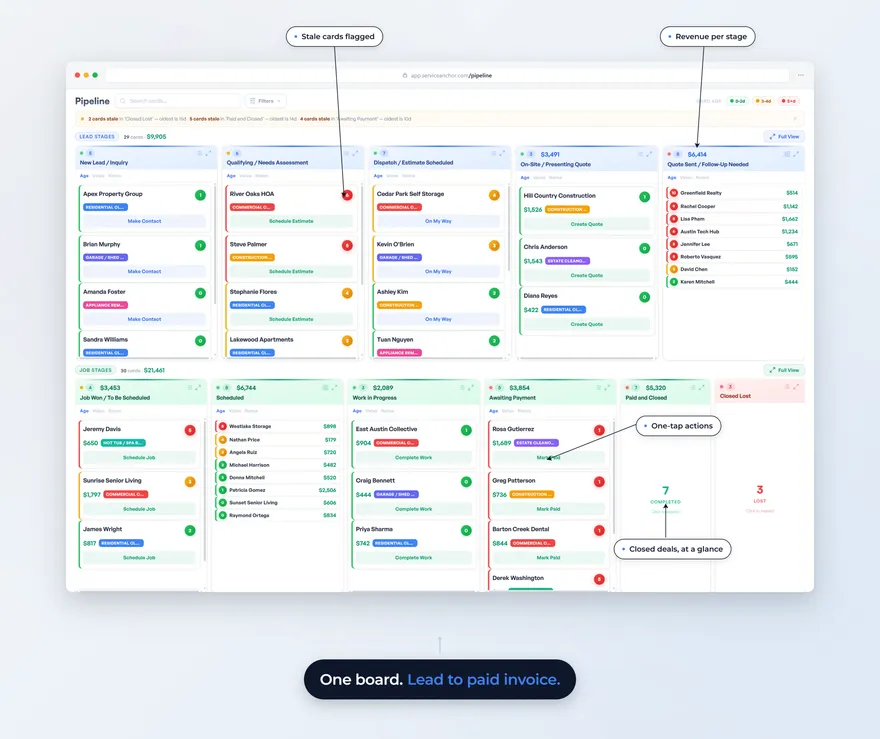
One line item in your plan is the system that turns the marketing section into the revenue section: how you catch, book, and follow up on every lead. Service Anchor is the lead-to-paid pipeline that books, quotes, and chases each junk removal lead automatically, preloaded for the trade, and founding pricing is $29 a month, everything included. It is the working-capital-friendly way to make sure the jobs your plan projects do not leak out of your text messages before you invoice them.
FAQ
How do I write a junk removal business plan?
Write a junk removal business plan by covering the SBA’s nine sections: executive summary, company description, market analysis, organization and management, service and product line, marketing and sales, funding request, financial projections, and appendix. Build the financial projection and startup-cost numbers first, because they anchor everything else, then write the one-paragraph executive summary last. For a one-truck start, the whole plan should fit on a few pages with real numbers rather than placeholders.
How much does it cost to start a junk removal business?
Starting a junk removal business costs roughly $12,000 to $40,000, with the truck driving most of the range. A used dump trailer behind a pickup you own sits at the low end, and a used or new box truck with a dump bed sits at the high end. Other line items include hauling equipment, the first insurance payment, LLC and permit fees, initial marketing, and a working-capital buffer for fuel and dump fees.
Is a junk removal business profitable?
A junk removal business can be profitable, with a conservative one-truck first year penciling to roughly $75,000 in owner take-home before taxes on about $120,000 in revenue. Profitability depends on keeping disposal costs, fuel, and slow-callback lost leads under control. Margins improve as you add a second truck and spread fixed costs, but the first-year owner-operator economics work because labor is your own and overhead is low.
Do I need a business plan to get a loan for a junk removal business?
Yes, most lenders and the SBA expect a business plan with financial projections before approving a loan for a junk removal business. The funding request and financial projections sections are the ones a lender reads most closely, so they need real startup costs, a first-year revenue projection, and a repayment explanation. Even if you are self-funding, the projection tells you whether the business clears your personal break-even.
How many jobs a week does a junk removal business need?
A one-truck junk removal business needs roughly 6 jobs a week at a $400 average ticket to reach about $120,000 in first-year revenue, which is a conservative, defensible target. Your actual break-even depends on your costs, but the math is simple to run: divide your monthly personal and business expenses by your average ticket to get the jobs per month you must book to survive, then build from there.
U.S. Small Business Administration, Write your business plan: official guidance on the nine sections of a traditional business plan and the lean startup plan alternative. https://www.sba.gov/business-guide/plan-your-business/write-your-business-plan
IBISWorld, Junk removal services and waste collection industry research: source for U.S. industry revenue above $10 billion, the highly fragmented market structure, and the under-5-percent share held by the largest player. https://www.ibisworld.com/united-states/industry/waste-collection-services/1506/
Last updated: June 2026. First publication: a fill-in junk removal business plan built on the SBA’s nine sections, with a real startup-cost table, a worked conservative first-year projection, and a market-analysis section grounded in the fragmented industry structure.