A moving lead costs between $4 and $163 in 2026, depending on who sells it, whether it’s shared, and whether it’s local or long distance. The cheapest published price is a local lead shared with up to three other movers; the top of the range is a managed Google Ads lead at the 90th percentile of one network’s published range, which counts ad spend only. This is for a 1 to 3 truck mover who gets pitched by a lead vendor every week and can’t compare the offers. As of October 6, 2026, Compare The Carrier publishes $15 for an exclusive local moving lead and $4 for a local lead shared with up to three other movers (Compare The Carrier, Best Moving Leads, read October 6, 2026). Below: prices by provider type, where the leads come from, shared versus exclusive, the cost-per-booked-move formula, and when buying pays.
- Published moving lead prices in 2026 run from $4 (a local lead shared with up to three other movers) to $163 (the top of 99 Calls’ managed Google Ads range). Moving.com, Thumbtack, Angi and Google’s Local Services Ads charge per lead but don’t publish a mover’s price.
- The number that matters is the cost per booked move: price divided by close rate. A $100 managed lead you close one time in four costs $400 a booking, which is most of what a two-bedroom local move earns.
- Most lead sources send the same customer to several movers: up to four on Moving.com, up to five in the first four hours on Thumbtack. On a shared lead, the mover who responds first usually has the best shot at the job.
- Long-distance leads cost more ($20 against $15 at one vendor) and book a bigger job: in our price book a studio is a $2,200 long-distance flat against $495 for the same studio moved locally. They’re often worth it, if you hold the authority the route needs and know your margin on the job.
- Buy leads when you need to fill a gap, enter a new market, or can answer in minutes. Fix response speed first if you can’t, because every source loses money through the same hole.
How much do moving leads cost in 2026?
Published moving lead prices run from $4 to $163 each in 2026 (the top figure is the 90th percentile of one network’s managed range), and three things explain the spread: whether the lead was generated by organic pages or by ad spend, whether it’s sold to one mover or several, and whether the move is local or long distance. Here’s the field, with every published figure read from the vendor’s own page on October 6, 2026.
| Provider type | Example | Published price | Exclusive? | Notes |
|---|---|---|---|---|
| Moving lead vendor, exclusive | Compare The Carrier | $15 local (under 100 miles), $20 long distance | Yes | “Base package price”; filters can change the rate |
| Moving lead vendor, shared | Compare The Carrier | $4 local, $6 long distance | Shared with up to 3 other movers | The cheapest published moving lead we found |
| Pay-per-lead network, organic | 99 Calls | $24.99 per organic lead, flat rate | Yes, per 99 Calls | From its own ranking pages |
| Pay-per-lead network, paid search | 99 Calls (Google Ads managed) | $48 to $163 per lead, 10th to 90th percentile over 12 months | Yes, per 99 Calls | Ad spend divided by leads delivered, per 99 Calls’ method; any management fee is on top. Your metro decides where you land |
| Quote-matching aggregator | Moving.com | Per lead, price not published | Shared with up to 4 movers | Credits for fake, invalid and out-of-area leads |
| Marketplace | Thumbtack | You set an exact price per lead for each service, inside a weekly budget | Up to 5 pros in the first 4 hours | Your weekly budget caps total spend; mover prices aren’t published |
| Google Local Services Ads | Per valid lead, price not published | One business per contact; customers can contact several | Moving is in the first phase of the move to Performance Max |
Two things the table can’t show. First, Angi doesn’t publish a mover’s lead price, and the ranges on third-party blogs carry no source, so we leave them out. Second, some “moving leads” aren’t inquiries: pre-mover data vendors such as MovingLeads.com sell homeowner names and addresses from recent property records, at $0.35 a record, for postcards. That’s a mailing list. Compare it with other mailing lists, never on the same line as a person asking for a quote.
Google’s Local Services Ads deserve their own note this year. Google started moving Local Services Ads into Performance Max in August 2026, and moving is named in the first phase; you still pay per valid lead rather than per click, and weekly budgets convert to daily ones (Google Ads Help, Local Services Ads migration, read October 6, 2026). The detail that matters for this post is in Google’s charging rules: a lead still counts as valid, and is still charged, if it came in outside your business hours or if the customer didn’t respond to your return call (Google Local Services Ads Help, read October 6, 2026). On LSA, slow follow-up is something you pay for. Our Local Services Ads guide covers the dispute and credit mechanics.
Where do moving leads actually come from?
Moving leads come from four places: a vendor’s own ranking pages, a vendor’s paid ads, quote-comparison forms that match one customer with several movers, and marketplaces where the customer picks from a list of pros. The source decides how many other movers got the same customer.
A network like 99 Calls ranks its own pages and runs ad accounts, then sells you the calls and forms they produce. Its organic leads are cheap because nobody paid for the click; its managed Google Ads leads cost what the clicks cost, plus whatever the management costs. A quote-matching site like Moving.com takes one form and sends it to as many as four movers. A marketplace like Thumbtack lets a customer contact up to five pros in the first four hours of their search (Thumbtack Help Center, Quality commitment, read October 6, 2026).
What the vendor pages leave out is how customers shop. A family moving next month often fills out more than one form. A comparison site, a marketplace and a mover’s own website or two is a normal evening of shopping. So the lead a vendor sold you as exclusive can still be in three other movers’ inboxes, because the customer created it three other times. “Exclusive” describes the vendor’s sale, not the customer’s behavior.
The owned channels sit outside all of this: your Google Business Profile, your reviews, referrals, and real-estate agents who send you their buyers. Our moving company marketing guide covers the order to build those in. Those keep producing after the work is done; a lead vendor stops the day the payments do.
What is the difference between shared and exclusive moving leads?
An exclusive moving lead is sold to one mover; a shared lead is sold to several at once, usually up to four, and your close rate on a shared lead depends mostly on being the first mover to respond. The price gap reflects that: Compare The Carrier sells the same kind of local lead at $15 exclusive or $4 shared with up to three others.
Cheap isn’t automatically worse. With illustrative close rates: a $4 shared lead you close one time in twelve costs $48 per booked move. A $15 exclusive lead you close one time in five costs $75. On those numbers the shared lead is the better buy, but only for a mover who answers in minutes. The same shared lead answered the next morning rarely closes, and then even $4 is a waste. Your close rate on it depends on your response more than on the lead.
The race is real and it’s old news. In the 2007 MIT and InsideSales.com lead response study, contacting a web lead within five minutes produced 21 times more qualifications than waiting 30 minutes (InsideSales.com, Lead Response Management Study results, October 2007). The study covered six companies and didn’t measure close rates, so read it as a direction, not a forecast. But every mover who has called back a shared lead an hour late knows how the call goes: “We already booked someone, thanks.”
What does a bought moving lead really cost per booked move?
Per booked move, a bought moving lead costs its price divided by your close rate, and it pays only when that number is smaller than what the move earns after crew, fuel, materials and overhead. That second number is the one most movers have never written down.
Here’s the shape, using the worked examples in our moving estimate template: a studio move with two movers for three hours is $495 at the starting rates and leaves about $258 after crew, fuel, materials and overhead; a two-bedroom with three movers for five hours is $910 and leaves about $450. Your own tickets will differ by market, and the cost of movers by crew size shows the range customers are quoted. The close rates below are illustrative; use your own.
- A $100 managed Google Ads lead, closed one time in four: $400 per booked move, before any management fee. On the two-bedroom, that leaves $50. On the studio, you lose $142 on every booking.
- A $24.99 organic network lead, closed one time in four: about $100 per booked move. The two-bedroom still leaves about $350.
- A $15 exclusive local lead, closed one time in five: $75 per booked move. Comfortable on either job.
- A $20 exclusive long-distance lead, closed one time in six: $120 per booked move. Our price book’s studio long-distance flat is $2,200 against a $950 cost estimate, about $1,250 before the overhead of a multi-day job. Even after that overhead, $120 is a small share, which is why long-distance leads look best on paper.
The sticker price moves the result less than two other numbers. The close rate is mostly response speed and follow-up. The size of the move is the other: a managed lead that’s a bad buy for a studio can be a fine buy for a four-bedroom house, which is why it’s worth filtering what you buy by move size when a vendor offers filters. For the same math on junk removal jobs, see the junk removal leads breakdown.
When does buying moving leads make sense?
Buying moving leads makes sense when you’re new in a market with no reviews yet, when there’s a gap in next month’s calendar you need filled, or when your shop answers every lead in minutes and follows up on the ones that go quiet. Whether they pay rarely comes down to the vendor. Don’t buy when callbacks wait until the crew is back in the yard, when follow-up means “I’ll remember to call them Thursday,” or when the lead is shared with three movers who answer faster than you.
Moving has two quirks worth planning around. Demand bunches up around the summer and the end of the month, so the gap-filling case is strongest in the months your calendar is thin and weakest when you’re already turning jobs away. And the long-distance lead is its own math: it costs a few dollars more and books a ticket several times larger, but only a shop with the authority the route needs (interstate registration under its USDOT number for state-line moves, your state’s license for in-state ones), set up to survey a home and write a binding or non-binding estimate, should buy them. Weigh them separately from local leads.
If you’re starting a moving company, get reviews on your Google Business Profile before you spend on leads. A customer who finds you on a lead site will look you up, and a profile with no reviews loses the job you paid for.
How do you stop wasting the leads you buy?
You stop wasting bought leads with three habits: answer within minutes, follow up on a schedule instead of from memory, and record where every lead came from so the formula above runs on real numbers. None of the three needs software, and all three are hard to keep up when you’re halfway up a staircase with a dresser. If you do want software for it, our moving company software comparison prices the options.
- Speed: whoever responds first usually has the best shot at a shared lead. If you’re on a job, a text back from your business number buys you the time a voicemail does not.
- Follow-up: a quote that goes quiet gets a text two days later and a call on day five. Write the schedule down and keep it.
- Source: write the vendor on every lead, and once a month count booked moves by vendor. A vendor you can’t count is a vendor you can’t cut.
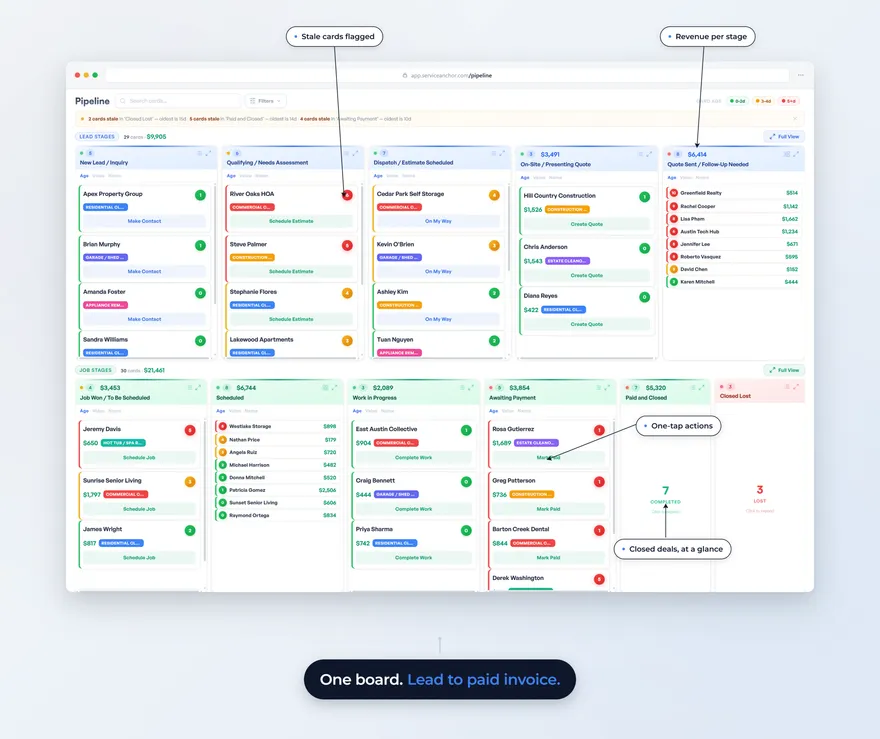
Service Anchor’s part starts once the lead is in, whoever sold it. Every lead you put on the board stays there from the first call to the paid invoice, and each lead carries its source, so the monthly count is a filter instead of a spreadsheet. A missed call from a new number gets a text back. The follow-up you set for two days after the quote sends itself. We don’t sell or generate leads. Our job is the part after the lead lands: the text back, the follow-up and the count.
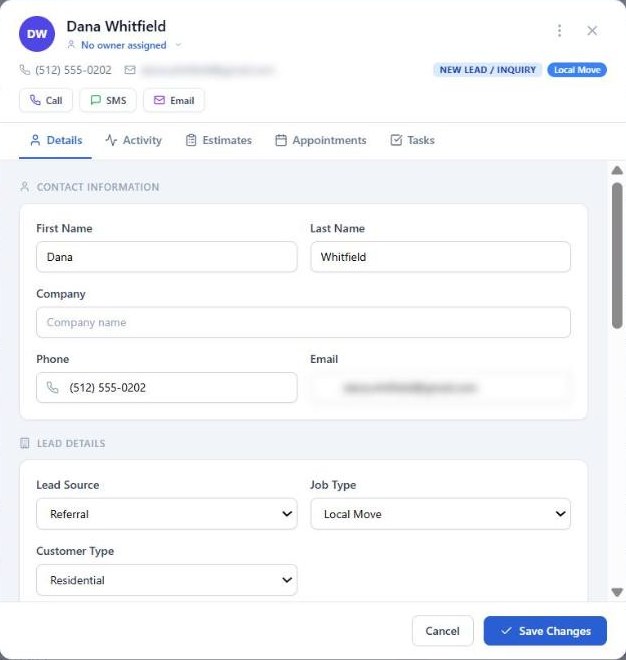
Every lead carries its source and job type, so counting booked moves by source is a filter, not a spreadsheet. Demo account; contact details blurred.
What to do next
- Write down what an average move earns after crew, fuel, materials and overhead, for a small local move and a long-distance one. That’s the number every lead price gets compared to.
- Run every vendor through the formula: price per lead divided by close rate. If you don’t know your close rate, track it by source for thirty days before you buy more.
- Fix response speed before you buy. If a lead can sit for an hour, every source loses money. If you want the board, the text-back and the source on every lead set up for movers, see Service Anchor’s setup for movers.
FAQ
How much do moving leads cost? Published prices in 2026: $4 for a local lead shared with up to three other movers, $15 local or $20 long distance for an exclusive lead (Compare The Carrier), $24.99 for an organic lead (99 Calls), and $48 to $163 for a managed Google Ads lead (99 Calls’ 10th to 90th percentile), all read October 6, 2026. Moving.com, Thumbtack, Angi and Google Local Services Ads don’t publish a mover’s per-lead price.
Where do moving companies get leads? From owned channels (Google Business Profile, reviews, referrals, real-estate agents) and bought ones: moving lead vendors, pay-per-lead networks, quote-comparison sites like Moving.com, marketplaces like Thumbtack, and Google Local Services Ads. The owned channels compound; the bought ones stop when the spending stops.
Are bought moving leads worth it? Yes when you’re new in a market, filling a slow-season gap, or able to answer every lead in minutes. No when callbacks are slow or follow-up runs from memory. Divide the lead price by your close rate: a $100 lead closed one time in four costs $400 per booked move, more than a studio move earns after costs.
What is the difference between shared and exclusive moving leads? An exclusive lead is sold to one mover; a shared lead goes to several, usually up to four. Shared leads cost less ($4 against $15 for the same kind of local lead at one vendor), and whoever responds first usually has the best shot. Customers often fill out more than one form, so even an exclusive lead can be competitive.
Are long-distance moving leads worth more? Often, if you’re set up for them. They cost a little more ($20 against $15 exclusive at one vendor) and book a ticket several times larger, with long-distance flats starting around $2,200 for a studio in our price book. You also need the authority the route needs (interstate registration under your USDOT number for a state-line move), and an interstate move needs a survey and a written binding or non-binding estimate.
How do I get more moving jobs without buying leads? Build the owned channels: a complete Google Business Profile with steady reviews, referrals from past customers, and real-estate agents who send their buyers. Answer every inquiry in minutes and follow up on every quote. Get the reviews before the bought leads: a customer who finds you anywhere will look you up.
Every lead price above came from the vendor’s own page on October 6, 2026. Prices change without notice, so run the formula on the number in your own quote.
Last updated: October 2026. First publish; Compare The Carrier, 99 Calls, Moving.com and Thumbtack pricing and terms, Google’s Local Services Ads charging and migration documentation, and the 2007 MIT and InsideSales.com lead response study, read October 6, 2026.