
A moving estimate template is a price book, not a blank form. Local moves are crew rate times hours, plus a truck and travel fee, plus the accessorials that apply at each address; long-distance moves are flats by bedroom count. This is for an owner running one to three trucks who quotes local moves by phone and loses margin whenever the stairs or the long carry come up on the day. As a starting point, three movers and a truck are $155 an hour, a two-bedroom runs four to five hours, and the truck and travel fee is $135 (Service Anchor moving price book, 54 items, October 2026, the product’s default prices). Below: what goes in an estimate, how to size the crew, the full price book, the accessorial questions, binding versus non-binding, the cost check, and five lines for saying the number.
- Most pages ranking for “moving estimate template” are blank forms. What you actually need is the price book: 54 lines covering crew rates, long-distance flats, packing, specialty items and the accessorials that stack.
- Local moves price as crew rate times hours plus a flat truck and travel fee. Starting points: 2 movers and a truck $120 an hour, 3 movers $155, 4 movers $195, 5 movers $240, travel fee $135.
- Moving quotes go wrong in two places: the crew was sized wrong on the phone, or an accessorial at one of the two addresses never came up. Each access and handling fee has a question that catches it before moving day.
- Interstate moves follow federal rules: a physical survey unless the customer waives it in writing, a binding or non-binding written estimate, and two FMCSA documents handed over with it.
- The download is the same price book as a two-page PDF with a crew card and a spreadsheet with a quote builder and a cost-plus worksheet. It’s also the price book that loads when you pick moving in Service Anchor.
What goes in a moving estimate?
A moving estimate has seven parts. They are the crew size and expected hours, the truck and travel fee, the accessorials at the origin and at the destination, the coverage the customer picked, any packing, the specialty items priced one by one, and for long distance, the flat by home size plus mileage. Add the two addresses, the date, what isn’t included and your terms, and both sides have something to point at on moving day. Terms means your minimum hours, whether you bill in 15- or 30-minute steps, any deposit, and your cancellation window.
The order matters because of how a move goes wrong. A quote that says “3 movers, about 5 hours” gets argued with when the destination turns out to be a third-floor walk-up nobody mentioned. A quote that says “3 movers and a truck at $155 an hour, 4 to 6 hours expected; destination is a third-floor walk-up, two flights, one past the first, so $50 for stairs” does not. Our general estimate template for home service businesses covers the document fields; this page is the moving price book that goes in it. If your customer is asking what a move costs rather than how to price one, the moving cost guide is the homeowner side of the same math.
How many movers for which home, and how long?
Two movers handle a studio or one-bedroom apartment in three to four hours. Three movers handle a two- or three-bedroom apartment or condo in four to six hours, and four movers handle a three- or four-bedroom house in six to eight. Five movers are for a large home or a tight timeline, at eight hours and up. Hours are door-to-door crew time; the travel fee covers the trip from the yard and back.
| Crew | Rate (starting point) | Typical home | Typical hours |
|---|---|---|---|
| 2 Movers and Truck | $120 an hour | Studio or 1-bedroom apartment | 3 to 4 |
| 3 Movers and Truck | $155 an hour | 2- or 3-bedroom apartment or condo | 4 to 6 |
| 4 Movers and Truck | $195 an hour | 3- or 4-bedroom house | 6 to 8 |
| 5 Movers and Truck | $240 an hour | Large home or tight timeline | 8 and up |
The guide breaks down at the edges, and the phone call is where you catch that. A two-bedroom with a full garage and a basement is a three-bedroom job. A one-bedroom on the fifth floor with no elevator is a three-mover job, because two people carrying for four hours up and down stairs is slower and riskier than three. Ask about the garage, the basement, the shed and the floors at both ends before you name a crew. The mover cost by crew size page shows the same tiers from the customer’s side, which helps when someone has already been quoted elsewhere.
What is in this moving estimate template?
The moving price book below has 54 line items in eight sections. The prices are national starting points, the defaults Service Anchor loads for the trade, with a Yours column for your own number. Adjust up 15 to 25 percent in high-cost metros and down 10 to 15 percent in rural markets. A line marked fee stacks on top of a price when it applies; a line marked upgrade is the customer’s choice.
Local move
| Item | Suggested | Yours |
|---|---|---|
| 2 Movers and Truck (per hour) | $120 | |
| 3 Movers and Truck (per hour) | $155 | |
| 4 Movers and Truck (per hour) | $195 | |
| 5 Movers and Truck (per hour) | $240 | |
| Additional Mover (upgrade, per hour) | $55 | |
| Second Truck (upgrade) | $175 |
Long distance move
| Item | Suggested | Yours |
|---|---|---|
| Studio or 1 Bedroom | $2,200 | |
| 2 Bedroom | $3,400 | |
| 3 Bedroom | $4,800 | |
| 4+ Bedroom | $6,500 | |
| Mileage, per mile beyond 100 (fee) | $1.10 | |
| Expedited or Guaranteed Delivery Window (upgrade) | $650 |
Packing and unpacking
| Item | Suggested | Yours |
|---|---|---|
| Full Packing Service, Whole Home | $700 | |
| Partial Packing, Kitchen or Fragile Only | $325 | |
| Unpacking Service | $475 | |
| Packing Labor (per packer hour) | $65 |
Labor-only loading and unloading
| Item | Suggested | Yours |
|---|---|---|
| Loading Only, 2 Movers (per hour) | $110 | |
| Unloading Only, 2 Movers (per hour) | $110 | |
| Loading Only, 3 Movers (per hour) | $155 | |
| Container or POD Load or Unload, 2 Movers (per hour) | $115 | |
| Rental Truck Load Securing and Tie-Down (upgrade) | $75 |
Specialty and heavy items
| Item | Suggested | Yours |
|---|---|---|
| Upright Piano | $400 | |
| Baby Grand or Grand Piano | $800 | |
| Pool Table: disassemble, move, reassemble | $550 | |
| Gun Safe or Floor Safe, under 600 lbs | $450 | |
| Gun Safe or Floor Safe, 600 lbs and over | $700 | |
| Hot Tub or Spa | $650 | |
| Rigging or Hoisting, balcony or window | $450 | |
| Custom Crating, artwork or antiques (upgrade) | $275 |
Commercial and office move
| Item | Suggested | Yours |
|---|---|---|
| Crew of 4 (per hour) | $260 | |
| Crew of 6 (per hour) | $380 | |
| Cubicle or Workstation Disassembly and Reassembly (per item) | $125 | |
| File or Records Move (per bin) | $12 | |
| Certificate of Insurance, Additional Insured Endorsement (fee) | $50 | |
| IT Equipment Disconnect and Reconnect (upgrade, per item) | $95 |
Storage move
| Item | Suggested | Yours |
|---|---|---|
| Move Into Storage | $375 | |
| Move Out of Storage | $375 | |
| Storage-in-Transit (per day) | $45 | |
| Warehouse Handling In or Out (upgrade) | $150 | |
| Climate-Controlled Storage (upgrade, per month) | $185 |
Accessorials and coverage, any move
| Item | Suggested | Yours |
|---|---|---|
| Truck and Travel Fee (every truck job) | $135 | |
| Fuel Surcharge (fee) | $60 | |
| Stairs, per flight beyond the first, at each end (fee) | $50 | |
| Long Carry, over 75 ft from the truck (fee) | $75 | |
| Elevator or High-Rise Access (fee) | $75 | |
| Shuttle Truck, limited access (fee) | $350 | |
| After-Hours, Weekend or Holiday (fee) | $150 | |
| Parking Permit or Street Reservation (fee) | $75 | |
| Heavy Item Handling, over 300 lbs (fee, per item) | $100 | |
| Appliance Servicing (fee, per appliance) | $85 | |
| Waiting Time (fee, per crew hour) | $95 | |
| Third-Party Service, billed through (fee) | $150 | |
| Full-Value Protection (upgrade) | $90 | |
| Furniture Disassembly and Reassembly (upgrade, per item) | $50 |
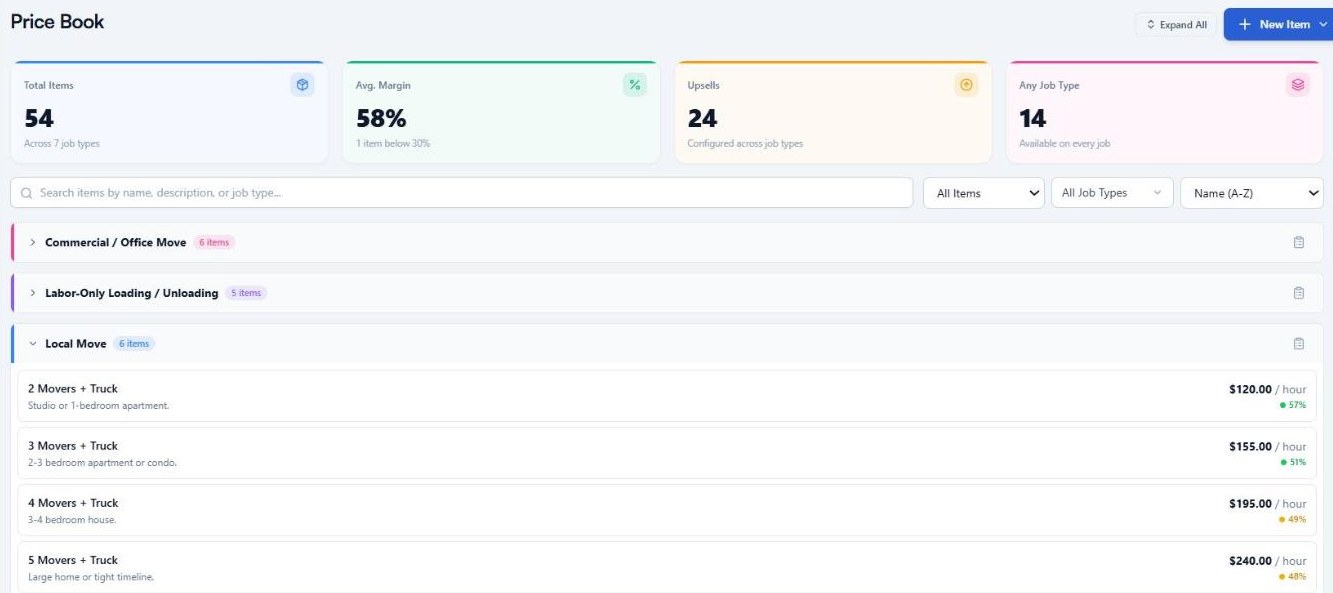
The moving price book as it loads in Service Anchor: the same crew rates as the table above, each with its margin from price and cost. Demo account.
Which accessorials stack, and what question tells you each one applies?
All of them stack: each one that applies goes on top of crew time and the travel fee, and most apply at each address. The access and handling fees each have one question that tells you whether they apply, and asking all of them on the first call is what keeps the moving-day bill from turning into an argument. Most of them apply per address, so ask each question twice: once for where the stuff is and once for where it’s going.
| Accessorial | Price | The question that catches it |
|---|---|---|
| Stairs | $50 a flight past the first, each end | “What floor is it at each address, and is there an elevator?” |
| Long carry | $75 | “How close can the truck park to the door at each end?” |
| Elevator or high-rise | $75 | “Does the building need the elevator reserved, and who books it?” |
| Shuttle truck | $350 | “Can a full-size truck get down the street and turn around?” |
| Parking permit | $75 | “Will we need a permit or a reserved spot on the street?” |
| Heavy item | $100 an item | “Anything over 300 pounds that isn’t a piano, safe, pool table or hot tub: a treadmill, an armoire, a marble tabletop?” |
| Appliance servicing | $85 an appliance | “Is the washer, dryer or fridge staying, and does it need disconnecting?” |
| Waiting time | $95 a crew hour | “Will the keys be ready, and does the building need our insurance certificate first?” (the $50 certificate line covers issuing it) |
| After-hours | $150 | “What day and start time do you need, and is there any flexibility?” |
Pianos, safes, pool tables and hot tubs have their own specialty lines in the book; price those instead of the $100 heavy-item fee, not on top of it.
Waiting time is the line operators forget most. A crew standing in a lobby because the elevator wasn’t reserved, the keys weren’t ready, or the building never approved the certificate of insurance is billable time, and it’s only collectable if it was on the quote. The same goes for the shuttle: when the big truck can’t get down the street, every load gets handled twice, and the customer will only accept that line if you asked about the street before moving day.
What changes for a long-distance move?
Long distance changes the price first: it becomes a flat by home size plus mileage instead of an hourly rate. And on an interstate move, federal rules decide the estimate itself: binding or non-binding, in writing, with set documents. The flats in the book are a starting point for that estimate, not a substitute for seeing the house. Quoting a bedroom flat for an agreed inventory is a binding estimate; a non-binding estimate needs your weight-based tariff.
For an interstate move, the mover must survey the goods, on site or by video, and give a written estimate based on that survey. The customer can waive the survey, but only in writing, signed before loading (49 CFR 375.401 and Appendix A, eCFR). The estimate has to say which kind it is:
- Binding: an agreed total for the quantities and services on the estimate. You may charge for writing one.
- Non-binding: your reasonably accurate estimate of the cost, with final charges based on actual weight and your tariff. You may not charge for writing one, and at delivery the customer can’t be required to pay more than 110 percent of it (49 CFR 375.405).
With the written estimate, the mover also has to give the customer two documents, “Ready to Move?” and “Your Rights and Responsibilities When You Move,” as copies or as a link to FMCSA’s page (FMCSA, Consumer Rights and Responsibilities; 49 CFR 375.213).
Coverage is where interstate and local moves differ most. On an interstate move, Full Value Protection, which covers replacement value, is the coverage the customer gets unless they waive it in writing; the waiver option is released value at 60 cents per pound per article, which costs them nothing extra (49 CFR 375.201, 375.303 and Appendix A). So on an interstate quote, price full-value protection in and offer released value as the written waiver, rather than selling full value as an add-on. On a local move inside one state, your state’s rules decide the basic coverage, and the book’s $90 full-value line is the upgrade to say out loud: a customer who assumes their grandmother’s dresser is covered at replacement value is the one who leaves the one-star review.
The mileage line covers distance past 100 miles at $1.10 a mile, and the guaranteed delivery window is a $650 upgrade because it means the truck can’t wait to fill. Our moving contract template covers the document that comes after the customer approves the estimate.
Does your rate cover your costs?
Your rate covers your costs when the quoted total is above the floor from the cost-plus worksheet: variable costs plus overhead, divided by one minus your target margin. Here it’s on three local moves, the same three the spreadsheet in the download runs, with the assumptions stated.
Assumptions: labor at $22 an hour per mover in wages, with payroll tax and workers’ comp counted in overhead. That’s a working rate above the May 2025 national median of $19.35 an hour for hand laborers and material movers, the federal wage category that includes movers (U.S. Bureau of Labor Statistics, OEWS, SOC 53-7062, May 2025). Overhead at $4,200 a month across 60 jobs, or $70 a job, and a full eight-hour day counts as two job slots. Target margin 45 percent. Crew hours are mover hours: two movers for three hours is six.
- A studio, 2 movers, 3 hours: $20 fuel, $15 materials, 6 crew hours at $22 ($132). Variable costs $167, plus $70 overhead, divided by 0.55: a floor of about $431. The book says $120 times 3 plus the $135 travel fee, $495, which clears the floor by $64.
- A two-bedroom, 3 movers, 5 hours: $30 fuel, $30 materials, 15 crew hours ($330). Variable costs $390, plus $70, divided by 0.55: about $836. The book says $155 times 5 plus $135, $910. A margin of about 49 percent.
- A four-bedroom house, 4 movers, 8 hours: $40 fuel, $60 materials, 32 crew hours ($704). Variable costs $804, plus $140 overhead for the full day, divided by 0.55: about $1,716. The book says $195 times 8 plus $135, $1,695. That’s $21 under the floor.
The four-bedroom is where the margin leaks, because the overhead of a full day and the fuel of a big truck land on a single ticket. The book’s $60 fuel surcharge is yours to apply, and a full day in the big truck is the obvious place; with it the job comes to $1,755, which clears the floor. The other fix is a higher four-mover rate. Leave both alone and you work the hardest day of the week a little under your target margin. The spreadsheet in the download runs this math with your numbers and flags any quote that lands under the floor.
How do you say the number out loud?
Say what the price covers before the number, because a lot of moving-day fights come from a customer who didn’t know the stairs or the travel fee were separate, not from the hourly rate. These are the five lines from the crew card in the download; swap in your own numbers from the Yours column.
- “Three movers and the truck are $155 an hour, and a two-bedroom usually runs four to five hours. There’s a flat $135 for the truck to get to you and back, and that’s the whole bill unless something comes up that isn’t on our list.”
- “Stairs past the first flight are $50 a flight, at each end. Tell me the floors now and I’ll put them in the quote so nothing surprises you on moving day.”
- “A piano, a safe or a hot tub is its own line. Send me a photo and I’ll price it before moving day.”
- “Basic coverage is included. Full-value protection is $90 if you want the replacement cost covered instead.”
- “If the day runs shorter than I quoted, you pay the shorter time.”
The coverage line is for local moves; on an interstate move, full-value protection is the default unless the customer waives it in writing. The last line is the one customers remember, because hourly pricing only feels fair when it can go down as well as up.
What to do next
- Set your market factor first. Around 1.2 for a big-city market, 0.9 for rural, 1.0 if you aren’t sure. Then change a line only where you know your market better than the starting point.
- Run your longest common job through the cost-plus check. Often it’s the four-bedroom house, and that’s the job most likely to sit under the floor.
- Ask the accessorial questions on every first call, for both addresses. Write the answers on the quote. If you’re starting a moving company, make the question list the first thing anyone answering your phone learns.
- Quote from the book, not from memory. A moving estimate template only works if everyone who quotes uses it, which is what price book software is for. Our ranking of moving company software covers the tools that hold a price book like this one, and our moving estimate software comparison lines up their published prices. If you want it already loaded, with the estimate carrying both addresses and the two FMCSA documents set up for your long-distance moves, see how Service Anchor sets up for moving.
FAQ
How do you write a moving estimate? Size the crew from the home (bedrooms, floors, garage and basement), multiply the crew rate by the expected hours, add the truck and travel fee, then add the accessorials that apply at each address: stairs, long carry, elevator, shuttle, heavy items, appliances. List coverage and packing as the customer’s choices, state what isn’t included, and total it. As a starting point, three movers and a truck are $155 an hour with a $135 travel fee.
How do movers calculate an estimate? Local movers multiply an hourly crew rate by the expected hours and add a flat travel fee plus accessorials. Long-distance movers quote a flat by home size or by weight, plus mileage. For interstate moves, federal rules require a physical survey, on site or by video, unless the customer waives it in writing, and a written binding or non-binding estimate.
What is the difference between a binding and a non-binding moving estimate? A binding estimate is an agreed total for the items and services listed, and the mover may charge for writing it. A non-binding estimate is the mover’s reasonably accurate estimate with final charges based on actual weight; it must be free, and on an interstate move the customer can’t be required to pay more than 110 percent of it at delivery (49 CFR 375.405).
How many movers do I need for a 3-bedroom house? Four movers and a truck for a three-bedroom house, usually six to eight hours. A three-bedroom apartment or condo is usually a three-mover job at four to six hours. A full garage, a basement or several flights of stairs at either end pushes it up a crew size.
What are accessorial charges in moving? Accessorials are charges for conditions at the addresses, not the move itself: stairs past the first flight, a long carry from the truck, elevator access, a shuttle truck where a full-size truck can’t reach, heavy items over 300 pounds, appliance servicing, parking permits and waiting time. As starting points, stairs are $50 a flight at each end and a long carry over 75 feet is $75.
Prices on this page are the starting points in the Service Anchor moving price book as of October 2026, the defaults the product loads for the trade. Adjust for your market, and check the cost-plus floor before you quote under one. Federal rules cited apply to interstate moves; local moves follow your state’s rules.
Last updated: October 2026. First publish; price book from the Service Anchor moving setup, 49 CFR Part 375 (eCFR, current as of October 1, 2026), FMCSA’s consumer rights page and BLS May 2025 wage data, read October 6, 2026.