A good estimate template for a home service business needs a clear set of fields: your business info, the customer and job address, an itemized list of work and prices, a subtotal and total, a deposit line, an expiration date, an approval instruction, and clear terms. This template is for the one-truck-to-five-truck owner who quotes from a texts app or a generic Word file and loses jobs to silence. The fields that decide whether an estimate closes are the ones the template mills leave out: an expiration date, a deposit line, and a one-tap way to say yes. The FTC advises customers to get every job estimate in writing with a description of the work, materials, a completion date, and a price, so a clean written estimate is also what a careful customer expects. Below is the full template you can copy, the field-by-field reason each one closes jobs, and three filled examples for junk removal, moving, and pressure washing.
- A trade estimate is a sales document, not a printable form. The fields that close it are an expiration date, a deposit line, good-better-best options, and a one-line approval instruction.
- Most generic templates skip those fields, which is why so many estimates die: the customer has no deadline, no reason to commit, and no easy way to say yes.
- Copy the template below into your tool of choice. It works for any trade, and three filled examples (junk removal, moving, pressure washing) show the real numbers in place.
- Set an expiration date by default (7 days is common) and send the estimate the same day you see the job. Speed and a deadline close more work than a lower price.
What should a job estimate template include?
A job estimate template should include these core elements: your business details, the customer’s details, the job address, an itemized scope of work with prices, a subtotal, a deposit, a total, an expiration date, an approval instruction, plus an estimate number and a terms line. The IRS also expects you to keep records of the sales documents your business generates, so a consistent estimate format does double duty as a clean paper trail. Here is the complete template, ready to copy:
| Section | What goes in it |
|---|---|
| Business info | Your company name, phone, email, license number if your trade requires one |
| Customer info | Name, phone, email |
| Job address | The service location (not the billing address, they are often different) |
| Estimate number and date | A simple sequential number and the date issued |
| Scope of work | Itemized lines: quantity, description, price per line |
| Subtotal | Sum of the line items |
| Deposit | The amount due to book, and what it secures |
| Total | The full price, with any surcharge or discount shown |
| Expiration date | The date this price is good until (7 days is common) |
| Approval | “Reply YES to this text or click approve to book your date” |
| Terms | Payment due on completion, deposit policy, what could change the price |
That is the whole thing. The difference between this and the file you download from a template mill is not the layout. It is the four fields below that turn a price quote into a booked job.
Which estimate fields actually close jobs?
The estimate fields that actually close jobs are the expiration date, the deposit line, good-better-best option tiers, and the approval instruction. A price alone gives the customer no reason to act today, so the estimate sits. Each of these fields removes a specific reason the job stalls:
- Expiration date. Without a deadline, an estimate has no urgency and the customer files it away. “This price is good for 7 days” gives them a reason to decide now and protects you from honoring a quote weeks later when your costs have moved.
- Deposit line. A deposit turns a maybe into a commitment. Asking for a small deposit to hold the date keeps your schedule full of real jobs instead of tentative ones, and it filters out the price-shoppers who were never going to book.
- Good-better-best options. One price is take-it-or-leave-it. Three tiers (the basic scope, a recommended scope, and a do-it-all option) let the customer choose how much to spend instead of whether to spend, which raises both your close rate and your average ticket.
- Approval instruction. The single most-skipped line. “Reply YES to book” tells the customer exactly how to say yes. Without it, “looks good” sits in a text thread and never becomes a date on your calendar.
Picture the estimate that died. You quoted a $475 garage cleanout, the customer said “looks good,” and then nothing, because there was no expiration, no deposit ask, and no clear next step. The price was never the problem. The missing fields were.
What does a junk removal estimate look like?
A junk removal estimate prices the job by load size and lists any surcharges as their own lines so the customer sees exactly what they are paying for. Here is a filled example for a Saturday half-truck garage cleanout, using rates from our junk removal price sheet:
| Line | Detail | Price |
|---|---|---|
| Base service call | Dispatch and first 60 minutes | $75 |
| Half-truck haul | Up to half of a 15 cu yd truck | $345 |
| Weekend surcharge | Saturday service, 25% | +$105 |
| Disposal (pass-through) | Transfer station fee, billed at cost | ~$65 |
| Total | ~$590 | |
| Deposit to book | Holds your Saturday slot | $50 |
| Expires | Price good for 7 days |
The pass-through disposal line is what builds trust here: the customer sees you are not marking up the dump fee, you are passing it through. That transparency closes price-sensitive cleanout jobs.
What does a moving estimate look like?
A moving estimate prices the job by crew size and hours, with the truck fee, materials, and any stair or access surcharge on their own lines. Here is a filled example for a three-bedroom local move with one flight of stairs, using rates from our guide on how much moving costs:
| Line | Detail | Price |
|---|---|---|
| Crew labor | 3 movers x $140/hr x 7 hrs (estimated) | $2,940 |
| Truck fee | Flat | $100 |
| Packing materials | 30 boxes, mattress bags | $150 |
| Stair surcharge | One flight above ground, $50/flight | $50 |
| Estimated total | Final billed at actual hours | $3,240 |
| Deposit to book | Holds your move date | $200 |
| Expires | Price good for 7 days |
Moving estimates carry one extra honesty requirement: hourly jobs should say “estimated total, final billed at actual hours” so the customer is not surprised. The crew-hour formula is (crew size x hourly rate x hours) + truck fee + materials + surcharges.
What does a pressure washing estimate look like?
A pressure washing estimate prices the job by square footage and surface type, because a soft-wash vinyl wall and a concrete driveway clean at very different rates. Here is a filled example for a single-story vinyl house wash, using rates from our guide on how much pressure washing costs:
| Line | Detail | Price |
|---|---|---|
| House wash | 2,000 sq ft vinyl soft wash at $0.15/sq ft | $300 |
| Chemicals | Sodium hypochlorite and surfactant | $35 |
| Total | $335 | |
| Deposit to book | Holds your service date | $35 |
| Expires | Price good for 7 days |
The square-foot rate is the line that prevents disputes. When the customer sees the rate per square foot and the measured area, the price reads as a calculation, not a guess. The formula is (sq ft x rate per sq ft x surface multiplier) + chemical cost + surcharges.
What to do next
Copy the template above into whatever you quote from today, set a 7-day expiration as your default, add a deposit line, and send the estimate the same day you see the job. The single highest-return habit is speed: the operator who sends a clean, professional estimate within the hour usually beats the one who sends a lower price two days later. And when a customer goes quiet after you send it, a short quote follow-up sequence is what turns the silence back into a booked job. After the customer approves, the work order tells the crew exactly how to run the job, and the contractor invoice closes it and collects payment, so set all three up together. To get the approved estimate moving toward a booked date, an on-my-way text on the day of service keeps the customer in the loop.
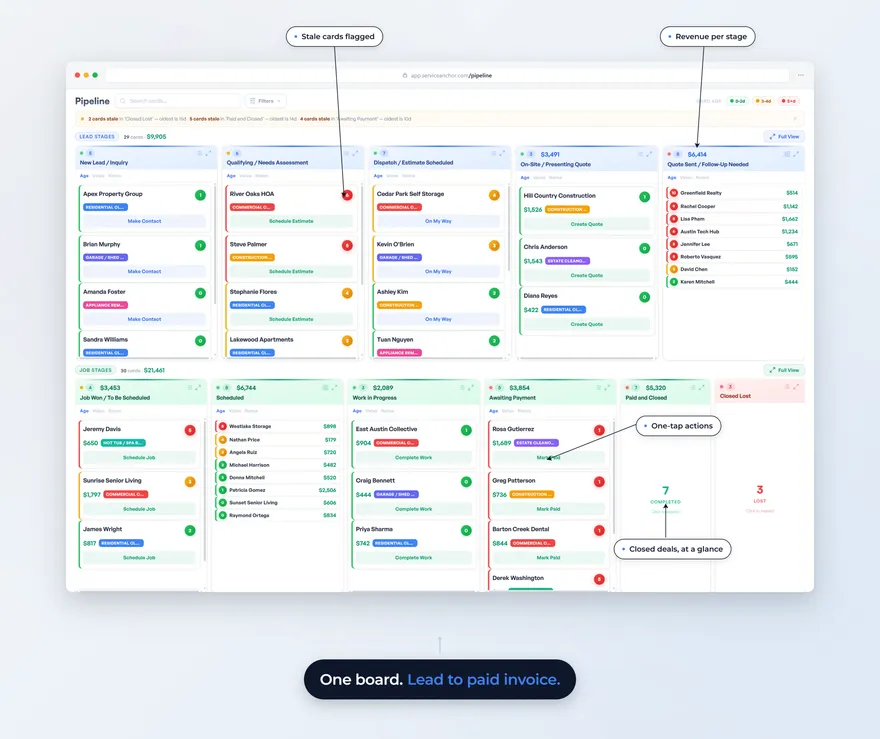
If you would rather not rebuild this in a Word file every time, Service Anchor generates line-item estimates from a price book preloaded for your trade, with a customer approve-or-decline link built in, and tracks each one through the pipeline to the paid invoice. Founding pricing is $29 a month, everything included. If you run a junk removal operation, the estimate above is already loaded as a template on day one.
FAQ
What is the difference between an estimate and a quote?
An estimate is an approximate price that can change if the scope or conditions change, while a quote is usually a firm, fixed price. In the trades the words are often used interchangeably, but the safe practice is to label hourly or variable work as an “estimate” with a note that the final price is billed at actual hours or volume, and label fixed-scope work as a “quote.” Either way, put an expiration date on it.
How long should an estimate be valid?
A home service estimate is commonly valid for 7 to 30 days, with 7 days being a good default for small jobs. A short expiration protects you from honoring a price after your fuel, disposal, or labor costs have moved, and it gives the customer a reason to decide instead of sitting on the quote. State the expiration date clearly on the estimate itself.
Should I charge a deposit on an estimate?
Charging a deposit to book is a strong practice for trade services, because it turns a maybe into a committed job and keeps your schedule full of real work. A modest deposit (often $35 to $200 depending on job size) also filters out price-shoppers and covers your scheduling risk. State plainly what the deposit secures and whether it applies to the final total.
How do I write an estimate for a job?
Write an estimate by listing your business and customer details, the job address, an itemized scope of work with a price per line, a subtotal and total, a deposit amount, an expiration date, and a clear approval instruction. Keep the line items in plain language the customer understands, show any surcharge as its own line, and send it the same day you see the job. The FTC recommends customers get this in writing, so a clean format also builds trust.
Are estimates legally binding?
An estimate is generally not a binding contract by itself, but it can become part of one once the customer approves it and work begins, and some states regulate written estimates for home improvement work. To stay clear, label variable work as an estimate, state what could change the price, and keep the approved version on file. Check your state’s consumer-protection rules, since requirements for written estimates vary.
U.S. Federal Trade Commission, Consumer Advice on home improvement: source for the guidance that customers should get a written estimate including a description of the work, materials, a completion date, and the price, and get it in writing even when the state does not require it. https://consumer.ftc.gov/articles/how-avoid-home-improvement-scam
U.S. Internal Revenue Service, Recordkeeping for small businesses: source for the guidance that businesses should keep the supporting documents their sales generate to substantiate income. https://www.irs.gov/businesses/small-businesses-self-employed/recordkeeping
Last updated: June 2026. First publication: a trade-service estimate template with the close-driving fields (expiration, deposit, option tiers, approval) explained, plus filled junk removal, moving, and pressure washing examples with real rates.