A contractor invoice template for a trade service business needs the job address, deposit reconciliation from the estimate, line items a homeowner can read, payment due on completion, and a review-ask footer, which is a different document from the freelancer invoice most templates give you. This is for the one-truck-to-five-truck owner who invoices from a generic app shaped for office work and wants to get paid on the driveway, not in 30 days. Getting paid faster matters: a 2025 QuickBooks report found 56 percent of small businesses are owed money from unpaid invoices, averaging $17,500 each, and nearly half have invoices more than 30 days overdue. The fix starts with an invoice built for a truck-based trade. Below is the full template you can copy, the fields that make it different from a freelancer invoice, and filled examples for junk removal and moving.
- A trade invoice is not a freelancer invoice. The customer is a homeowner in their driveway, payment is due on completion (not net-30), and the deposit from the estimate needs reconciling.
- The five fields that matter: job address (not billing address), deposit credit, on-completion terms, plain-language line items, and a review-ask footer.
- The review-ask footer is the line almost every operator forgets. Asking for a Google review on the paid invoice feeds the reviews that win your next job.
- Copy the template below, send it the moment the job is done with a card payment link, and you collect on the driveway instead of chasing a check for a month.
What should a contractor invoice include?
A contractor invoice should include your business details, the customer and job address, an itemized list of completed work, the subtotal, any deposit already paid, the balance due, the payment terms, and how to pay. The IRS expects you to keep the sales documents your business generates, so a consistent invoice format is also your income record. Here is the full template, ready to copy:
| Section | What goes in it |
|---|---|
| Business info | Company name, phone, email, license number if your trade requires one |
| Invoice number and date | Sequential number and the date the job was completed |
| Customer info | Name, phone, email |
| Job address | Where the work happened (not the billing address) |
| Completed work | Itemized lines in plain language: what you did and the price |
| Subtotal | Sum of the line items |
| Deposit credit | The deposit already paid on the estimate, subtracted |
| Balance due | What the customer owes now |
| Payment terms | “Due on completion,” accepted methods, any late fee |
| How to pay | Card link, the same-day ask, or your payment details |
| Footer | A short thank-you and a request for a Google review |
The layout is ordinary. The difference is in five fields, covered next, that the freelancer templates ranking on this search were never built to carry.
How is a trade-service invoice different from a freelancer invoice?
A trade-service invoice differs from a freelancer invoice in five ways: it uses the job address instead of a billing address, it credits the deposit from the estimate, it bills on completion instead of net-30, it uses homeowner-readable line items, and it ends with a review request. The templates ranking for “contractor invoice template” are mostly built for a 1099 worker billing a company: hours, rate, net-30, remit-to. A junk hauler or mover is billing a homeowner standing in their driveway, which changes the document:
- Job address, not billing address. The work happened at a specific service location, and that is what goes on the invoice. For a trade, the two addresses are often different, and the job address is the one that matters for your records and any dispute.
- Deposit reconciliation. If you collected a deposit on the estimate, the invoice has to credit it and show the remaining balance. Skipping this is how operators accidentally double-charge or undercharge.
- Pay on completion, not net-30. A homeowner is not a corporate accounts-payable department. The invoice should say “due on completion,” because the moment to collect is when the truck is still in the driveway and the customer is happy.
- Homeowner-readable line items. “Haul fee, disposal fee, weekend surcharge” beats internal codes. The customer who understands the line items pays without a phone call.
- Review-ask footer. The single most-skipped field. A one-line review request on the paid invoice turns a finished job into the review that wins your next one. None of the office templates think to include it.
What does a junk removal invoice look like?
A junk removal invoice lists the completed haul by load size, shows the pass-through disposal fee, credits any deposit, and states the balance due on completion. Here is a filled example for a Saturday half-truck garage cleanout, using rates from our junk removal price sheet:
| Line | Detail | Amount |
|---|---|---|
| Base service call | Dispatch and first 60 minutes | $75 |
| Half-truck haul | Half of a 15 cu yd truck, completed | $345 |
| Weekend surcharge | Saturday service, 25% | $105 |
| Disposal (pass-through) | Transfer station fee, billed at cost | $65 |
| Subtotal | $590 | |
| Deposit credit | Paid at booking | -$50 |
| Balance due on completion | $540 |
The pass-through disposal line and the deposit credit are what make this read as honest. The customer sees the dump fee billed at cost and the deposit they already paid subtracted, so there is nothing to argue about and they pay on the spot.
What does a moving company invoice look like?
A moving company invoice bills the actual crew hours worked, adds the truck fee and materials, credits the deposit, and collects on completion. Because moving is usually hourly, the invoice shows the real hours, not the estimate. Here is a filled example for a one-bedroom local move, using rates from our guide on how much moving costs:
| Line | Detail | Amount |
|---|---|---|
| Crew labor | 2 movers x $100/hr x 4 hrs actual | $800 |
| Truck fee | Flat | $75 |
| Packing materials | 10 boxes | $60 |
| Subtotal | $935 | |
| Deposit credit | Paid at booking | -$200 |
| Balance due on completion | $735 |
Showing the actual hours worked, next to the estimated hours from the original quote, is what keeps an hourly move from turning into a dispute. The customer sees you billed what you worked, the deposit comes off, and the balance is clear.
When should you send the invoice, and how do you get paid faster?
You should send the invoice the moment the job is marked complete, while you are still on site, because that is when the customer is happiest and most ready to pay. Pay-on-completion with a card link in hand is how a trade business avoids the overdue-invoice problem entirely. The QuickBooks data is blunt: nearly half of small businesses have invoices more than 30 days overdue, and that gap is mostly a net-30 habit carried over from office work. A homeowner will pay on the driveway if you ask; they will forget a paper invoice mailed later.
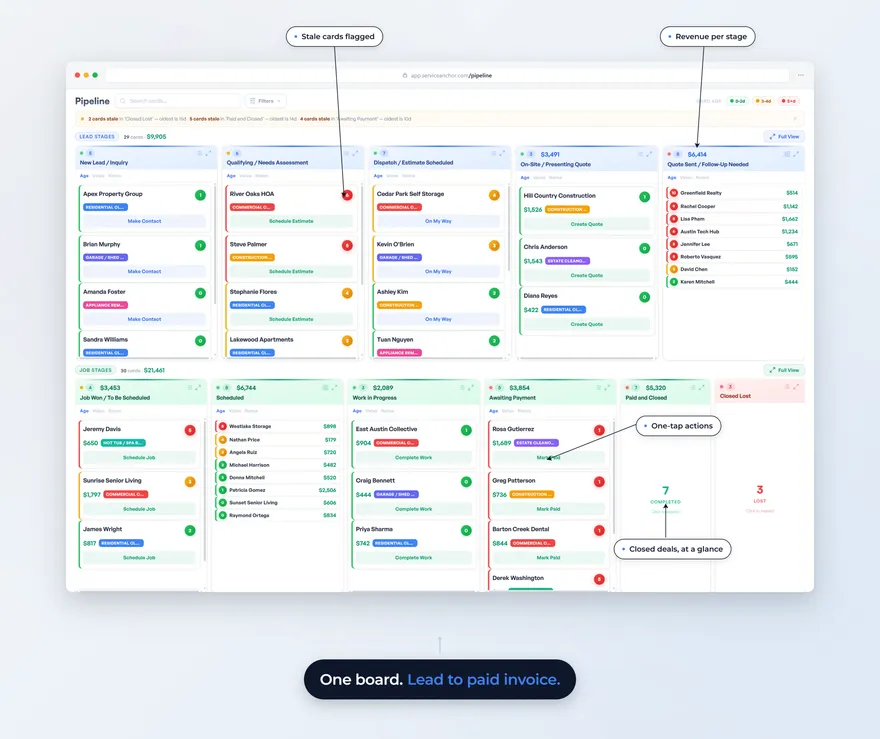
Two moves get you paid faster. First, take a card on completion rather than waiting for a check, so the money moves while the customer is in front of you. Second, automate the send so the invoice goes out the instant the job is done, not that night when you remember. Service Anchor generates the invoice automatically the moment a job is marked complete, with a card payment link the customer can tap on the spot, and it fires the review request after the invoice is paid. Founding pricing is $29 a month, everything included. The work order the crew ran the job from carries the same line items, so the invoice matches what was actually done. The on-my-way text starts that customer-communication arc, and the paid invoice ends it with the review ask that feeds your Google Business Profile. If you run a junk removal operation, that whole flow is preloaded for the trade.
FAQ
How do I write an invoice as a contractor?
Write a contractor invoice by listing your business and customer details, the job address, the completed work as itemized lines in plain language, the subtotal, any deposit credit, and the balance due. State the payment terms as due on completion and include a way to pay, like a card link. End with a short thank-you and a request for a review. Send it the moment the job is done, while the customer is still on site.
What is the difference between an invoice and an estimate?
An estimate is the price you quote before the work, and an invoice is the bill for the work after it is done. The estimate opens the job and often collects a deposit; the invoice closes it, credits that deposit, and collects the balance. For trade work, the two documents should match: the invoice reflects the approved estimate plus any agreed changes, so the customer is never surprised.
When should a contractor send an invoice?
A contractor should send the invoice the moment the job is marked complete, ideally while still on site. Pay-on-completion is the norm for home service trades, not net-30, and the best time to collect is when the customer is happy and the work is fresh. Sending later invites the overdue-invoice problem that affects nearly half of small businesses, so automate the send if you can.
Should an invoice include payment terms?
Yes, every invoice should state its payment terms clearly. For a trade service, that usually means “due on completion” with the accepted payment methods listed, plus any late fee if you charge one. Clear terms prevent the slow-pay problem and set the expectation that payment happens when the work is done, not weeks later.
Can I charge a late fee on an invoice?
You can charge a late fee on an invoice if you disclose it in advance, such as on the estimate and the invoice terms, and if it complies with your state’s rules on late fees and interest. A common approach is a small flat fee or a percentage after a stated grace period. The cleaner fix for a trade business is collecting on completion so invoices rarely go late in the first place.
Intuit QuickBooks, 2025 US Small Business Late Payments Report: source for the finding that 56 percent of small businesses are owed money from unpaid invoices, averaging about $17,500 each, with nearly half reporting invoices more than 30 days overdue. https://quickbooks.intuit.com/r/small-business-data/small-business-late-payments-report-2025/
U.S. Internal Revenue Service, Recordkeeping for small businesses: source for the guidance that businesses should keep the supporting sales documents they generate, including invoices, to substantiate income. https://www.irs.gov/businesses/small-businesses-self-employed/recordkeeping
Last updated: June 2026. First publication: a trade-service contractor invoice template with the job-address, deposit-reconciliation, pay-on-completion, plain-line-item, and review-ask fields explained, plus filled junk removal and moving examples with real rates.