A moving contract is the written agreement that sets the price basis, the mover’s liability, and the customer’s obligations before the truck is loaded. This template is built for a local or intrastate moving company owner who needs a contract to actually issue, not for a consumer reading about their rights. The single clause most small movers get wrong is liability: under the federal valuation rule that governs interstate moves and that most states model, a mover’s default liability is released value protection, which caps the mover at 60 cents per pound per item, so a 25-pound TV that gets destroyed is a $15 claim unless the customer bought more coverage. A local move is governed by your state’s rules, so confirm yours, but the framework below is the standard nearly everyone borrows from. Below is every clause your contract needs, a breakdown of what each one protects you from, and the rules that decide whether it holds up, so you can build an agreement with your attorney instead of reusing one you copied years ago.
- A moving contract is your risk-control document. It is the difference between a clean job and a chargeback, a damage claim, or a customer who refuses to pay because the price changed on site.
- The clauses that actually decide disputes: the pricing basis stated in writing, the deposit and cancellation terms, the valuation option the customer initialed, the long-carry and stairs contingencies, and the claims window.
- Released value protection caps your liability at 60 cents per pound and costs the customer nothing. Full value protection is the upsell. The customer has to pick one in writing. (That is the federal rule for interstate moves; most states model it, but confirm yours.)
- This is an operator education resource, not legal advice. Adapt the template, then have a local attorney review it once before you issue it.
What should a moving contract include?
A moving contract should include the parties, the scope and inventory, the pricing basis with any minimum, the deposit, the valuation option, the payment terms, the cancellation policy, the access and delay contingencies, the claims window, and signatures. The clause structure below is what a two-to-four-truck local mover can adapt. Have a local attorney review it once before you put it in front of a customer:
| Clause | What it states |
|---|---|
| Parties | Your legal business name and the customer’s name and contact |
| Scope and inventory | Origin and destination addresses, the move date, and the inventory or a reference to the attached list |
| Pricing basis | Hourly with a stated minimum, or a flat rate, and exactly what is included |
| Deposit | The amount due to book and whether it is refundable |
| Valuation | Released value at 60 cents per pound, or full value protection, with the customer’s initialed choice |
| Payment terms | When payment is due, accepted methods, and any deposit credit |
| Cancellation | Notice required and what the customer forfeits |
| Access and contingencies | Long carry, stairs, shuttle, and elevator conditions that change the price on site |
| Claims window | How many days the customer has to file a damage claim, and how |
| Signatures | Both parties sign and date; the customer initials the valuation choice |
Every one of those clauses exists because a mover somewhere lost an argument that the clause would have won. The five that do the most work are next.
Which clauses actually protect a moving company?
The clauses that protect a moving company are the pricing basis, the deposit and cancellation terms, the valuation election, the access contingencies, and the claims window. Each one closes off a specific dispute:
- Pricing basis with a minimum. State whether the job is hourly (for example, two movers at $100 per hour with a three-hour minimum) or a flat rate, and what is included. This is the clause that answers “but you said it would be cheaper.” The math behind those rates lives in our guide on how much movers cost; the contract is where you put the quoted basis in writing.
- Deposit and cancellation. The deposit you keep on a late cancellation is the clause that protects the slot a no-show stole from a paying job. State the notice required and what the customer forfeits.
- Valuation election. The most misunderstood clause in the trade, covered in full below. The customer has to initial released value or full value protection, because that one initial decides whether you owe 60 cents a pound or replacement cost.
- Access and contingencies. Long carry, stairs, a shuttle for a truck that cannot reach the door, an elevator reservation. These change the price on the day, and the contingency clause is what lets you charge for them without a fight, as long as you disclosed them up front.
- Claims window. A stated number of days for the customer to file a damage claim, in writing, closes off the call that comes three weeks later about a scratch nobody saw on move day.
What is the difference between released value and full value protection?
Released value protection caps the mover’s liability at 60 cents per pound per item and costs the customer nothing, while full value protection makes the mover liable for the repair or replacement value of damaged items and costs extra. Under the U.S. Department of Transportation’s FMCSA valuation rule, released value is the economy option: if a 25-pound television is destroyed, the mover owes 60 cents times 25 pounds, or $15, not the cost of a new TV. Full value protection covers the replacement value but the customer pays for it, and the price varies by mover and deductible.
For a small mover, the honest default is released value with a clear full value upsell, and the customer’s choice initialed on the contract. The reason the initial matters: under the federal rule, if the customer does not select released value, the shipment moves at full value protection automatically, which means you are on the hook for replacement cost on a job you priced as economy. Movers can also limit liability on items of extraordinary value (worth more than $100 per pound) unless the customer lists them, so a high-value-item declaration line belongs on the contract too.
Do local movers have to follow FMCSA rules?
Interstate moves are federally regulated by the FMCSA, and local or intrastate moves are regulated by the state, with rules that vary. The FMCSA’s “Your Rights and Responsibilities When You Move” and its valuation rules govern moves that cross state lines. A move that stays inside one state is governed by that state’s regulator instead: California licenses household goods carriers through its Bureau of Household Goods and Services, and Texas regulates movers through the Texas Department of Motor Vehicles, each with its own contract and disclosure requirements. The practical takeaway: borrow the FMCSA framework for your valuation and bill-of-lading language because it is the clearest national standard, then check your own state’s household-goods rules before you finalize the contract, because the binding requirements for a local move are set at the state level. This is also why the federal complaint data matters as a warning: the FMCSA receives roughly 3,000 moving complaints a year, and the most common ones (shipments held hostage, loss or damage, and overcharges) are exactly the disputes a clear contract is built to prevent.
What to do next
Adapt the template to your business, have a local attorney review it once, and then issue it on every single job, because the contract you never sign is the one that costs you. Put the pricing basis in writing, get the valuation choice initialed, and disclose the access contingencies before the truck rolls.
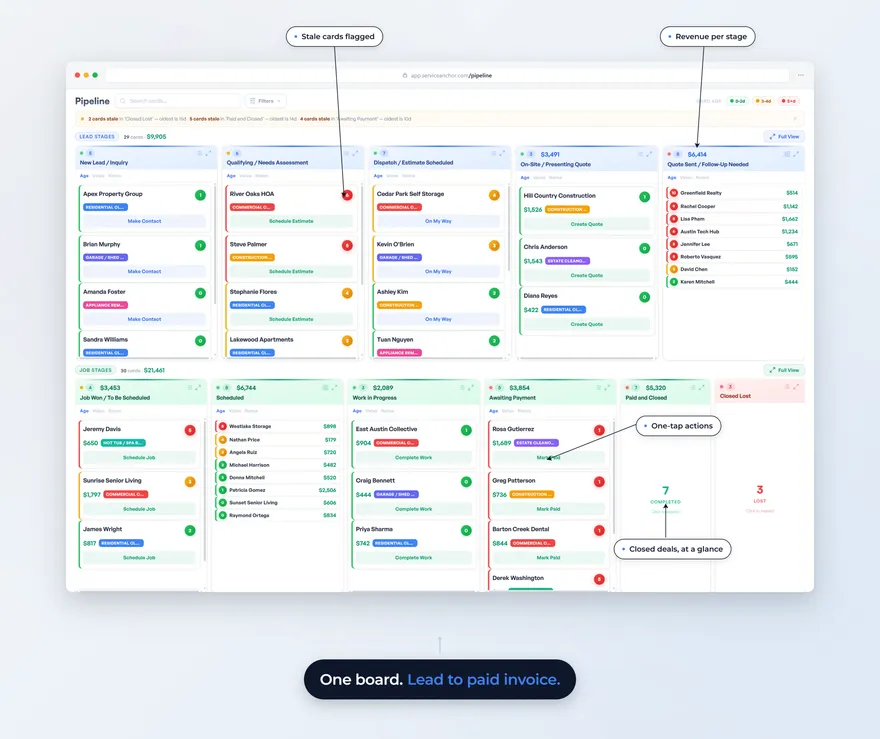
The step before the contract is the estimate the customer approves, and that is the part Service Anchor handles. We generate the line-item estimate and send it with a hosted page where the customer approves or declines before the job is booked, so the price they agreed to is recorded before anyone signs anything. Founding pricing is $29 a month, everything included. That approved estimate is what your contract’s pricing basis points back to, and you can issue the estimate template the same day you take the call. The software that runs a moving operation is the same board that tracks the job from that estimate to paid, and if you are still standing up the business, the contract is one of the documents that belongs in the setup pile. The whole flow comes preloaded for moving operators.
FAQ
Is a moving contract legally binding?
A moving contract is legally binding when both parties sign it, it states the essential terms (the parties, the service, the price basis, and the date), and its terms are lawful in the state where the move happens. For interstate moves, the bill of lading is the binding contract under federal rules. Because the binding requirements for a local move are set by your state, have a local attorney confirm your contract meets them before you rely on it.
What is the difference between a binding and a non-binding moving estimate?
A binding estimate guarantees the total price for the listed items and services, while a non-binding estimate is the mover’s best guess and the final bill can change based on the actual weight or hours. Under FMCSA rules, the type of estimate has to be stated clearly on the paperwork. For a small local mover, an hourly job is usually non-binding by nature, so the contract should state the hourly rate and the minimum rather than a guaranteed total.
What is a bill of lading in moving?
A bill of lading is the receipt for your shipment and the contract for its transportation, and the mover is required to issue one. It lists the parties, the service, the pricing, and the valuation choice, and it is the document a customer signs at pickup. For interstate moves the FMCSA requires it; for local moves, many states require an equivalent contract or work order that serves the same purpose.
Can a moving company hold your belongings hostage over a payment dispute?
No. Holding a shipment hostage to force a payment beyond the agreed terms is one of the practices federal and state regulators specifically pursue, and it is among the most common complaints the FMCSA receives. A mover can hold goods until the lawfully owed and properly estimated charges are paid, but not to extract charges that were never disclosed. A clear contract with the price basis in writing is the mover’s protection against the dispute that leads here.
What should a local moving contract include?
A local moving contract should include the parties, the origin and destination, the move date, the pricing basis and minimum, the deposit, the valuation option initialed by the customer, the payment and cancellation terms, the access contingencies, the claims window, and signatures. Because local moves are state-regulated, check your state’s household-goods rules for any required disclosures, and have a local attorney review the contract once before you use it.
U.S. Department of Transportation, Federal Motor Carrier Safety Administration, Liability and Protection (Protect Your Move): source for released value protection capping mover liability at 60 cents per pound per article, full value protection as the default if the customer does not select released value, and the extraordinary-value declaration rule. https://www.fmcsa.dot.gov/consumer-protection/protect-your-move/are-you-moving/liability-protection
U.S. Department of Transportation, Federal Motor Carrier Safety Administration, Protect Your Move: source for the FMCSA’s consumer-complaint program and the common complaint categories (shipments held hostage, loss or damage, and deceptive overcharges). https://www.fmcsa.dot.gov/consumer-protection/household-goods/protect-your-move
Last updated: June 2026. First publication: a moving contract template for local and intrastate movers, with the pricing-basis, valuation, deposit, access, and claims clauses explained, the federal released-value rule, and the interstate-versus-state regulatory framing.