Starting a moving company takes six steps: decide whether you’ll move locally or across state lines, register the business and get the right authority, get insured and bonded, buy or lease a truck and gear, set your pricing, and land your first moves. Realistic startup costs run about $10,000 to $20,000 if you lease your truck and start lean, and $30,000 to $50,000 if you buy. The step that trips up new movers is licensing, because a moving company faces more of it than almost any other home service trade, and the rules split sharply depending on whether you cross state lines. This guide is written for the operator starting a local moving company, and it gets the regulatory part right instead of skimming it.
- Startup cost is roughly $10,000 to $20,000 leasing your truck, $30,000 to $50,000 buying. The truck is the biggest single variable.
- Licensing splits on one question: do you cross state lines? Interstate movers need FMCSA operating authority (an MC number), a BOC-3 filing, and federal insurance filings. Local and intrastate movers usually do not need FMCSA operating authority and answer to their state instead.
- You will likely need a USDOT number even for local work in many states, plus general liability and cargo insurance, because movers are legally liable for customers’ goods.
- The US moving services market is about $25.7 billion (IBISWorld, 2025), a fragmented market of mostly small operators. Margins are real but labor-heavy, and about half of new US businesses close within five years (BLS), so crew efficiency and steady bookings matter more than the size of your truck.
How much does it cost to start a moving company?
Starting a moving company costs about $10,000 to $20,000 if you lease your truck and start lean, and $30,000 to $50,000 if you buy a truck outright. As with most trades, the truck is the swing variable, but moving carries two costs the others don’t: cargo insurance (because you’re liable for customers’ belongings) and, for interstate operators, federal registration fees.
Typical line items:
| Line item | Lease-truck lean start | Buy-truck full start | Note |
|---|---|---|---|
| Business registration (LLC) | $35 to $520 | $35 to $520 | One-time state filing fee; varies by state |
| EIN | $0 | $0 | Free from the IRS |
| USDOT number / authority fees | $0 to ~$300 | $0 to ~$300 | Interstate operating authority carries a federal application fee; USDOT number itself is free |
| Truck | $1,000 to $2,500 / month lease | $15,000 to $45,000 used box truck | The big variable |
| Dollies, straps, pads, ramps, wrap | $1,500 to $3,000 | $2,000 to $4,000 | The moving-specific gear kit |
| Liability + cargo insurance | $4,000 to $8,000 / year | $5,000 to $10,000 / year | Higher than other trades because of cargo liability |
| Basic marketing | $1,000 to $3,000 | $2,000 to $5,000 | Google Business Profile is free; ads and a site cost more |
A note on the used box truck range: those are current marketplace figures, not a fixed price, so check live listings when you’re ready to buy. Leasing keeps your week-one cash outlay down and lets your first 30 moves prove the demand before you take on a truck note.
Do you need a license to start a moving company?
Yes, and the answer splits on one question: are you moving customers within a single state, or across state lines? This is the distinction generic guides get wrong, and getting it wrong means operating illegally or uninsurable. Here is the operator-correct version. Treat all of it as directional and confirm with the FMCSA and your state regulator, because the specifics change by state.
If you cross state lines (interstate): You are regulated federally by the FMCSA. You need three things beyond your business entity:
- A USDOT number. Required for interstate commercial vehicles (FMCSA, Do I Need a USDOT Number?).
- Operating authority (an MC number). Separate from and in addition to the USDOT number. Household goods movers need a “Motor Carrier of Household Goods” authority, and the FMCSA does not grant it until your insurance and BOC-3 are on file (FMCSA, Get Operating Authority).
- A BOC-3 filing. A blanket designation of legal process agents in every state, filed electronically through a BOC-3 filer.
If you move only within your state (intrastate or local): You generally do NOT need FMCSA operating authority. Instead, you answer to your state. Many states still require a USDOT number for intrastate carriers, and many license movers specifically. Two illustrative examples (yours will differ):
- California requires a household goods carrier permit through the state (the “Cal-T” permit number), with insurance on file, and the permit number must appear in your advertising (CPUC, Licensing Requirements for Carriers).
- Texas requires moving companies to register with the TxDMV and obtain a certificate number, with liability and cargo insurance on file, and a USDOT number is required first (TxDMV, Motor Carrier Handbook).
The takeaway: start by deciding your service area, then call your state’s DOT or utilities/transportation regulator before your first move. If you ever plan to cross a state line, you’re in FMCSA territory and the bar is higher. Once your service area is set, put your terms in writing: our moving contract template covers the clauses that protect a local mover, including the valuation rule that decides your liability on a damaged item.
What insurance and bonding does a moving company need?
A moving company needs general liability and cargo insurance at a minimum, because unlike most trades you are legally responsible for your customers’ belongings. The exact minimums depend, again, on whether you operate interstate or intrastate.
For interstate household goods movers, the FMCSA sets federal filing minimums: $750,000 in public liability (bodily injury and property damage) for vehicles rated 10,001 pounds or more, filed on form BMC-91, and cargo insurance of $5,000 per vehicle and $10,000 per occurrence for household goods, filed on form BMC-34 (FMCSA, Insurance Filing Requirements, 49 CFR 387.9 and 387.303). For intrastate movers, your state sets the minimums, which are often lower; confirm with your state regulator.
Two more points. First, interstate movers must offer customers two valuation options: Full Value Protection (the mover is liable for the replacement value of lost or damaged goods) and Released Value (free, but the mover’s liability is capped at 60 cents per pound per article), and customers have nine months to file a claim (FMCSA, Liability and Protection). Second, on bonding: the FMCSA does not require a surety bond for ordinary carriers (bonds apply to brokers), but some states require a mover registration bond. Check your state. Once you hire crew, you’ll also need workers’ compensation in most states.
What equipment do you need to start a moving company?
The core equipment is a box truck sized for local moves, plus the hand tools that protect both the goods and your crew’s backs. The truck is the big decision: buy or lease.
The gear list:
- A truck. A 16 to 26 foot box truck covers most local residential moves. Many 26-foot box trucks fall under the non-CDL weight threshold, but confirm the gross vehicle weight rating against your state’s CDL rules before you buy.
- Dollies. Both an appliance dolly (the upright two-wheeler for fridges and washers) and a four-wheel furniture dolly.
- Moving blankets and pads. The single biggest defense against damage claims, which are the margin killer in this trade.
- Straps, ratchets, ramps, shrink wrap, and basic tools for disassembling beds and tables.
Buy-versus-lease on the truck is the decision that moves your startup cost by tens of thousands of dollars. Leasing for the first year lets you confirm the demand before you commit to a note.
How do you price moving jobs?
Local moves are usually priced by the hour for a crew plus the truck, with a minimum that covers a half-day. Booking platforms report typical local rates around $100 to $120 per hour for a two-mover crew and truck, with two to three hour minimums common, and our breakdown of what movers cost by crew size shows how those hourly rates translate into a full move total. Long-distance and interstate moves price differently, usually by weight and distance with a binding or non-binding estimate.
Because moving is labor-heavy, your pricing has to cover real crew cost, not just your own time. A move that takes longer than quoted eats the margin fast. For the customer-side view of what moves cost (which sets the ceiling on what you can charge), see our moving cost guide.
Is a moving company profitable?
A moving company is profitable, but the margins are labor-heavy, so crew efficiency and avoiding damage claims matter more than they do in lighter trades. Look at a representative local move:
That 61% is before your own pay, the truck, and insurance, and it assumes the move ran on time with no damage. The two things that quietly destroy moving margins are moves that run long (you quoted four hours, it took six, and you’re paying a crew the whole time) and damage claims (you’re liable for the goods, and one dropped TV can wipe out the profit on several moves). The operators who make real money are obsessive about crew efficiency and careful handling, not about volume alone.
The market is real: US moving services run about $25.7 billion (IBISWorld, Moving Services in the US, 2025), a fragmented market dominated by small local operators. But so is the failure rate. About three-quarters of new US businesses survive year one and roughly half survive five years (BLS Business Employment Dynamics). In moving, survival usually comes down to peak-season cash management and not dropping the booking ball, which is the focus of the last step.
How do you get your first moving jobs?
You get your first moving jobs from a verified Google Business Profile, local pay-per-lead ads, the moving-lead marketplaces, and referral relationships with apartments and realtors. The free, highest-impact starting point is a verified Google Business Profile that lands you in the local map results for “movers near me.” Our full moving company marketing guide ranks these channels in order and works the cost per booked move for each.
Where to start:
- Google Business Profile. Free and essential. Verify it before spending on ads, and avoid the traps that suspend new service-area businesses, covered in our Google Business Profile guide.
- Local Services Ads. Pay-per-lead at the top of Google. The operator payback math is in our Local Services Ads guide.
- Moving-lead marketplaces. They generate volume, but read the economics carefully: you often pay per lead and compete with several other movers on each one, so the cost per booked job can be high.
- Apartment and realtor relationships. A property manager who recommends you, or a realtor who hands your card to every closing, is the cheapest steady lead source in the trade. It compounds.
Would you rather pay for a shared marketplace lead or get the next move free because a property manager recommended you? Both, in order, but build the referral relationships early because they’re what carry you through the slow months.
What to do next
If you’re starting out, the action this week is to decide your service area (local or interstate), then form the LLC, get the free EIN, and start the licensing process for your situation. Interstate means FMCSA operating authority; local means your state regulator. None of that requires a truck purchase, and all of it makes you a legitimate, insurable business.
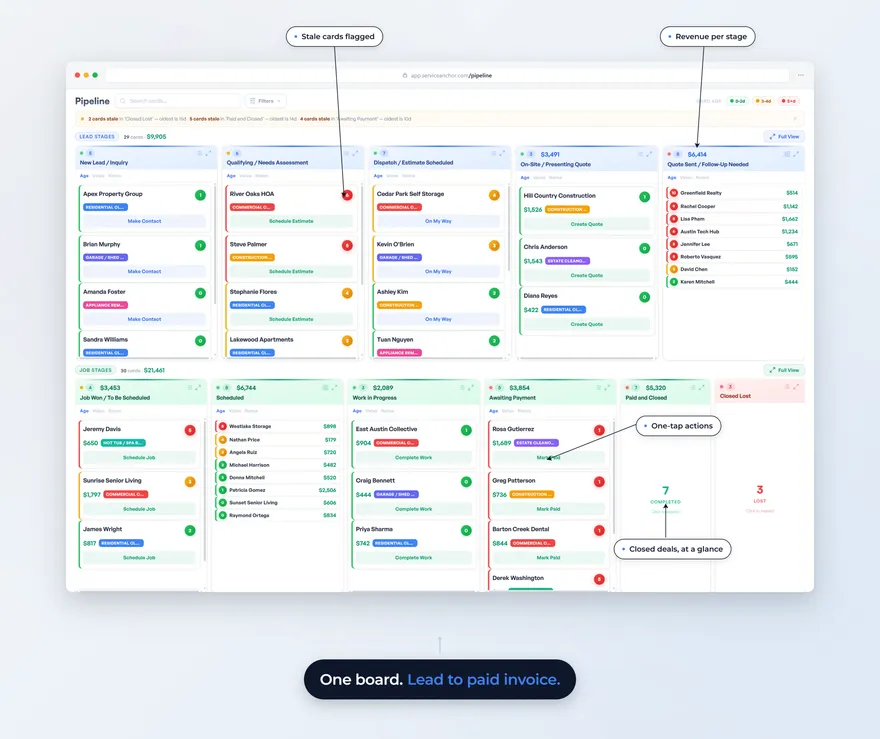
The thing to set up before the bookings start is a way to track them. Moves are scheduled, crewed, and damage-sensitive, so the trail from the first call to the paid invoice matters more in moving than in almost any trade. That’s what Service Anchor is built for: one pipeline from lead to paid invoice, pre-configured for moving so your price book loads in about 90 seconds, with the customer texts (confirmation, on the way, job done, invoice, review request) firing automatically as you work. Founding pricing is $29 a month, locked for life for the first 25 operators. Once you’re booking moves and comparing tools, our moving company software comparison covers the landscape, and the moving hub has the operator-side view.
Frequently asked questions
How much does it cost to start a moving company?
About $10,000 to $20,000 if you lease your truck and start lean, and $30,000 to $50,000 if you buy a used box truck. The truck is the biggest variable. Moving also carries higher insurance costs than most trades (often $4,000 to $10,000 a year) because you need cargo insurance on top of liability, since you’re responsible for customers’ belongings.
Do you need a license to start a moving company?
Yes, and it depends on whether you cross state lines. Interstate movers need FMCSA operating authority (an MC number), a USDOT number, a BOC-3 filing, and federal insurance filings. Local and intrastate movers usually do not need FMCSA operating authority but face state licensing, and many states still require a USDOT number. Confirm with the FMCSA and your state regulator.
Do I need a USDOT number to start a moving company?
If you move across state lines, yes. If you move only within your state, it depends on the state: many states require intrastate carriers to have a USDOT number even when no vehicle ever crosses a state line, and others do not. Check your state’s DOT or transportation regulator before your first move.
Is owning a moving company profitable?
Yes, but the margins are labor-heavy. A representative local move might leave around 60% contribution margin before your own pay, the truck, and insurance, and that assumes the move ran on time with no damage. Profitability over time depends on crew efficiency, avoiding damage claims, and managing peak-season cash flow, not just booking volume.
How much can a moving company make?
It varies widely with crew size and bookings, but the US moving market is about $25.7 billion (IBISWorld, 2025), so there’s real room. A one-truck local operator’s income depends on keeping the calendar full at a price that covers crew cost, and on not losing margin to moves that run long or to damage claims.
Can you start a moving company with one truck?
Yes. Most local moving companies start with a single box truck, often leased for the first year to keep startup costs down and prove demand before committing to a purchase. Starting with one truck also lets you build the apartment and realtor referral relationships that carry a moving business before you scale to a second crew.
What insurance does a moving company need?
At minimum, general liability and cargo insurance, because movers are legally liable for customers’ goods. Interstate movers must meet federal FMCSA filing minimums ($750,000 public liability for larger trucks, plus cargo coverage of $5,000 per vehicle and $10,000 per occurrence). Intrastate movers meet their state’s minimums. Once you hire crew, add workers’ compensation.
US Federal Motor Carrier Safety Administration, Get Operating Authority (Docket/MC Number): the requirement that interstate for-hire household goods movers obtain operating authority in addition to a USDOT number, granted only after insurance and BOC-3 filings are on file. https://www.fmcsa.dot.gov/registration/get-mc-number-authority-operate
US Federal Motor Carrier Safety Administration, Insurance Filing Requirements (49 CFR 387.9 and 387.303): federal minimum financial responsibility of $750,000 public liability and household goods cargo minimums of $5,000 per vehicle and $10,000 per occurrence for interstate movers. https://www.fmcsa.dot.gov/registration/insurance-filing-requirements
US Federal Motor Carrier Safety Administration, Liability and Protection (Protect Your Move): the Full Value Protection and Released Value (60 cents per pound per article) valuation options interstate movers must offer, and the nine-month claim window. https://www.fmcsa.dot.gov/protect-your-move/are-you-moving/liability-protection
IBISWorld, Moving Services in the US (Market Size): US moving services revenue of about $25.7 billion in 2025. https://www.ibisworld.com/united-states/market-size/moving-services/1154/
US Bureau of Labor Statistics, Business Employment Dynamics, Survival of Private Sector Establishments: about three-quarters of new establishments survive year one and roughly half survive five years. https://www.bls.gov/bdm/bdmage.htm
Last updated: May 2026 (first version).