The fastest moving company marketing for a small operator is a fully optimized Google Business Profile, a steady flow of recent reviews, and a few real-estate-agent referral relationships, because local-intent searches, the Google map pack, and agent recommendations book moves before you spend a dollar on ads. This guide is for the one-to-five-truck moving company owner with a real budget cap and no interest in an agency retainer, not for a national van line. The reason the order matters: the 2026 BrightLocal Local Consumer Review Survey found 97 percent of consumers read reviews for local businesses, and 74 percent only trust reviews written in the last three months, so a mover with stale or thin reviews loses the booking before the phone rings. Below: how movers get customers for free, what paid leads actually cost, whether SEO is worth it for a small mover, and when to turn on paid ads.
- Moving company marketing is a sequence, not a list of tactics. Do them in order: Google Business Profile and reviews first (free), then referral and real-estate-agent loops, then paid lead channels, then ads.
- Reviews are not optional for movers. BrightLocal’s 2026 survey found 97 percent of consumers read reviews and 74 percent only trust ones from the last three months, so a steady recent trickle beats a one-time push.
- Paid moving leads have real costs. Local Services Ads are pay-per-lead and Google-screened; shared marketplaces like Thumbtack and Angi send the same lead to several movers at once. Per-lead costs commonly run $15 to $60 depending on your metro and move type.
- Real-estate agents are the moving-specific channel junk haulers do not have. A handful of agent relationships can feed steady move bookings that cost you nothing per lead.
What is the best marketing for a moving company?
The best marketing for a moving company is a prioritized sequence that starts with free local channels and adds paid leads only once the free base is producing. Most “moving company marketing ideas” lists hand you fifteen tactics with no order, so you dabble in all of them and commit to none. The order that works for a small mover is: Google Business Profile and reviews, then referrals and real-estate-agent partnerships, then paid lead channels, then paid ads. This is the same channel-order playbook that works for junk removal marketing, adjusted for the one channel movers have that haulers do not: real-estate agents who hand clients a mover the day they close. The 90-day version of this sequence is the marketing section of your moving company business plan.
The logic is return per dollar and per hour. The free channels compound and cost only time. Paid lead channels turn on fast but cost money per lead. Paid ads cost the most and need a working base underneath them. Work top to bottom, and only move down a step once the step above is genuinely handled.
How do moving companies get customers without paying for leads?
Moving companies get customers without paying for leads through an optimized Google Business Profile, a steady review habit, past-customer referrals, and relationships with local real-estate agents. These cost time, not per-lead dollars, and they are where every small mover should start because they feed both the map pack and the agent who recommends you.
Start with the profile, and if you have not locked your company name yet, our guide on choosing a moving company name comes first, because the name goes on the profile. Claiming and fully filling out your Google Business Profile with accurate service areas, real job photos, and your service list is the single highest-impact free move, and our walkthrough on how to verify and optimize a Google Business Profile covers the setup step by step. Then build the review loop. Ask every customer for a review the day the move finishes, while the relief of a smooth move is fresh, because BrightLocal found 74 percent of consumers only trust reviews from the last three months, so a steady trickle matters more than a one-time push.
Then work the channel that is unique to moving: real-estate agents. An agent closing a home sale has a client who needs a mover that week, and an agent who trusts you will hand your name over again and again. A few solid agent relationships, plus a simple referral ask to past customers, turns one move into the next at zero per-lead cost. Do this once your profile and reviews are running so you are sending those referrals to a listing that looks active.
Should a moving company buy leads?
Buy leads once your free channels are producing and you can absorb the cost per booked move, not before. Bought leads run roughly $15 to $60 each depending on the channel, your metro, and the move type, with Local Services Ads and shared marketplaces working on different models. Once the free base is producing, paid leads add predictable volume, but you need to know what each channel charges and what you get for it.
| Channel | Model | Typical cost | What you get |
|---|---|---|---|
| Google Local Services Ads | Pay per lead, Google-screened | $15 to $50+ per lead | A customer who selected your profile, shown above the map pack |
| Shared marketplaces (Thumbtack, Angi, Moving.com) | Pay per shared lead | $15 to $60 per lead | A lead sent to several movers at once; you compete on speed |
Local Services Ads run on a pay-per-lead model where Google screens the business before showing the Google Verified badge. Per Google’s own Local Services Ads documentation, you “pay only for leads related to your business and the services you offer,” and you “only hear from customers who have specifically selected your profile.” Our deeper guide on how Local Services Ads actually work covers the screening and payback math. Shared marketplaces send the same lead to several movers, so they are lower-intent and won on response speed.
Here is the part that decides whether paid leads pay off. You need the cost per booked move, not the cost per lead. If a marketplace lead costs $40 and you book one in four, your real cost is $160 per booked move. Against a local move that commonly runs several hundred to over a thousand dollars (see how much movers cost), that can work, but only if you answer fast. The phone rings while your crew is carrying a couch down three flights, and by the time you call back the customer booked the mover who answered first. That $40 is gone, and so is the move behind it.
Does SEO work for moving companies?
Yes, SEO works for moving companies, but for a small mover the highest-return SEO is local SEO, meaning your Google Business Profile and reviews, not a blog trying to rank nationally. Local search and the map pack are where movers get found, and the profile is what ranks there. Traditional website SEO, ranking your own pages for terms like “movers in [city],” is a longer play that pays off over months, not a first-move channel.
Prioritize accordingly. Get the Google Business Profile fully optimized and the review flow steady first, because that is the local SEO that books moves this month. Then, as you grow, a simple website with a page per service area and honest content supports the paid channels and gives agents and customers a credible place to land. Movers carry trust requirements that haulers do not, including a USDOT number for interstate moves, so a clean, credible web presence is worth more in this trade than in most. Do not buy an agency package promising national rankings before your local base is producing; the local profile is the lever, and it is free.
When should a moving company pay for ads?
A moving company should pay for ads only after three things are true: the Google Business Profile is optimized, recent reviews are coming in consistently, and there is a reliable system to answer leads fast. Paid ads multiply whatever base you already have. Point ad spend at a thin profile with old reviews and a slow phone, and you are paying to send strangers to a listing that does not convert.
The trigger is concrete. If a customer who finds you organically already books, ads will book too, just faster and at volume. If they do not, fix the base first. Spending on Local Services Ads or marketplace leads while leads sit unanswered for hours is the most common way small movers waste their first marketing budget. Get the response time tight, then turn on paid. Tracking which channel each booked move came from, so you scale the one that works, is a job for your moving company software, not a spreadsheet you update once a month.
What to do next
Work the sequence in order. Optimize the Google Business Profile this week, start asking every customer for a review the day the move finishes, build two or three real-estate-agent relationships, then layer in paid lead channels once that base is producing, and only then scale with ads. The single highest-return habit underneath all of it is answering leads fast, because every channel above feeds the same phone. New operators can start with our guide on how to get your first moving jobs.
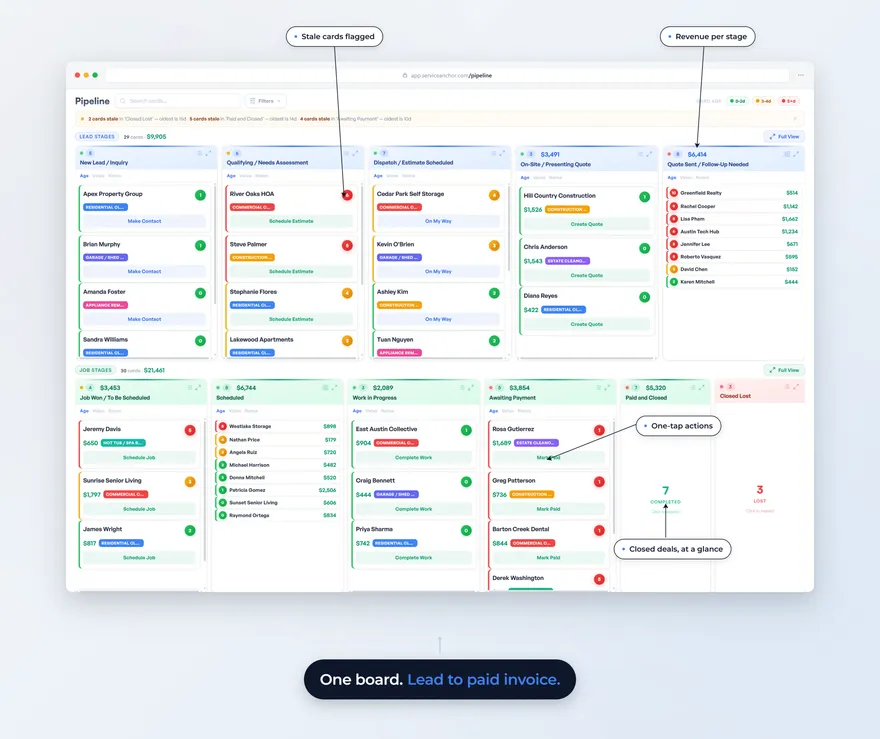
Marketing fills the top of the funnel. What you do with the call is the other half, and that is where moves are actually won or lost. Service Anchor is the lead-to-paid pipeline that books, quotes, and chases each moving lead automatically, preloaded for the trade, and it is free through beta. It is not a marketing tool and it does not run your ads or your SEO; it is how the leads your marketing earns stop falling through the cracks before you load the truck.
FAQ
How do I get more moving company customers?
Get more moving company customers by optimizing your Google Business Profile, building a steady habit of recent reviews, and developing a few real-estate-agent referral relationships before you spend on ads. These free channels feed the Google map pack and the agents who recommend movers. Once that base is producing, add paid lead channels like Local Services Ads, then scale with paid ads only after your response time is tight.
Should I pay for leads, or work the free channels first?
Moving leads cost roughly $15 to $60 each depending on the channel, metro, and move type. Local Services Ads are pay-per-lead and Google-screened, typically $15 to $50 or more per lead, while shared marketplaces like Thumbtack and Angi send the same lead to several movers at once. The number that matters is cost per booked move: a $40 lead you book one in four costs $160 per booked move.
Does SEO work for moving companies?
Yes, SEO works for moving companies, but the highest-return SEO for a small mover is local SEO, meaning a fully optimized Google Business Profile and steady recent reviews, not a national blog. Local search and the map pack are where movers get found. Website SEO ranking your own service-area pages is a longer play that supports paid channels and credibility over months rather than booking moves this week.
Are Local Services Ads worth it for movers?
Local Services Ads are worth it for movers once the free base is working and you can answer leads fast, because they are pay-per-lead and shown above the map pack with a Google Verified badge. They tend to send higher-intent leads than shared marketplaces because the customer specifically selected your profile. They are not worth it if leads sit unanswered, since you pay per lead whether or not you respond in time.
How do real-estate agents help a moving company get customers?
Real-estate agents help a moving company get customers because every home sale they close creates a client who needs a mover that week. An agent who trusts your work will recommend you to client after client at zero per-lead cost, making agent relationships the most valuable free channel unique to moving. Build a handful of solid relationships by being reliable, easy to schedule, and good to their clients, and the referrals compound.
Google, Local Services Ads Help: official documentation on the pay-per-lead model, Google screening and the Verified badge, and that customers specifically select your profile. https://support.google.com/localservices/answer/6224841
BrightLocal, Local Consumer Review Survey 2026: annual primary research on how consumers use reviews and Google to find and choose local businesses, including the 97 percent who read reviews and the 74 percent who only trust reviews from the last three months. https://www.brightlocal.com/research/local-consumer-review-survey/
Last updated: June 2026. First publication: prioritized channel sequence for movers, the real-estate-agent referral channel unique to moving, per-lead cost comparison with cost-per-booked-move math, and the trigger for starting paid ads. Sibling to the junk removal marketing guide.