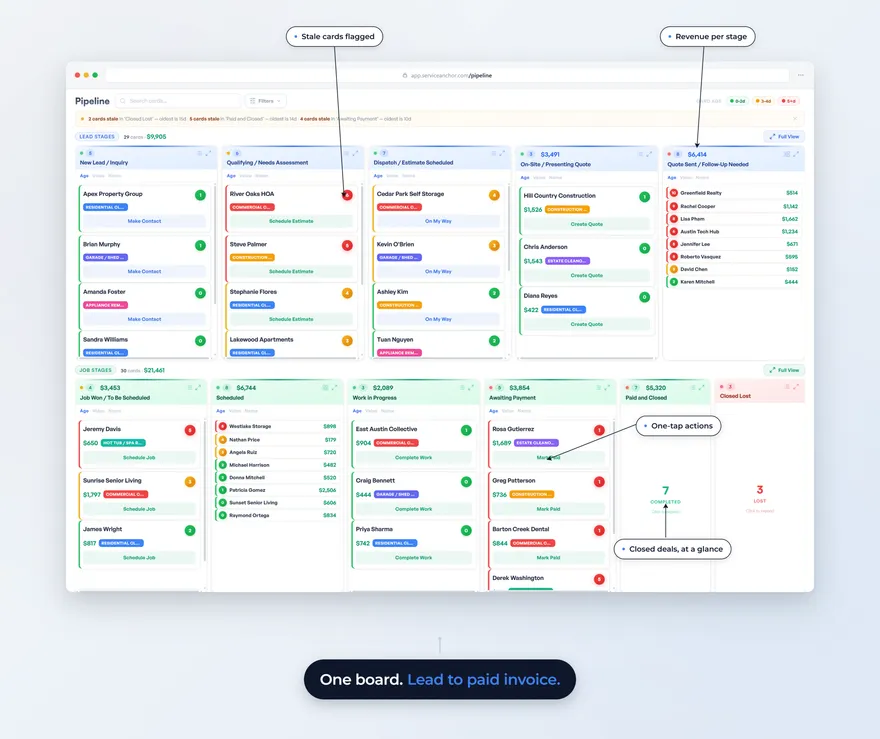
Moving estimate software turns a phone call into a priced estimate the customer can approve from their phone: your rates loaded once, both addresses on the quote, the extras asked on the call, and a follow-up when they go quiet. If you run one to three trucks, quote local moves by the hour over the phone, and are weighing a survey-app demo against something simple enough that your dispatcher quotes the way you do, this is for you. Published prices for quoting tools run from free with a 10-quote monthly cap to $699.99 a month (MoverBase pricing, QuoteIQ pricing); an AI phone receptionist for movers lists $499 to $799. Below: the five things you need, the three you can skip, and the published prices side by side.
- A local mover needs five things from estimate software: rates loaded once, both addresses on the estimate, the extras (stairs, long carry, heavy items) on the quote, a link the customer approves from their phone, and a follow-up that sends itself.
- Cube sheets, weight-based tariffs, and AI or video surveys are built for interstate and long-distance work. Skip them until that work is a real share of your jobs, with one exception: very large local jobs.
- Published prices for quoting tools run from free with a quote cap to $699.99 a month. SmartMoving, Supermove and Movegistics publish no price.
- Quoting from a phone doesn’t need an app store download; a web app on the phone’s home screen does the job.
- A quote nobody follows up on is a quote you wrote for free. Count last month’s unanswered ones before you shop.
What does a local mover need from estimate software?
A local mover needs estimate software that prices an hourly crew job the same way every time, no matter who answers the phone. In a lot of small moving companies the pricing lives in the owner’s head: they know a three-bedroom with a piano and a third-floor walk-up is a four-mover, six-hour job, and nobody else in the office does. The software’s job is to put that knowledge in one place.
The need-now list:
- Your rates, loaded once. Crew rates by mover count, truck fees, packing materials, and the heavy items you price separately (see what piano moves cost for one example). Our moving estimate template lays out a full local price book if you’re building one from scratch.
- Both addresses on the estimate. Origin and destination on the quote and the job, so the crew isn’t reading them out of a text thread.
- The extras, asked on the call. Stairs, elevators, long carries, shuttle trucks. If the estimate form doesn’t prompt for them, they get missed, and missed extras are where a profitable local move turns into a loss.
- A link the customer approves. Not a PDF they have to print, sign and scan. A page that opens on their phone with an approve button.
- A follow-up that sends itself. The quote you sent Tuesday and never heard about is the most expensive thing in your pipeline.
Everything else is a nice-to-have for a local operation. One caution before you build the list into software: some states set rules for local moves too, including what a written estimate has to contain, so check your state’s mover rules first.
What can you skip until you run interstate?
You can skip cube sheets, weight-based tariff pricing, and in-home, video or AI surveys until long-distance and interstate moves are a real share of your work. Those tools exist because interstate moves are priced by weight and distance, and a bad inventory estimate on a 1,200-mile move costs real money. A local move is priced by the hour, and the hour estimate comes from bedrooms, stairs, heavy items and the distance between the two addresses, which a five-minute phone call covers.
When those tools start to earn their price:
- Cube sheets and inventory lists: once you quote long-distance moves often enough that a volume or weight estimate decides the price.
- Video or AI surveys: once the customer is far enough away that a walkthrough is impractical and the job is big enough to justify a fifteen-minute video call.
- Weight and tariff pricing: once you’re an interstate carrier pricing by weight under your own tariff, with the federal registration that comes with it (our moving company license guide covers that).
The exception is the very large local job, a five-bedroom house or an office: an underquoted hourly job loses the most money there, so a walkthrough or a set of customer photos earns its time. Interstate moves also come with paperwork: movers must give customers two federal brochures on their rights, which FMCSA’s consumer rights page carries. If interstate is a large part of your business, a tool built for it (Movegistics, SmartMoving and others) is the honest recommendation.
What does moving estimate software cost in 2026?
Moving estimate software costs anywhere from free with a monthly quote cap to $699.99 a month, and an AI receptionist that quotes on the call lists up to $799; the contract-only plans sit in the middle of that range. Prices below were read on each vendor’s own site on October 14, 2026; check before you buy, because they change.
| Tool | Published price | Built for | What to know |
|---|---|---|---|
| MoverBase | Free; Pro $29/mo; Fleet $99/mo; Unlimited $299/mo | Local and long distance | Month to month. Quotes capped at 10, 20 and 100 a month on the lower plans; past the cap, $1.99 a quote on Pro and $1.49 on Fleet (Free requires an upgrade) |
| QuoteIQ | Essentials $29.99, Beginner $99.99, Pro $199.99, Elite $299.99, Max $699.99 a month | Several home service trades, moving among them | 1 to 20 users by plan, extra users $25/mo; 14-day trial with a card |
| Service Anchor | $79 a month, every feature, up to 5 users (current offer on our pricing page) | 1-to-5-truck home service companies, with a moving setup | Free for 14 days with a card on file; texting and calling included, with caps; no survey or weight tools |
| Chariot | Starting at $254/mo | Moving companies | Paid quarterly or annually; final price set by company size |
| Elromco | Professional $289/mo (3 office users); Enterprise $399/mo | Moving companies | Month to month; website add-on $99/mo; texts past the monthly allowance $0.025 each |
| MoveitPro | $449/mo on a 12-month agreement, $404 on 24 months, $365 on 36 months | Moving companies | 15% less if the whole term is prepaid; 2 office users included, more at $70 to $80/mo; crew app $20/user |
| MoveJoy | $499 to $799/mo (on its homepage) | An AI phone receptionist for movers | Quotes on the call from your rate card and books into the software you already use |
| SmartMoving, Supermove, Movegistics | Not published (checked October 14, 2026) | Moving companies, including interstate | Demo or quote required |
This table covers moving-specific tools plus the general tools that rank for moving estimates. General field service software like Jobber and Housecall Pro also publishes prices; our moving company software comparison puts them alongside the moving tools.
Two ways to read the table:
- Cost per quote. A quote cap changes the math. At 30 quotes a month, a $29 plan with a 20-quote cap and a $1.99 overage is about $49; at 60 quotes, about $109, when the same vendor’s $99 plan covers 100 quotes. The $99 plan is the cheaper one from 56 quotes a month. Count how many estimates you send in a busy month before you compare.
- Contracts. A low monthly price on a 36-month agreement is a three-year commitment. For a two-truck company that might be a five-truck company in a year, month to month matters.
Can you quote a move from your phone?
Yes. Many current estimate tools work from a phone, and you don’t need an app store download for it: a web app saved to the home screen opens like an app and quotes the same way. What matters on a phone is speed: pick the move size, add the extras, confirm both addresses, send. If building a quote takes more taps than the call took minutes, the dispatcher will go back to texting a number.
Two checks when you test one on a phone:
- Can you build and send a quote with one thumb from the truck cab between jobs?
- Does the customer’s side work on their phone without creating an account?
What happens after the moving estimate is sent?
After the estimate is sent, the customer approves it, asks a question, or goes quiet. Going quiet is the expensive one: a customer collecting quotes may book whoever followed up first, and you won’t hear why. Count how many of last month’s quotes got no reply at all; that number is what this part of the software is for.
What the software should do here:
- Show you when the estimate was viewed. “Opened twice yesterday, no reply” is a different call than “never opened.”
- Let the customer approve from the link, so a yes doesn’t wait on you being at your desk.
- Send the follow-up for you a set time after the quote goes out.
Our quote follow-up email guide has the wording for the follow-ups themselves. Once the job is booked, a written agreement protects the date; our moving contract template covers what goes in it.
Where Service Anchor fits, and where it doesn’t
We make one of the tools in this table, so read this section knowing that. The need-now list above is the one we built to, because it’s how local hourly moves get quoted; if your moves are priced by weight, the list (and our product) is the wrong fit. Service Anchor fits a local or regional mover who quotes hourly crew jobs and wants the estimate, the follow-up, the job and the invoice in one place.
What it does for a mover:
- The moving price book loads at setup: crew rates down to pianos and gun safes, with fees that attach themselves when their condition applies.
- Both addresses travel with the job: the lead, the estimate, the hosted approval page and the estimate emails all carry From and To.
- The customer approves from a link, with a branded PDF attached and no account to create, and you see when they viewed it. Add photos to any line.
- Follow-up sends itself after the delay you set.
- A two-day move is one job: one invoice, a visit for each day.
- The FMCSA brochures, linked: the two federal brochures are set up for your long-distance moves.
- Deposit rules come on for new moving accounts: 25% by default, $300 flat on long-distance moves, editable on every estimate and credited on the final invoice.
What it doesn’t do: cube sheets, inventory surveys, weight or tariff pricing, video or AI surveys, bills of lading, or route and mileage between the two addresses. If those decide your prices, the interstate tools in the table are the better fit, and we’d rather say so here than after you sign up.
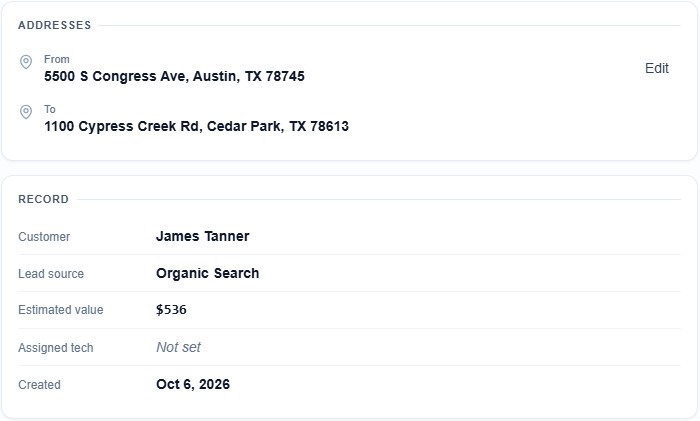
Both addresses on a local move, carried from the lead to the estimate and the job. Demo account.
What to do next
- Count last month’s estimates and how many you never heard back on. That’s the number to fix first.
- Write down your rates if they only live in your head; our local moving price book is a starting point.
- Test two tools on your phone with a real recent job: one from the table above, one you already use. Time how long the quote takes.
- See how it runs for a moving company: Service Anchor for movers.
FAQ
What is the best moving estimate app for a small moving company? The best one is the one your dispatcher will use on every call: rates loaded once, both addresses, extras prompted, an approve link, and an automatic follow-up. For local hourly moves, skip survey-first tools; for interstate work priced by weight, choose a tool built for it.
How do moving companies estimate a local job? Local moves are usually priced by the hour: crew size times hours, plus a truck fee, materials, and extras like stairs, long carries and heavy items. The hours come from move size and access at both addresses, which a phone call or a few photos usually covers. Our guide to what a move costs shows the customer’s side of the same math.
Do I need an in-home or video survey for a local move? Usually not. Surveys earn their cost on long-distance and interstate moves priced by weight or volume, and on very large local jobs. For a typical local hourly move, a structured phone call covering bedrooms, stairs, heavy items and both addresses is enough.
How much does moving estimate software cost? Is there a free one? Published prices for quoting tools run from free (with a monthly quote cap) to $699.99 a month. MoverBase has a free plan with a 10-quote cap; SmartMoving, Supermove and Movegistics only quote on request.
Can the customer approve a moving estimate online? Yes, in many current tools. Look for a link that opens on the customer’s phone with an approve button, no account needed, and a notice to you when they view or approve it.
Last updated: October 2026. First publish; vendor pricing pages read October 14, 2026.