A moving company license is state-issued authority for local moves and federal FMCSA registration for moves that cross state lines. If you only move households inside one state, your license comes from your state regulator, and which agency that is depends on where you operate: California’s Bureau of Household Goods and Services, the Texas Department of Motor Vehicles, and the New York State Department of Transportation all sit in different departments. If you cross state lines for hire, you register with the Federal Motor Carrier Safety Administration, which since October 1, 2025 issues a single USDOT number as your only federal identifier and no longer hands out separate MC numbers. This guide is for owners starting or legitimizing a 1-to-5-truck moving company. It walks the licensing path in the order you actually do it, with the real fee at each step, and flags the traps that get small movers fined or delisted. Treat it as operator education, not legal advice: requirements vary by state and change, so the primary sources are linked at each step.
- The first question is not “which form,” it is “do I cross state lines?” Local-only movers are licensed by their state. Interstate movers register with FMCSA. Most 1-to-5-truck shops are one or the other, not both.
- Local (intrastate) licensing lives in a different agency in every state: California’s Bureau of Household Goods and Services (a $500 permit plus fingerprints and a rate exam), the Texas DMV (a household goods certificate, renewed annually), New York’s DOT (authority plus a filed tariff). Check yours by name before you file.
- Interstate registration runs through FMCSA’s Unified Registration System: the USDOT number is free, for-hire operating authority is $300 per authority type, and you then file BOC-3 process agents and your insurance before authority activates.
- Since October 1, 2025, FMCSA no longer issues MC numbers. Your USDOT number is the sole federal identifier, and operating authority is attached to it in the same application.
- You can file all of this yourself on the government sites. The paid filing services are optional convenience, not a requirement.
Do you need a license to run a moving company?
Yes, in almost every case, and the license you need depends entirely on one question: do your trucks cross a state line? A moving company that stays inside one state is regulated by that state, and most states require household goods movers to hold a specific permit or certificate no matter how small the operation. A moving company that hauls a customer’s belongings across a state line for money is an interstate for-hire carrier and must register with the Federal Motor Carrier Safety Administration. The two paths are separate, and a lot of small movers get this wrong by assuming a general business license is enough. It is not. A business license lets you exist; a moving license lets you legally move people’s property for hire.
| Your operation | Who licenses you | The core credential |
|---|---|---|
| Local moves, one state only | Your state regulator (agency varies by state) | State household goods permit or certificate |
| Moves that cross state lines | Federal Motor Carrier Safety Administration (FMCSA) | USDOT number plus for-hire operating authority |
| Both local and interstate | Both your state and FMCSA | State permit plus federal registration |
The rest of this guide follows the two branches in order. Start with the one that matches your actual routes, and if you do both, you file both. Our walkthrough of how to start a moving company puts this licensing step in sequence with the rest of the setup.
What license do you need for local (intrastate) moves?
For local moves, your license comes from your state, and the agency that issues it is different almost everywhere, which is the single most confusing part of the whole process. There is no national “local mover” license. You have to find your state’s household goods regulator by name and file with that specific office. Three examples show how much the setup varies.
In California, intrastate household goods movers are licensed by the Bureau of Household Goods and Services, which took over mover regulation from the CPUC. There are no exceptions for a “man with a van,” the permit application carries a $500 filing fee, and applicants submit fingerprints for a background check and pass a written exam on the state’s maximum rates and rules. In Texas, the Texas Department of Motor Vehicles issues the household goods certificate, you must already hold a valid USDOT number before you apply, and household goods carriers renew the certificate every year rather than getting a permanent one. In New York, the New York State Department of Transportation grants the authority to transport household goods, requires your insurer to file proof of liability and cargo coverage, and also requires you to file a tariff showing your rates.
The pattern to take from this: do not assume. Search your state’s name plus “household goods mover permit,” confirm the exact agency, and read its current requirements before you spend a dollar. Agencies reorganize, and the name on last year’s blog post is often wrong.
How do you register for interstate operating authority?
For interstate moves, you register once through FMCSA’s Unified Registration System, and that single application gives you a USDOT number and your for-hire operating authority together. The USDOT number itself is free. The operating authority carries a $300 filing fee per authority type, and it is non-refundable, so file for the authority you actually need. The big change to know: as of October 1, 2025, FMCSA stopped issuing MC numbers to new applicants. Your USDOT number is now the sole federal identifier, and your authority is attached to it rather than living on a separate MC docket number.
Registration is not finished the moment you submit. Two more filings have to land before your authority activates. First, you designate BOC-3 process agents, a legal service-of-process contact in each state you operate in, which most filing companies handle for $20 to $100. Second, your insurance company electronically files proof of the federally required coverage. FMCSA also runs a 21-day protest period after your application posts, so plan for a few weeks between filing and going live, not a same-day turnaround.
One honest note that the paid filing mills will not tell you: you can do every step of this yourself directly on the FMCSA site. The filing services charge to type your information into government forms for you. That is a convenience purchase, not a legal requirement, and a first-time mover on a tight budget can complete the whole registration without them.
How much insurance does a licensed mover need?
A licensed interstate mover needs a minimum of $750,000 in public liability coverage plus cargo insurance, and the insurance filing is part of what activates your authority, not a separate afterthought. Under 49 CFR 387.303, an interstate household goods carrier must carry $750,000 in public liability (filed on Form BMC-91), cargo insurance of at least $5,000 per vehicle and $10,000 per occurrence (filed on Form BMC-34), and prove financial responsibility with an MCS-90 endorsement on its auto policy. Local-only movers answer to their state’s minimums instead, which usually means commercial auto at the state limit plus workers’ compensation once you hire.
The insurance is where the license and the real bill meet, and it is worth budgeting before you register rather than after. For the full stack, what each coverage costs, and where a one-truck operation actually lands for the year, our breakdown of moving company insurance walks the numbers. It is the companion to this post: the license tells you what to file, the insurance guide tells you what to pay, and our guide on what movers actually charge shows what the work brings in.
What happens if you operate without a license?
Operating without the required license exposes you to state fines, shutdown orders, and a customer-trust problem that is now baked into how people hire movers. States treat unlicensed household goods moves seriously: California, for example, can charge fines up to $5,000 per violation, with each unlicensed move counted separately. Beyond the fines, an unlicensed mover has no legal standing when a payment dispute or a damage claim goes sideways, which turns a routine disagreement into a loss you simply eat.
The quieter cost is discoverability. Consumers are actively taught to check a mover’s credentials before booking, and the tools to do it are one search away. An unlicensed operator that cannot survive that check loses the job to the one that can, and marketplaces and review platforms increasingly gate verification on exactly these credentials. Licensing is also how you win the customer who does their homework, and that is a larger and larger share of the market every year.
What to do next
Get legal in the order that avoids rework, because filing out of sequence is how movers pay twice. The checklist: form your business entity and get an EIN first, then file your state household goods permit if you move locally or register with FMCSA if you cross state lines, then get your insurance filed, and only then build out the operating side. Naming matters here too, since the name on your authority filing has to match the name on your truck and your marketing, so lock the name before you register. Our guides on picking a moving company name that books jobs and building the operator’s business plan cover those two steps, and the plan is where these licensing and insurance costs become real line items.
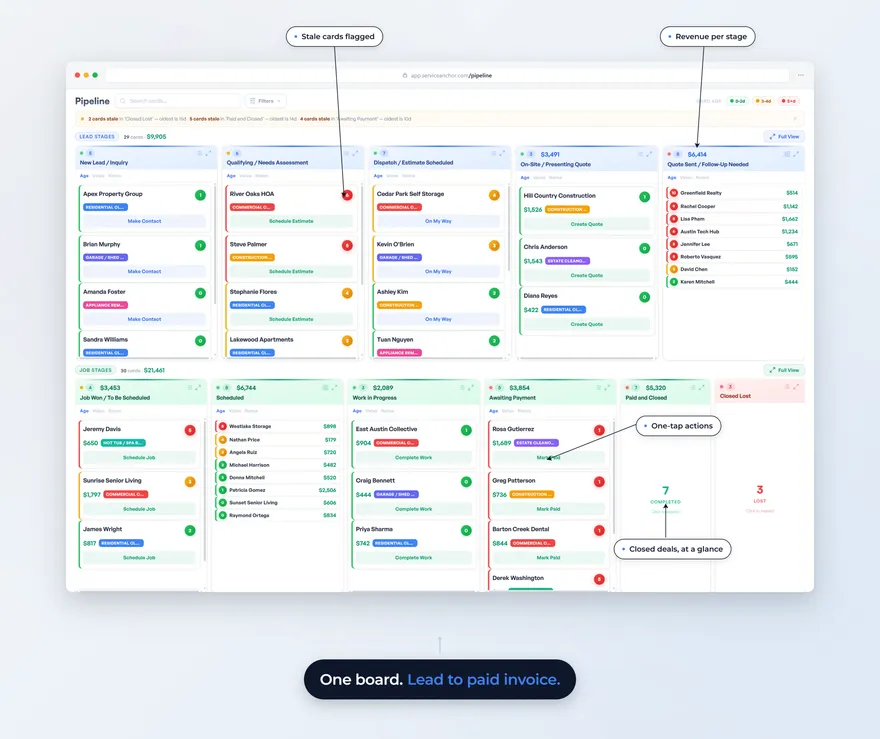
Once the authority clears, the business side is the part you can stand up fastest. Service Anchor is the lead-to-paid pipeline that books, quotes, and chases each move automatically, preloaded for moving, so the office and the trucks run on one board the same week your license comes through. It does not handle licensing, compliance filings, or DOT registration, and it does not replace your state agency or FMCSA. Those are still yours to file. What it does is make sure that the day you are legal to move people, you are also ready to actually run the jobs.
FAQ
How much does it cost to get a moving company license?
A moving company license costs between roughly $300 and $500 in filing fees for most 1-to-5-truck operators, before insurance. Interstate registration through FMCSA is a free USDOT number plus $300 per operating-authority type, and state permits vary widely: California’s household mover permit carries a $500 filing fee, while other states charge less. The larger cost is not the license fee but the insurance you have to file to activate it, which runs into the thousands per year.
Do you need a USDOT number for local moves?
You generally do not need a federal USDOT number for moves that stay inside one state, unless your state specifically requires an intrastate USDOT number as part of its own registration. The federal USDOT number is the identifier for interstate for-hire carriers. Texas, for example, requires you to hold a USDOT number before applying for its state household goods certificate, so always check your state’s rule rather than assuming local means no number at all.
How long does FMCSA registration take?
FMCSA registration takes a few weeks in practice, not a few days, because of the mandatory 21-day protest period after your application posts. Your authority does not activate until that window passes and both your BOC-3 process agent designation and your insurance filing are on record. Plan for roughly three to four weeks from submission to being legally active, and file early if you have a start date in mind.
What is the difference between a USDOT number and an MC number?
A USDOT number is your federal safety identifier, and an MC number was historically a separate docket number granting operating authority to haul regulated commodities for hire across state lines. As of October 1, 2025, FMCSA no longer issues MC numbers. Operating authority is now attached to your USDOT number in a single registration, so new movers deal with one identifier instead of two.
Do movers need a CDL?
Movers usually do not need a commercial driver’s license, because most moving trucks fall under the 26,001-pound gross vehicle weight rating that triggers the CDL requirement. If you run a larger truck or a truck-and-trailer combination that crosses that weight threshold, then a CDL applies. Confirm the gross vehicle weight rating on your specific truck before you assume, since a heavy box truck can put you over the line.
FMCSA, Get Operating Authority and register through the Unified Registration System: source for the USDOT-number-as-sole-identifier change effective October 1, 2025, the free USDOT number, and the $300-per-authority-type filing fee. https://www.fmcsa.dot.gov/registration/get-mc-number-authority-operate
FMCSA financial-responsibility requirements, 49 CFR 387.303 (eCFR): source for the $750,000 public liability minimum, the $5,000-per-vehicle and $10,000-per-occurrence cargo minimums, and the BMC-91 and BMC-34 filing forms. https://www.ecfr.gov/current/title-49/subtitle-B/chapter-III/subchapter-B/part-387
California Bureau of Household Goods and Services, Household Movers: source for the California intrastate mover permit, the $500 filing fee, the fingerprint and written-exam requirements, and the no-exemptions rule. https://bhgs.dca.ca.gov/consumers/movers.shtml
Last updated: July 2026. First publication: the operator-side moving-license path in execution order, updated for the October 1, 2025 FMCSA change that retired MC numbers and made the USDOT number the sole federal identifier, with named state-agency examples for California, Texas, and New York.