A good moving company name is one that passes five checks: it is readable on a truck, sayable on a phone, unclaimed in your metro’s search results, consistent with your registered business name, and available as a domain. This is for someone at day zero of a moving company who is choosing the name this week, not for a marketer collecting a thousand options. Most name lists online give you exactly that, a thousand options and no way to decide, when what an operator actually needs is a filter. This post is the filter first: the five checks that make a name work when it is painted on a truck door and typed into Google next to three competitors. Then 120 example names organized by the positioning each one signals, so the list teaches instead of just piling up. Then the 30-minute checklist to lock the name and register it before someone else does.
- The framework beats the list. Before a name goes on a truck it has to clear five pass-or-fail checks, covered below, and most name-generator lists skip every one of them.
- The check nobody writes about: your marketing name, your DBA, and the name on your state or FMCSA registration all have to match, because customers are taught to verify a mover’s credentials and a name mismatch reads as a red flag.
- The 120 examples below are sorted by positioning (trust, speed, local, premium, and family-name), because the category you choose signals something to the customer before they ever call.
- Putting your city in the name helps local search but caps you if you expand to a second metro. It is a real tradeoff, not a default.
- Checking availability takes four searches: your metro’s Google and Google Business Profile, your state business registry, the USPTO trademark database, and a domain lookup. Do all four before you print anything.
What makes a good moving company name?
A good moving company name survives five pass-or-fail checks, and a name that fails any one of them will cost you jobs no matter how clever it sounds. Run every candidate through all five before you get attached.
Readable on a truck at 40 feet. Your truck is a moving billboard, and the name has to be legible from across a parking lot at highway speed. Short beats long, plain beats clever, and creative spelling fails here every time. “Anchor Moving Co.” reads instantly; “Muv-Rite Relokation” does not.
Sayable on a phone without spelling it. Half your leads will say the name out loud to a spouse or read it off a truck and search it later. If a customer cannot say it, spell it, and find it without help, you lose the search. Silent letters, unusual spellings, and puns that only work in writing all fail the phone test.
Unclaimed in your metro’s search results. If three movers in your city already use some variation of “Two Guys Moving,” a fourth one drowns. Before you commit, search the name in your actual metro and see who already owns those results. A name that ranks nowhere because a competitor owns it is a name that costs you every organic lead.
Consistent with your registered business name. The name on your truck, your DBA, and your state or FMCSA registration should line up, because customers verify movers now and a mismatch looks like a scam. This is the check the name-generator sites never mention, and it ties your naming decision directly to your licensing.
Available as a domain and Google Business Profile. A name you cannot claim online is a name you will fight for every day. Check the .com and your Google Business Profile before you print a single flyer, because the moving company that owns its name across search, maps, and the web is the one customers find first.
What are the best moving company name ideas?
The best moving company name ideas are the ones that match the positioning you want to own, so the smart way to browse a list is by category, not alphabetically. Each category below signals something different to a customer before they call. Pick the lane that fits how you want to compete, then run your favorites through the five checks above. Treat these 120 as illustrative patterns to spark your own, and spot-check any you love against your metro’s Google results, since a name that is open in one city may be taken in another.
| Positioning | When it wins | Example names |
|---|---|---|
| Trust and heritage | You compete on reliability and want to read as established, not brand-new | Anchor Moving Co., Cornerstone Movers, Trusted Hands Moving, Reliant Moving Co., Steadfast Movers, Landmark Moving, Legacy Moving Co., Granite Moving Co., Keystone Movers, Blue Ribbon Moving, Guardian Moving Co., Homestead Movers, Charter Moving Co., Pillar Moving, Ironwood Movers, Evergreen Moving Co., Redwood Moving Co., Sentry Moving Co., Bedrock Movers, Trueline Moving, Honest Load Moving, Solid Ground Movers, Dependable Moving Co., Anvil Moving |
| Speed and efficiency | You compete on fast, same-week booking and quick turnarounds | Swift Move Co., Rapid Relocation, Quickstep Movers, Fast Lane Moving, Direct Route Moving, Express Move Co., Momentum Moving, Onward Movers, Prime Time Moving, Lift and Go Moving, In and Out Movers, Clockwork Moving, Nimble Movers, Dash Moving Co., Velocity Moving, Fleet Foot Moving, Full Speed Moving, Ready Set Move, Uphaul Moving, Brisk Moving Co., Tempo Movers, Straightaway Moving, Snap Move Co., Double-Time Moving |
| Local and hometown | You compete on being the neighbor’s mover and want local-search strength | Hometown Moving Co., Main Street Movers, Local Lift Moving, Neighborly Movers, River City Moving, Uptown Movers, Front Porch Moving, Community Moving Co., Corner Lot Moving, Home Turf Moving, Township Movers, City Limits Moving, Downtown Moving Co., Parkside Movers, County Line Movers, Backyard Movers, Crosstown Moving, Hometown Hauling, Metro Line Movers, Home Base Moving, Blockside Movers, Local Route Moving, Front Street Movers, Old Town Movers |
| Premium and white-glove | You compete on careful, high-touch service and charge above market | White Glove Moving Co., Concierge Movers, Premier Moving, Elite Relocation, Signature Moving Co., First Class Movers, Prestige Moving, Marble Moving Co., The Careful Movers, Handled Moving Co., Fine Line Moving, Curated Moving Co., Tailored Move, Silk Glove Moving, Ivory Moving Co., Polished Moving, Bespoke Moving Co., Grace Moving, Refined Relocation, Velvet Move, Pristine Movers, Heirloom Moving Co., Estate Moving Co., Whitecloth Movers |
| Family name | You want the trust that comes with a real name behind the company | [Lastname] and Sons Moving, [Lastname] Brothers Moving, [Firstname]’s Moving Co., The [Lastname] Moving Company, [Lastname] Family Movers, [Firstname] and Co. Movers, [Lastname] Moving and Hauling, [Lastname] Bros. Moving, Papa [Lastname] Moving, [Lastname] Household Movers, [Lastname]’s Reliable Moving, The [Lastname] Crew, [Firstname]’s Careful Moving, [Lastname] and Daughters Moving, [Lastname] Family Moving Co., [Firstname] and Son Movers, [Lastname]’s Hometown Moving, House of [Lastname] Movers, [Lastname] Legacy Moving, [Firstname]’s Handled Moving, [Lastname] and Crew Moving, [Lastname] Point Moving, [Firstname] the Mover, [Lastname]’s Move Co. |
The family-name patterns use brackets on purpose: drop in your own name, because a real name on the truck carries trust a made-up brand has to earn. Whichever lane you pick, the full startup sequence for a moving company puts naming in order with the rest of the setup.
Should your moving company name include your city?
Putting your city in your moving company name is a real tradeoff between local-search strength today and expansion room later, not an automatic yes. On the plus side, a name like “Springfield Moving Co.” tells Google and a searcher exactly where you work, which helps you rank for the “movers near me” and “movers in Springfield” searches that drive most local booking. Your Google Business Profile and your name reinforce each other, and for a mover who plans to own one metro, that is a strong pick.
The cost shows up if you grow. A city name puts a ceiling on the brand the day you open a second metro, because “Springfield Moving Co.” looks out of place bidding for jobs in the next city over, and rebranding after you have trucks, reviews, and a ranked website is expensive. The middle path many operators take is a name that suggests the region without locking to one town, or a name with no geography at all paired with location-specific landing pages. If you are certain you will stay local, use the city. If a second market is even possible, keep the name portable.
How do you check if a moving company name is taken?
You check if a moving company name is taken with four searches, in order, and you do all four before you spend a dollar on signage or a website. Skipping any one of them is how movers end up rebranding six months in.
First, search the name in your metro’s Google and Google Business Profile to see who already ranks and whether a competitor owns the map results. Second, check your state’s business registry, usually run by the Secretary of State, to confirm the exact legal name is available to register. Third, run the name through the USPTO’s federal trademark database, Trademark Search (the cloud-based system that replaced the old TESS in late 2023), to make sure you are not stepping on a registered mark. Fourth, check the domain and your main social handles, because a name you cannot claim online is a name you will fight for.
One mover-specific step goes with these: check the name against carrier records. Because customers are taught to verify a mover’s USDOT registration, and because your marketing name should match your registered name, run your candidate through the FMCSA company snapshot to see whether a registered carrier is already operating under something close to it. This is the same name-consistency check that ties back to your state and federal licensing, and it is the one that keeps your name from colliding with a carrier a customer might confuse you for.
What to do next
Lock your name in the next 30 minutes using a simple order that turns a shortlist into a registered brand. Pick your top candidate, run it through the five checks, then run the four availability searches above. If it clears, register your DBA or LLC with your state, claim the .com and your Google Business Profile immediately, and keep the exact name consistent across your registration, your insurance filing, and your truck. That consistency is not busywork; it is what lets a customer verify you and what keeps your licensing clean. The name also goes on the cover of your plan, so lock it before you build the operator’s business plan around it.
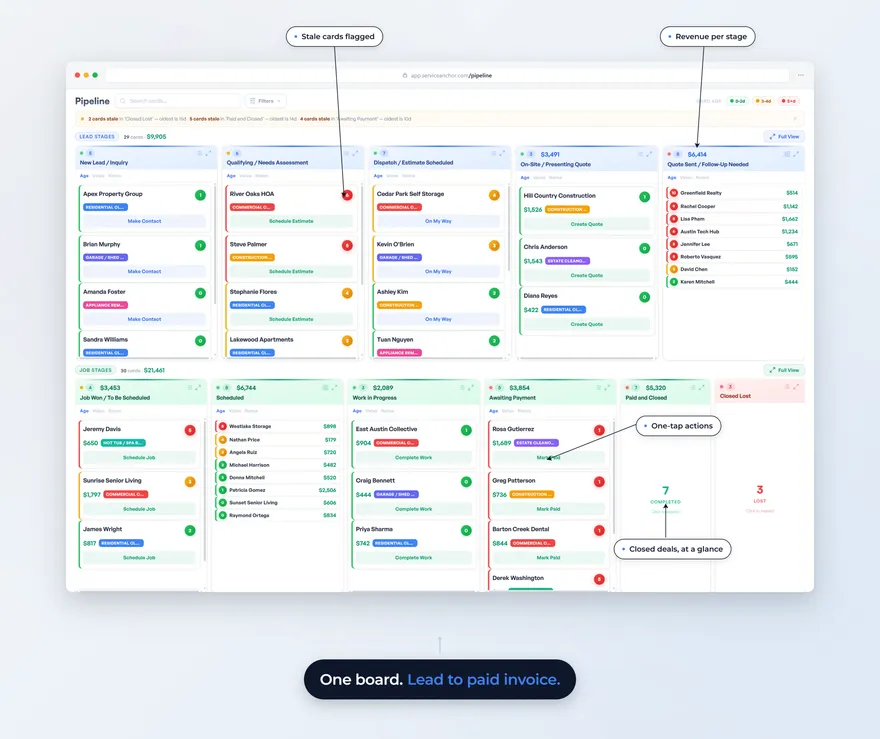
Once the name is set, it becomes the first line of every customer interaction, so the system behind it should be ready on day one. Service Anchor is the lead-to-paid pipeline that books, quotes, and chases each move automatically, preloaded for moving, so the name on your truck is backed by an office that runs itself. It does not register your name, file your trademark, or claim your domain, since those are yours to lock this week. What it does is make sure that the first time someone calls the number under that name, the lead lands somewhere that actually follows up. When you are ready to get that name in front of customers, our guide on how movers actually book jobs covers the channels that pay off first.
FAQ
What should I name my moving company?
Name your moving company something that passes five checks: readable on a truck, sayable on a phone, unclaimed in your metro’s search results, consistent with your registered business name, and available as a domain. Start by choosing the positioning you want to own, whether that is trust, speed, local presence, premium service, or your family name, then run your favorites through the checks. The right name is the one that clears all five, not the cleverest one on your list.
Can two moving companies have the same name?
Two moving companies can sometimes share a name if they operate in different states and neither holds a federal trademark, but it is a bad idea and often a legal risk. A shared name splits your search visibility, invites customer confusion, and can trigger a trademark dispute if the other company registered the mark first. Always run a state registry and USPTO trademark search before committing, and pick a name no one near you already uses.
Should I use my own name for my moving company?
Using your own name is a strong choice for a moving company because a real name signals accountability and trust, which matters in a trade where customers are handing strangers their belongings. The tradeoff is that a personal name is harder to sell later and ties the brand to you specifically. Many successful movers use a family-name format like “[Lastname] and Sons Moving” precisely because it reads as established and personal at the same time.
How do I check if a business name is taken?
Check if a business name is taken with four searches: your metro’s Google and Google Business Profile, your state’s business registry through the Secretary of State, the USPTO federal trademark database, and a domain and social-handle lookup. For a moving company, add a check of the FMCSA carrier records so your name does not collide with a registered mover. Do all of these before you print signage or build a website.
Do I have to register my moving company name?
Yes, you have to register your moving company name, either as your LLC or corporation name or as a DBA if you operate under a name different from your legal entity. Registration is also what lets your marketing name match your state or FMCSA licensing, which customers verify. Check availability with your Secretary of State first, then register before you advertise so no one else claims it while you build.
USPTO Trademark Search: source for the federal trademark database used to confirm a proposed name is not a registered mark, and the cloud-based system that replaced TESS in November 2023. https://www.uspto.gov/trademarks/search
FMCSA Company Snapshot (SAFER): source for the carrier-records check that confirms a proposed moving name does not collide with a registered motor carrier and matches the operator’s own registration. https://safer.fmcsa.dot.gov/CompanySnapshot.aspx
Last updated: July 2026. First publication: the operator’s moving-company naming framework (five checks) with 120 example names by positioning and the four-search availability workflow, including the mover-specific name-consistency check against carrier records.