A moving company business plan is a short operating document that states your service area, your crew-day economics, your rates, and how you survive the November-to-February demand trough. It is for the owner running or starting a one-to-five-truck local moving company, not for an MBA and not for a bank that wants a forty-page funding deck. More than 60% of all moves happen between May and September, which means a moving company lives or dies on whether its plan survives the other seven months, and almost no template online models that. This post rebuilds the plan around the four numbers that actually decide a small mover’s first year: the crew-day, the rate floor, the seasonal trough, and the startup line items. The full one-page plan is rendered inline below, each section with the math behind it, so you leave with a working plan instead of a blank template to fill in.
- A useful moving business plan is one page you run the company on, not a funding document you file and forget. The centerpiece is your crew-day economics, not an executive summary.
- The one number every plan needs and no template shows: the crew-day margin. One truck and two movers at 6 billable hours and a $140 rate is $840 in revenue against roughly $520 in direct cost, or about $320 a day before your own overhead.
- Seasonality is the plan’s real stress test. With 60%-plus of moves in May through September, a flat revenue projection is a lie, and the plan has to name how you cover the winter.
- Startup lands anywhere from about $5,000 to $10,000 out of pocket to get rolling if you rent a truck, or $25,000 to $50,000-plus if you buy one, with the full annual insurance premium as a recurring cost on top.
- Every number here is a derivation from stated inputs, not a promise. Swap in your own rate, hours, and costs and the plan still holds.
What goes in a moving company business plan?
A moving company business plan needs seven short sections, and only one of them is the executive summary that template mills lead with. The plan exists to answer a single question: can this company make money in the busy months and survive the slow ones? Everything in it should serve that answer. Here is the whole plan on one page.
| Section | What it states |
|---|---|
| Service area and focus | Your metro, your radius, and whether you do local only, local plus interstate, or add labor-only and loading jobs |
| Crew-day economics | What one truck and two movers earn and cost in a day (the engine of the whole plan) |
| Rate card and floor | Your hourly rate, your minimums, and the cost-based floor you will not price below |
| Seasonality plan | Your peak-season targets and, more important, how you cover the November-to-February trough |
| Startup costs | Entity, license, insurance, truck, and gear, as real line items |
| 90-day marketing plan | The two or three channels you will actually work to book the first jobs |
| Operating stack | The tools that run bookings, dispatch, and invoicing without an office manager |
The rest of this post derives the three sections that carry the weight: crew-day economics, seasonality, and startup costs. Our full walkthrough of how to start a moving company covers the operational setup around the plan.
What are the unit economics of one moving crew?
The unit economics of one moving crew come down to the crew-day: what one truck and two movers earn against what they cost in a single working day. This is the number that decides whether the business works, and it is the number no ranking business-plan template will show you. Start with revenue. A local crew billing at an hourly rate for two movers and a truck, running roughly 6 billable hours in a day, produces this:
Now the direct cost of putting that crew on the road for the day: two movers’ wages, the truck (fuel plus its amortized payment and maintenance), and the day’s share of your insurance.
That leaves a crew-day margin of about $320, or roughly 38% of revenue, before your own overhead and pay come out. Every input here is one you can replace: raise the rate to $160 and the margin jumps to $440; drop to 4 billable hours on a slow day and it collapses to near breakeven. That sensitivity is the point. The plan should show the margin at a realistic day, a great day, and a bad day, because your job as the owner is to keep the average above the line where overhead is covered. For the market rates that set your revenue side, our breakdown of what movers actually charge has the full hourly and per-crew numbers.
How do you price moving jobs in the plan?
You price moving jobs off a cost-based floor, not off what the mover down the road charges, and the plan should state that floor explicitly. The floor is your all-in cost per billable hour divided by one minus your target margin. Using the crew-day above, roughly $520 in direct cost over 6 billable hours is about $87 an hour in direct cost, and once you add a share of overhead you are closer to $110 to $115 an hour in true cost per billable hour. To hit a 25% margin, the floor lands near $150 an hour for a two-mover crew:
That is a floor, not your price. Your actual rate should sit above it, and in peak season it can sit well above it. What the floor gives you is a hard line: any job quoted below it earns less than your target margin, and anything below your true cost of roughly $112 an hour actually loses money once overhead is counted. The $140 rate in the crew-day example above clears your true cost and turns a healthy day, but it sits just under this 25%-target floor, which is exactly why peak-season pricing well above the floor is what makes the year work. The most common first-year mistake is booking a full summer of jobs priced under the floor and wondering why the bank account never grows. Carry the same binding-versus-hourly logic into your quotes that a solid moving contract uses, so the price you plan is the price you actually collect.
How does seasonality change a moving company’s plan?
Seasonality is the difference between a plan that survives and a projection that lies, because moving demand is one of the most seasonal in all of home services. More than 60% of moves happen from May through September, per moveBuddha’s peak-season analysis, and peak-month pricing runs 20% to 30% above winter rates. A flat revenue line across twelve months, which is what most templates produce, assumes a company that does not exist. The real curve spikes in summer and troughs hard from November to February, and the trough is what ends first-year movers who spent every peak-season dollar.
The plan absorbs the trough three ways, and it should name which ones you will use. First, a cash reserve: bank a set percentage of every peak-season crew-day specifically to cover fixed costs (insurance, truck payment, phone) through the slow months. Second, an off-season service mix: labor-only loading jobs, junk hauling, light delivery, and commercial work hold up better in winter than household moves and keep the crew paid. Third, off-season marketing: the operators who book January work are the ones still spending on lead generation in December when everyone else goes quiet. A plan that budgets for all three treats winter as a known season to manage, not a surprise to survive.
What does it cost to start a moving company?
Starting a moving company costs roughly $5,000 to $10,000 out of pocket to get rolling if you rent a truck, or $25,000 to $50,000 and up if you buy one. The swing is almost entirely the truck. That rent-to-start range covers your entity, your license, your gear, a truck rental deposit, and the down payment on your first insurance policy; the full annual insurance premium is the recurring cost you carry on top of it. Here are the real line items to put in the plan:
| Line item | Typical range | Notes |
|---|---|---|
| Business entity and EIN | $0 to $500 | EIN is free from the IRS; state LLC filing varies by state |
| License and authority | $300 to $500 | State household goods permit or FMCSA registration |
| Insurance (first year) | $15,000 to $26,000 | The largest recurring cost; often paid as a down payment plus monthly |
| Truck | $0 to $50,000+ | Rent or lease to start, or buy a used box truck |
| Gear (dollies, straps, blankets, tools) | $1,000 to $3,000 | The cheapest line, and the one that protects the customer’s goods |
Two of these link straight to their own guides, because they are big enough to plan on their own. The licensing path and its fees are covered in our moving company license walkthrough, and the coverage stack that drives that insurance number is broken down in our moving company insurance guide. Buying versus renting the truck is the honest first decision: renting keeps startup low and lets you prove the business before you take on a payment, while buying lowers per-job cost once volume is steady. The plan should state which you are doing and why.
What to do next
Write the one-page plan today, not next quarter, because the act of filling in your own crew-day and startup numbers surfaces the gaps before they cost you money. Stress-test it against January specifically: if the plan only works in July, it is not a plan, it is a good summer. Then revisit it every quarter as your real numbers come in and replace the estimates with actuals. A plan you update is worth ten you file.
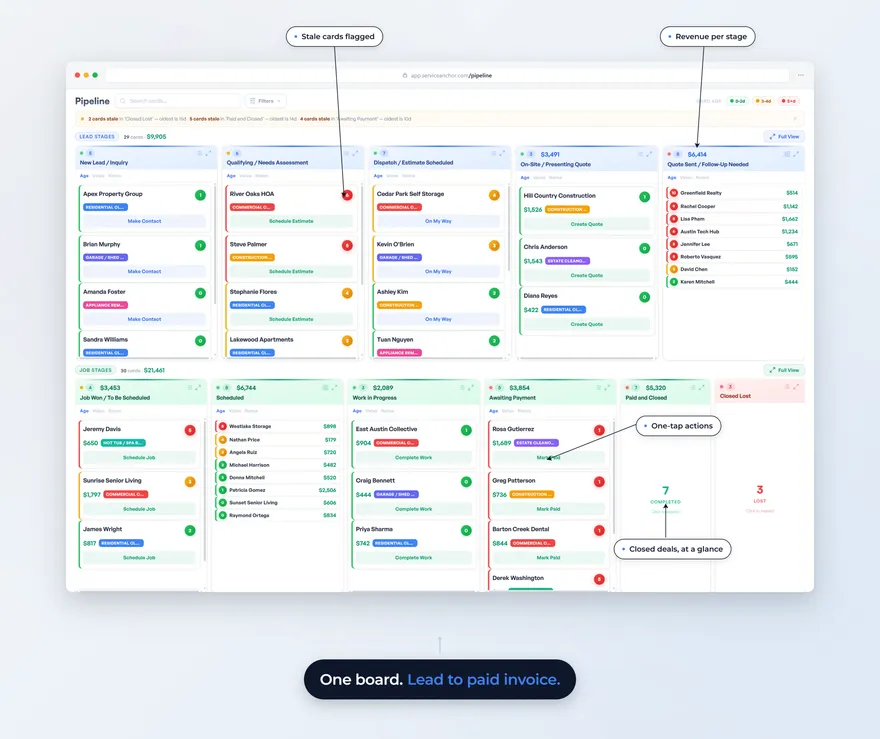
The operating-stack line in your plan is the part you can set up fastest and cheapest. Service Anchor is the lead-to-paid pipeline that books, quotes, and chases each move automatically, preloaded for moving, so the office runs itself while you are on the truck. It handles the pipeline from the first call to the paid invoice on one board, which is exactly the operating layer a lean plan assumes and a one-person shop cannot staff. It does not do your accounting, your payroll, or your financial projections, so the plan’s numbers stay yours to build. When you are ready to book the first jobs, our guide on how movers actually get customers covers the 90-day marketing section of the plan.
FAQ
How profitable is a moving company?
A well-run small moving company commonly holds a crew-day margin in the range of 30% to 40% before the owner’s overhead and pay, based on the cost derivation above, though the real figure depends entirely on your rate, your utilization, and your winter coverage. Profit is not a fixed number you can promise; it is what is left after you cover the direct cost of each crew-day and your fixed overhead across a full year. The operators who make money are the ones who price above their cost floor and bank peak-season cash for the slow months.
How much does it cost to start a moving company?
Starting a moving company costs roughly $5,000 to $10,000 out of pocket to get rolling if you rent a truck, or $25,000 to $50,000 and up if you buy one. The largest single recurring cost is insurance at $15,000 to $26,000 a year, and the largest one-time cost is the truck if you buy. You can start lean by renting a truck and adding gear, then buy once your volume justifies a payment.
Do I need a business plan to get a moving company loan?
Yes, most lenders and the SBA expect a written business plan when you apply for financing, and it usually needs financial projections, a market description, and an owner background section. The operating plan in this post covers the substance a lender wants to see, and you can expand it into the fuller format a specific loan program requires. The plan you run the business on and the plan you show a bank share the same numbers.
What is the slow season for movers?
The slow season for movers is November through February, when household moves drop sharply after the summer peak. With more than 60% of moves happening May through September, the winter months can run less than half of peak volume, which is why a moving company’s plan has to budget for the trough. Operators cover it with a cash reserve, an off-season service mix like labor-only and commercial work, and continued marketing while competitors go quiet.
How many trucks do you need to start a moving company?
You need one truck to start a moving company, and many successful operators begin with a single rented truck and a two-person crew before buying anything. Starting with one truck keeps startup costs low, lets you prove demand in your service area, and avoids a payment before you have steady volume. Add a second truck only when your first is consistently booked and turning away work.
moveBuddha, When Is Peak Moving Season: source for the statistic that more than 60% of moves occur May through September and that peak-season pricing runs 20% to 30% above off-season rates. https://www.movebuddha.com/blog/peak-moving-season/
U.S. Small Business Administration, Write Your Business Plan: source for the standard business-plan components and the lender expectation that financing applications include a written plan. https://www.sba.gov/business-guide/plan-your-business/write-your-business-plan
Last updated: July 2026. First publication: the operator-side moving business plan built around crew-day economics and the November-to-February demand trough, with the one-page plan and startup line items rendered inline.