A quote follow-up email is a short, scheduled message you send after a quote to move a customer who went quiet toward a yes or a no. This is for the one-truck-to-five-truck owner who sends a price and never hears back, and never sends a second message. The jobs you lose after quoting are rarely lost on price. They are lost on silence, because the customer got busy, compared a couple of bids, and forgot the one who did not follow up. The fix is not a lower number. It is a simple sequence of two to four touches over about two weeks, and the operator who runs it books work the quiet competitor leaves on the table. Below is the timing, the four copy-paste templates, and the one line most operators forget to include.
- Quoted jobs die from silence, not price. A short follow-up sequence recovers the ones that would have gone cold.
- Send the first follow-up within 24 hours and run three to four total touches over about two weeks. Speed to first contact matters more than any single message.
- The four templates below cover the whole arc: the quote itself, a two-day nudge, a five-day objection-opener, and a ten-day breakup that quietly reopens the door.
- The one line most operators skip is the approval instruction. “Reply YES to book” closes more jobs than any clever subject line.
- Give every quote an expiration date. A deadline is what turns a follow-up from nagging into a real reason to decide.
Why do quoted jobs go cold?
Quoted jobs go cold because a price with no deadline and no follow-up gives the customer nothing to act on, so it sits. You sent a fair number, the customer meant to get back to you, and then a work week happened. Nothing about that is a rejection. It is just how attention works when a quote lands in an inbox next to forty other emails. Harvard Business Review’s study of online sales leads found that response speed decays fast: firms that followed up within the first hour were far more likely to have a real conversation than those who waited even a day, and the odds keep dropping from there. The same pattern holds for a home-service quote. The window where the customer is still thinking about their written estimate is short, and every day of silence on your side widens the gap for the competitor who does pick up the thread.
There is a second reason worth naming. Many operators treat one message as “following up” and stop there. One nudge is easy to miss. A short sequence is not, and it signals that you actually want the job, which in a trade where the customer is choosing who to let onto their property is its own quiet trust signal.
How soon should you send the first quote follow-up?
You should send the first quote follow-up within 24 hours of sending the quote, and ideally the same day. The HBR response-time research is blunt about it: the sooner you make contact, the more likely the lead turns into a conversation, and waiting past a day cuts your odds sharply. In practice that means the first follow-up is not really a chase at all. It is a confirmation that the quote landed, sent while the customer still remembers asking for it.
The rest of the sequence spaces out from there. A workable default is day zero (the quote), day two (the nudge), day five (the objection-opener), and day ten (the breakup). Adjust to the job size: a $475 cleanout can run on a tighter clock than a $6,000 whole-house move where the customer is genuinely gathering bids. The principle holds either way. Consistent, spaced touches beat one message and a shrug.
What should a quote follow-up sequence look like?
A quote follow-up sequence should be three to four short messages over about two weeks, each with one job: deliver, nudge, open the objection, then close it out. Here are the four templates. Swap the brackets for the real job and keep them short. Nobody reads a long follow-up.
Email 1, sent with the quote (day 0).
Subject: Your [garage cleanout] quote from [Company]
Hi [Name], here is the quote for [the Saturday garage cleanout]. The total is [$475], and it is good through [July 27]. To lock in [Saturday], just reply YES or click approve and I will get you on the schedule. If anything on the scope needs a change, reply here and I will sort it out.
Thanks, [Your name], [Company]
Email 2, the nudge (day 2).
Subject: Quick question on your [garage cleanout] quote
Hi [Name], wanted to make sure the quote landed and see if anything looked off. If the scope or the timing needs a tweak, tell me what you had in mind and I will adjust it. Still holding [Saturday] open for you.
[Your name]
Email 3, the objection-opener (day 5).
Subject: Still want to get [the garage] cleared out?
Hi [Name], most folks who go quiet on a quote are either weighing a couple of bids or waiting on timing. Happy to help with either. If it is price, tell me your number and I will see what I can do on the scope. If it is timing, I can hold a date up to [three weeks] out. One reply and I will take it from there.
[Your name]
Email 4, the breakup (day 10).
Subject: Should I close this out?
Hi [Name], I have not heard back, so I will assume the timing is not right and close out the quote for [the garage cleanout] so it is not cluttering your inbox. If anything changes down the road, reply to this and I will pick it right back up, no need to start over. Thanks for considering us.
[Your name]
The breakup email is the one operators skip and the one that most often works. Telling someone you are about to close their file gives a stalled customer a reason to speak up, and a surprising share of “closed” quotes come back to life on that last message.
What do you write in a follow-up email after a quote?
You write a follow-up email after a quote by keeping it to three parts: a one-line reason for writing, one specific reference to their job, and one clear next step. The reason for writing is usually just “checking the quote landed.” The specific reference (“the Saturday garage cleanout,” not “your project”) proves you remember them and are not blasting a template. The next step is the line most operators forget: tell the customer exactly how to say yes. “Reply YES to book” or “click approve and I will hold your date” removes the small friction that keeps a warm customer from acting.
Two things to avoid. Do not apologize for following up (“sorry to bother you again”) because it frames your own message as an intrusion. And do not drop the price to reopen the conversation before the customer has raised price as the issue, because you will train good customers to wait for a discount. Lead with the scope and the deadline. Save any flexibility for the objection-opener, and only if price is what they actually name.
What to do next
Pick the four templates above, drop in your business name, and set them somewhere you will actually use them: saved replies in your email, a note on your phone, or your CRM. Then give every quote a real expiration date, because a follow-up with no deadline is just a reminder, while a follow-up on an expiring quote is a reason to decide. Pair this with a same-day quote and a professional estimate that includes the close-driving fields, and you have covered the two places jobs leak out: the quote that goes out slow and the silence that follows it. On the day of service, an on-my-way text keeps the momentum going, and a clean invoice closes the loop.
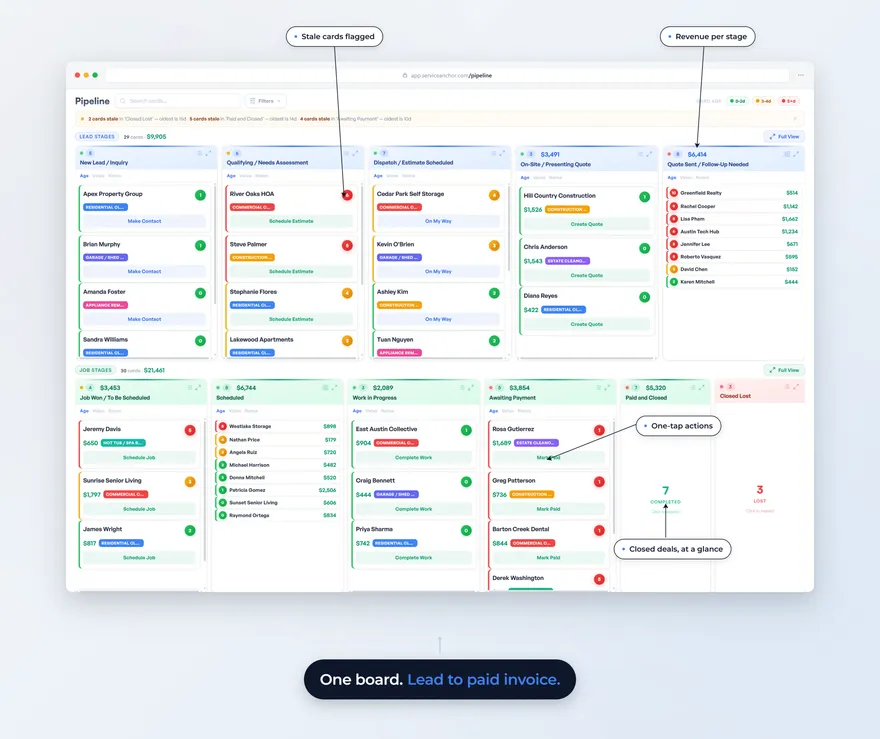
If remembering to send four emails per quote across a full schedule is the part that never happens, that is what a pipeline is for. Service Anchor sends a templated follow-up automatically when you send an estimate and tracks the moment the customer opens it, so you can see who is actually looking and who to chase next, preloaded for junk removal and the other trades. It will not write the customer’s decision for them, but it makes sure the first nudge goes out and the quiet ones do not slip through. When you are ready to turn more quotes into booked jobs, our guide on how operators actually get work covers the channels that fill the pipeline in the first place.
FAQ
How many times should you follow up on a quote?
Follow up on a quote three to four times over about two weeks. That is enough to catch a customer who got busy without tipping into nagging. A common sequence is the quote itself, a two-day nudge, a five-day message that opens the door to any objection, and a ten-day breakup email that closes the file while inviting them to reopen it. Most operators stop after one message, which is exactly why the second, third, and fourth touches recover jobs the competition already gave up on.
How long should you wait to follow up on a quote?
Send the first follow-up within 24 hours of the quote, then space the rest a few days apart. Research on sales-lead response time shows the odds of a real conversation drop sharply the longer you wait, so speed on the first touch matters most. After that, day two, day five, and day ten is a workable rhythm for most home-service jobs. Tighten the clock for small same-week jobs and loosen it for large jobs where the customer is genuinely gathering multiple bids.
What do you say in a follow-up email after a quote?
Say three things: why you are writing, one specific detail about their job, and exactly how to say yes. Keep it short, reference the actual job (“the Saturday garage cleanout”) so it does not read like a mass email, and end with a clear approval instruction like “reply YES to book.” Do not apologize for following up and do not cut the price before the customer has named price as the problem.
Should I follow up on a quote by text or email?
Follow up in whichever channel the customer first contacted you, and when in doubt, use both. Text gets read faster and works well for the short nudge, while email is better for sending the actual quote with line items and an approval link. Many operators send the quote by email and the day-two nudge by text. The channel matters less than the timing and the fact that you follow up at all.
When should you stop following up on a quote?
Stop after the breakup email, which is usually the fourth touch around day ten. At that point you have made it easy to say yes several times, and continuing to chase past a clear breakup message costs you more goodwill than the job is worth. The breakup itself does the work: it closes the file while leaving the door open, so the customer can reopen the conversation on their own timeline without you having to keep knocking.
Harvard Business Review, “The Short Life of Online Sales Leads”: source for the finding that speed of first contact strongly predicts whether a lead becomes a real conversation, and that the odds decay quickly after the first hour and day. https://hbr.org/2011/03/the-short-life-of-online-sales-leads
U.S. Federal Trade Commission, Consumer Advice on home improvement: source for the guidance that customers should get a written estimate with a description of the work, materials, a completion date, and a price, which is the written quote a follow-up sequence supports. https://consumer.ftc.gov/articles/how-avoid-home-improvement-scam
Last updated: July 2026. First publication: a four-touch quote follow-up email sequence for home-service operators, with copy-paste templates, response-time evidence, and the timing that books jobs the competition lets go cold.