A service agreement is a written contract between a home service business and a customer that sets the scope, price, payment terms, and cancellation rules before the work starts. This template is for the one-truck-to-five-truck owner who books jobs on a handshake or a texts-app quote and then eats the cost when the scope grows, the customer cancels the morning of, or someone says “I never agreed to that.” A clean agreement is not lawyer theater. It is the one page that decides who pays when a job goes sideways, and the clauses that protect you are the ones the generic template mills leave out. Below is the copy-paste template, the field-by-field reason each clause matters, and the four that keep a dispute from becoming a loss.
- A service agreement is the terms both sides sign before work starts. It sits between your estimate (the price) and your invoice (the bill), and it is what you point to when a job is disputed.
- Four clauses do most of the protecting: payment terms, cancellation and refund, change orders, and liability. Most free templates skip the reasons those clauses exist.
- Federal law gives customers a three-day right to cancel many in-home sales over $25, so your cancellation clause has to account for it rather than fight it.
- The template below works for any trade. For moving and dumpster rental, use the trade-specific versions that add the clauses those jobs need.
- Get it signed before the crew rolls. An agreement signed after the work is a receipt, not a protection.
What should a service agreement include?
A service agreement should include ten core elements: the parties, the scope of work, the price and payment terms, the schedule, a deposit line, a cancellation and refund policy, a change-order clause, a liability and insurance statement, a dispute and governing-law line, and signature blocks for both sides. The U.S. Federal Trade Commission advises customers to get the work, materials, timeline, and price in writing before a home-service job begins, so a complete agreement is also what a careful customer already expects. Here is the full checklist:
| Section | What goes in it |
|---|---|
| Parties | Your legal business name and the customer’s name, plus both contact methods |
| Service address | Where the work happens (often not the billing address) |
| Scope of work | Exactly what you will and will not do, itemized so there is no gray area |
| Price and payment terms | The total, what is due when (deposit, on completion, net terms), and accepted methods |
| Deposit | The amount to book and what it secures |
| Schedule | Start date or window and, where it applies, an estimated completion |
| Cancellation and refund | Notice required to cancel, any fee, and how the deposit is handled |
| Change orders | How added scope gets priced and approved before the crew does it |
| Liability and insurance | What you are responsible for, what you are not, and your coverage |
| Dispute and governing law | How disputes are handled and which state’s law applies |
| Signatures | Both parties, dated. This is what makes it an agreement |
That is the whole document. The difference between this and a form you download blind is not the layout. It is understanding which of these clauses is actually doing the protecting, which the next two sections cover.
What is the difference between a service agreement, an estimate, and a contract?
A service agreement is a type of contract that sets the full terms of a job, while an estimate is only the price and scope, and “contract” is the umbrella word for any binding agreement. In plain terms: your written estimate tells the customer what the work costs, and your service agreement adds everything that happens when reality does not match the plan, like a cancellation, a scope change, or damage. A signed estimate can function as a simple contract for a small job, but once the work carries real risk (a multi-hour crew job, access to a customer’s home, expensive property in your hands), the added clauses of a full agreement are what keep a disagreement from turning into a loss.
For most single-visit home service jobs, one document can do double duty: an estimate with the protective clauses attached becomes the service agreement, signed once. For repeat or higher-stakes work, a standalone agreement is cleaner. Either way the work order that follows tells your crew how to run the job, and the contractor invoice closes it out, so the three documents work as a set.
Which clauses actually protect a home service business?
The clauses that actually protect a home service business are the payment terms, the cancellation and refund policy, the change-order clause, and the liability statement, because those are the four places a job turns into a loss. A scope line and a price are easy. These four are the ones operators skip and then wish they had:
- Payment terms. State exactly what is due and when: the deposit to book, the balance on completion, and what happens if payment is late. Vague terms (“payment upon completion”) invite the “I’ll Zelle you tonight” job that never clears. Name the due date and the late consequence.
- Cancellation and refund. This is the one with a legal wrinkle. The FTC’s Cooling-Off Rule gives customers three business days to cancel many sales of $25 or more made in their home, and you are required to tell them about that right. Your clause should honor the three-day window, then set your own terms for cancellations after it (notice required, whether the deposit is kept). Fighting the cooling-off rule is a losing move; building your policy around it is not.
- Change orders. Scope creep is the quiet margin killer. “Oh, and the basement too” on the driveway is a new price, not a favor. A change-order clause says any work beyond the written scope gets a new price the customer approves before the crew does it. That one line turns an awkward driveway conversation into a routine one.
- Liability and insurance. State what you are responsible for (your crew’s work), what you are not (pre-existing damage, items the customer packed), and that you carry insurance. This is what protects you when a customer blames you for the crack that was already in the wall.
The pattern across all four: each clause names, in advance, who pays when something goes wrong. That is the entire job of a service agreement.
Free service agreement template
Copy the template below into your quoting tool, a document, or your CRM, and fill the brackets. It works for any trade. The bracketed guidance in each clause is there so you understand what you are agreeing to, not just where to sign.
SERVICE AGREEMENT

Business: [Legal business name], [phone], [email], [license # if your trade requires one]
Customer: [Name], [phone], [email]
Service address: [Where the work happens]
Date: [Issued date]        Agreement #: [Sequential number]

1. SCOPE OF WORK
[Itemize exactly what you will do. List anything explicitly excluded so there is no gray area.]

2. PRICE AND PAYMENT TERMS
Total: [$ amount]. Deposit due to book: [$ amount].
Balance due: [on completion / net 7 / etc.]. Accepted methods: [card, check, ACH].
Late payments: [state your late fee or interest, if any].

3. SCHEDULE
Start: [date or window]. Estimated completion: [date, or "billed at actual hours"].

4. CANCELLATION AND REFUND
Customer may cancel within three (3) business days of signing for a full refund of any
deposit, as required by law for in-home sales. After that window, cancellations require
[24/48] hours' notice; the deposit [is/ is not] refundable after that point.

5. CHANGE ORDERS
Any work beyond the scope above is a change order, priced and approved in writing
before it is performed. No added work is done without the customer's approval.

6. LIABILITY AND INSURANCE
[Business] is responsible for damage caused directly by its work. [Business] is not
responsible for pre-existing conditions or [items packed by the customer / etc.].
[Business] carries [general liability] insurance; proof available on request.

7. DISPUTE AND GOVERNING LAW
This agreement is governed by the laws of [State]. Disputes will be resolved by
[negotiation, then small-claims court / mediation in County, State].

8. SIGNATURES
Customer: ______________________  Date: __________
[Business]:  ______________________  Date: __________
For a small single-visit job, you can merge this with your estimate so the customer signs one page. For higher-stakes trades, use a version tuned to the job: the moving contract template adds the clauses a local move needs, and the dumpster rental agreement covers the drop-off, pickup, and overage terms a roll-off business runs on.
What to do next
Take the template above, fill in your business details and your standard payment and cancellation terms once, and save it as your default so every job starts from the same protected baseline. Then get it signed before the crew rolls, because an agreement signed after the work is just a receipt. Pair it with a same-day job estimate, a clear crew work order, and a fast invoice to get paid, and you have the full document set that keeps a job clean from the first call to the last check.
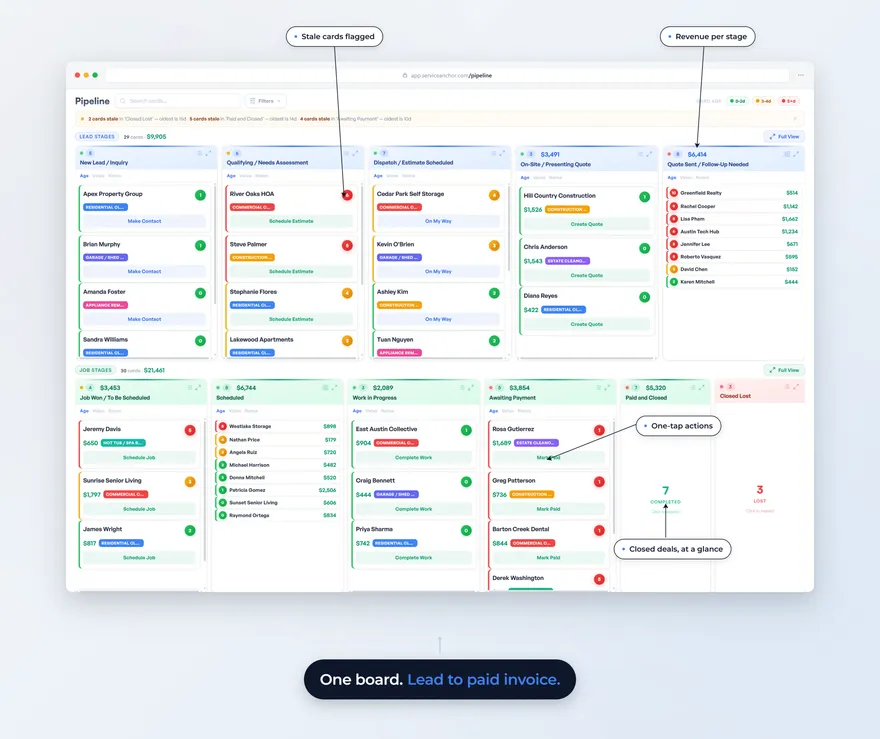
If rebuilding this in a Word file for every job is the part that never happens, that is what a pipeline is for. Service Anchor sends your estimate with a hosted link the customer approves or declines online, captures a digital signature in the field when the job is done, and carries the whole record from lead to paid invoice on one board, preloaded for junk removal and the other trades. It does not replace a lawyer or write your terms for you, but it keeps the agreed price, the approval, and the signature attached to the job instead of lost in a text thread.
FAQ
What is a service agreement?
A service agreement is a written contract between a service business and a customer that sets the scope of work, the price and payment terms, the schedule, and the rules for cancellation, changes, and liability before the work begins. It is what both sides point to if the job is disputed. For a home service business, it protects against the three most common losses: scope creep, last-minute cancellations, and blame for damage that was not your fault.
Do I need a service agreement for a small job?
For a small single-visit job, a signed estimate with a few added terms (payment, cancellation, and a change-order line) usually does the work of a service agreement. The larger the job or the higher the risk (crew access to a home, expensive property in your care, multi-hour work), the more you want a full agreement with liability and dispute clauses. The cost of writing it is one afternoon; the cost of not having it is a single disputed job.
Is a service agreement legally binding?
A service agreement is generally legally binding once both parties sign it and there is an exchange of value (the service for the payment). To hold up, it needs clear terms, mutual agreement, and signatures from both sides. Keep the signed version on file, and be aware that consumer-protection laws (like the FTC’s three-day cooling-off rule for in-home sales) can give the customer certain cancellation rights regardless of what the agreement says.
What is the difference between a service agreement and a contract?
A service agreement is a specific kind of contract; “contract” is the broader term for any legally binding agreement. In everyday use the words are interchangeable for home service work. The practical point is not the label but the content: a document that names the scope, price, payment terms, cancellation policy, and both signatures is enforceable whether you call it an agreement or a contract.
How do I write a service agreement?
Write a service agreement by listing the parties, the service address, an itemized scope of work, the price and payment terms, a deposit line, the schedule, a cancellation and refund policy, a change-order clause, a liability statement, and signature blocks for both sides. Use plain language the customer understands, honor the FTC three-day cooling-off window in your cancellation clause, and get it signed before work starts. The template above gives you the whole structure to copy.
U.S. Federal Trade Commission, Consumer Advice on home improvement: source for the guidance that customers should get the work, materials, timeline, and price in writing before a home service job begins. https://consumer.ftc.gov/articles/how-avoid-home-improvement-scam
U.S. Federal Trade Commission, Cooling-Off Rule: source for the three-business-day right to cancel many sales of $25 or more made at the customer’s home, and the seller’s duty to disclose it. https://consumer.ftc.gov/articles/buyers-remorse-when-ftcs-cooling-off-rule-may-help
Last updated: July 2026. First publication: a free home-service service agreement template with the four protective clauses (payment terms, cancellation with the FTC cooling-off rule, change orders, liability) explained, plus a copy-paste document.