Starting a dumpster rental business costs anywhere from about $10,000 for a bare micro-entry with a dump trailer and a few small containers to $300,000 or more for a full one-truck operation with a new roll-off truck and a starter fleet, and the gap between those numbers is almost entirely whether you own a roll-off truck and how many containers you carry, not a hidden cost the vendor guides are omitting. This is for the operator planning to enter the trade independently, weighing used against new and side-hustle against full-time. A representative middle path, one used roll-off truck and five containers, runs roughly $95,000 to $110,000 all in. Below is the cost math reconciled by scale, the permit question answered by category instead of a vague check-your-city, and what actually makes dumpster rental different to run than junk removal.
- Startup cost is driven by two things: whether you own a roll-off truck and how many containers you carry. A dump-trailer micro-start runs $10,000 to $30,000, a used one-truck operation $75,000 to $150,000, and a new-equipment full build $300,000 to $500,000 or more.
- A representative used one-truck starter, a $65,000 to $90,000 used roll-off truck plus five containers, insurance, permits, and software, lands around $95,000 to $110,000.
- You need a right-of-way or street-occupancy permit only when a container sits on a public street or sidewalk. On private property like a customer’s driveway, most cities require no permit. Street permits commonly run $10 to $25 per week.
- Dumpster rental is the one trade with a two-trip job: you drop the container, then pick it up days or weeks later. There is no upfront quote, and you settle overage and extra-day charges at the end.
- Most operators start with five to ten containers across two or three sizes, matched to one truck, and add as demand proves out.
How much does it cost to start a dumpster rental business?
Starting a dumpster rental business costs between about $10,000 and $500,000, and the enormous range is not a mystery: it tracks exactly one decision, whether you buy a roll-off truck new, used, or not at all, and a second, how many containers you stock. The vendor guides that quote wildly different numbers are all correct for the scale they assume. Financial Models Lab models a fully-built operation at roughly $445,000 in capital equipment and $661,000 all in with reserves, while a lean operator who starts with a dump trailer and contracts out hauling can be in business for a tenth of that.
Here is the range reconciled by path rather than thrown at you as a single confusing spread:
| Path | What it is | Startup range |
|---|---|---|
| Dump-trailer micro-start | Pickup plus a dump trailer or a few small containers, hauling contracted out | $10,000 to $30,000 |
| Used one-truck operation | Used roll-off truck plus five to ten containers | $75,000 to $150,000 |
| New-equipment full build | New roll-off truck plus a 10-to-15-container fleet and a yard | $300,000 to $500,000+ |
For most independents, the used one-truck path is the real starting point. A used roll-off truck runs $65,000 to $90,000, and used 10-to-30-yard containers run $2,000 to $6,000 each, so five of them is $15,000 to $25,000. Add first-year insurance, permits, and marketing, and a representative starter lands around $95,000 to $110,000 in startup capital, a single realistic configuration within the range rather than the sum of the extremes, with a storage yard as an ongoing monthly cost on top. Our full dumpster rental cost breakdown sizes the truck, container, tipping, and hauling numbers in detail, and the dumpster sizes guide helps you pick the two or three sizes that move fastest in your market.
| Line item (used one-truck starter) | Cost |
|---|---|
| Used roll-off truck | $65,000 to $90,000 |
| Five used containers (10 to 30 yard) | $15,000 to $25,000 |
| First-year insurance | $8,000 to $12,000 |
| Permits and licensing | $500 to $2,000 |
| Marketing and Google Business Profile setup | $1,000 to $3,000 |
| Operations software | From $29 a month |
Do you need a permit to start a dumpster rental business?
You need a permit to place a dumpster only when the container sits on public property, and you usually do not when it sits on private property like a customer’s driveway. This is the question every vendor guide waves away with check-your-local-laws, and the honest answer has a clear shape. When a roll-off container occupies a public street, sidewalk, or other part of the right-of-way, cities require a right-of-way or street-occupancy permit before placement. When the container sits entirely on the customer’s own driveway or lot, most cities require no permit at all.
The public-right-of-way permit is the one to understand, because it recurs on real jobs. Denver, for example, requires a revocable street-occupancy permit before any container goes in the right-of-way, mandates the container fit within the parking lane and stay clear of corners and crosswalks, and caps placement at 180 days in a 12-month window. Costs are modest, commonly in the $10 to $25 per week range though it varies by city, but processing can take several days, and the city will want proof of liability insurance on file. That timing matters operationally: if a customer needs a street placement Monday, you cannot promise it Friday afternoon. Beyond placement permits, you will also need the standard business licensing any operation carries, plus a waste-hauler registration in some jurisdictions.
What makes dumpster rental different from junk removal to run?
Dumpster rental is different from junk removal because it is a two-trip job with no upfront quote and a final settlement, where junk removal is a single visit priced on the spot. In junk removal, you show up, quote the load, haul it, and invoice once. In dumpster rental, you drop a container, leave, and come back days or weeks later to pick it up, and the customer never got a custom quote. They ordered a size and a rental window off a rate card, the same way our dumpster rental pricing guide lays out.
That structure changes the paperwork and the billing. The rental period, the weight cap, the overage rate, and the extra-day fee all have to be agreed before the drop and settled after the pickup, which is exactly what a solid dumpster rental agreement is built to govern. It also changes the software you need: your system has to track a container that is out on a job, when it is due back, and whether the final weight or the extra days changed the bill. That is a genuinely different shape of work than a one-and-done junk haul, and it is why picking operations software that fits dumpster rental is worth doing deliberately rather than bolting on whatever a truck vendor recommends. If you are still deciding whether to build this yourself or buy into a brand, our dumpster rental franchise versus independent breakdown runs that math.
What to do next
Start with five to ten containers across two or three sizes matched to one truck, and let real booking volume tell you what to add, because over-buying containers is the fastest way to tie up cash you need for the first slow season. Get your Google Business Profile verified and claim the “dumpster rental near me” local search before you spend a dollar on ads, since local intent is where the early bookings come from. Set your rate card, your rental windows, and your overage terms up front so every order runs off the same rules.
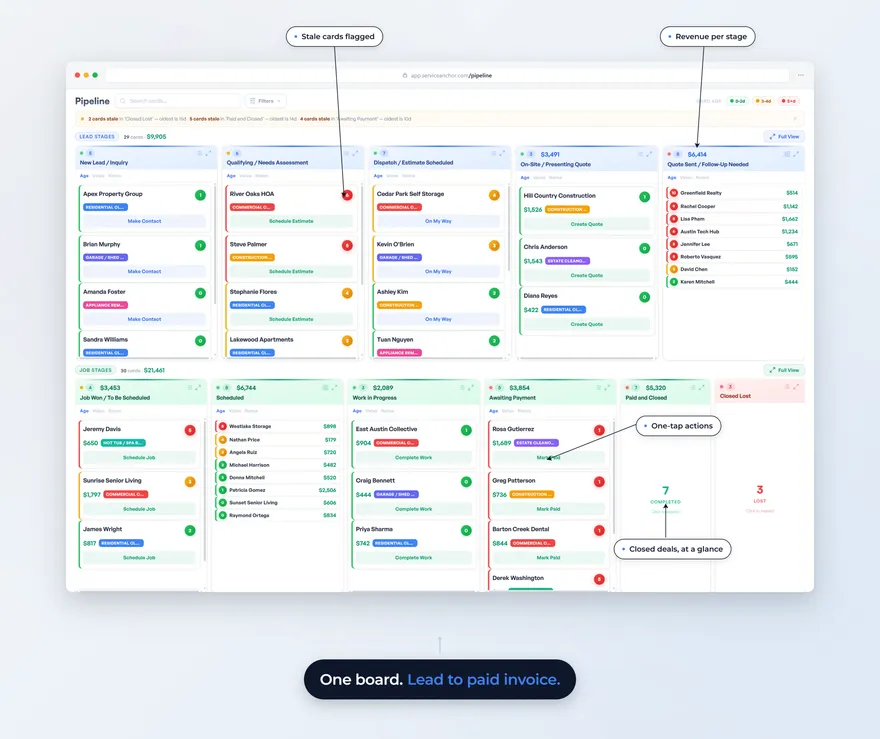
The customer-facing side of the operation, booking, quoting, invoicing, and follow-up, is the part you can stand up fastest. Service Anchor is the lead-to-paid pipeline that runs all of that on one board, and it ships with a dumpster rental price book preloaded so your sizes and rates are set up in about 90 seconds rather than built from a blank screen. Founding members lock in $29 a month, everything included. It covers booking through paid invoice, so you are not stitching a booking form to a spreadsheet to an invoicing app in your first month while you are also learning the trade. Tracking which container is sitting where and when it is due back is its own operational habit you run alongside it, not something a lead pipeline does for you. Once you are booking jobs and ready to set pricing that actually holds margin, our dumpster rental cost guide and the dumpster rental industry landing page are the next stops.
FAQ
How much does it cost to start a dumpster rental business?
Starting a dumpster rental business costs between about $10,000 and $500,000, depending almost entirely on whether you own a roll-off truck and how many containers you carry. A dump-trailer micro-start with contracted hauling runs $10,000 to $30,000, a used one-truck operation with five to ten containers runs $75,000 to $150,000, and a new-equipment full build with a larger fleet runs $300,000 or more. A representative used one-truck starter lands around $95,000 to $110,000 all in.
Do you need a permit for a dumpster rental business?
You need a permit to place a container on public property, but usually not to place one on private property. When a roll-off dumpster sits on a public street, sidewalk, or right-of-way, cities require a street-occupancy or right-of-way permit, commonly $10 to $25 per week, with proof of liability insurance and several days of processing time. When the container sits on the customer’s own driveway or lot, most cities require no placement permit, though you still need standard business licensing to operate.
How many dumpsters do you need to start a dumpster rental business?
Most dumpster rental operators start with five to ten containers across two or three common sizes, matched to a single roll-off truck. Starting lean and adding containers as booking volume proves out keeps your initial investment near the low end of the range and avoids tying up cash in bins that sit in the yard. The right size mix depends on your local demand, which is why watching which sizes book fastest in your first months matters more than buying a big fleet upfront.
Is dumpster rental a profitable business?
Dumpster rental can be a profitable business, and most cost models put breakeven for a well-run one-truck operation somewhere around 9 to 12 months. Profitability depends on keeping containers turning rather than sitting idle, controlling tipping and fuel costs, and pricing rental windows and overages so extra days and heavy loads are billed rather than absorbed. Utilization is the number that decides it: the same truck and containers make money or lose it based on how many jobs they turn in a month.
Can you start a dumpster rental business part time?
Yes, you can start a dumpster rental business part time, and the dump-trailer micro-start is the common way in. With a pickup, a dump trailer or a few small containers, and hauling you handle on evenings and weekends, an operator can test demand for $10,000 to $30,000 before committing to a roll-off truck. The tradeoff is limited capacity and slower turns, so most part-time starters graduate to a used roll-off truck once bookings are steady enough to justify the jump.
Financial Models Lab, Startup Costs to Launch a Dumpster Rental Business: source for the full-build capital figures (roughly $445,000 in equipment, $661,000 all in with reserves), the new-versus-used roll-off truck ranges, and the 9-to-12-month breakeven estimate used to reconcile the startup-cost spread by scale. https://financialmodelslab.com/blogs/startup-costs/dumpster-rental-service
City and County of Denver, Department of Transportation and Infrastructure, Dumpster and Container Right-of-Way Permit: source for the street-occupancy permit requirement, the placement restrictions (parking lane, clearance from corners and crosswalks), the 180-day placement cap, and the liability-insurance condition used as the representative public-right-of-way example. https://denvergov.org/files/assets/public/v/3/doti/documents/permits/dotipt-104.1-dumpster-and-container.pdf
Last updated: July 2026. First publication of this guide, built from live 2026 startup-cost models and a municipal right-of-way permit example.