An empty roll-off dumpster weighs about 3,500 pounds for a 10-yard up to roughly 7,000 to 9,000 pounds for a 40-yard, but the number that actually costs money is the debris weight, which most rentals cap at 1 to 5 tons depending on size. This is written for the roll-off operator, or the junk hauler adding roll-offs, quoting a heavy load and needing to know if it will blow the tonnage limit. The empty weight barely matters, because it does not bill against the customer; a 20-yard of broken concrete hits the truck’s legal haul limit at roughly a quarter full, while a 20-yard of household junk barely registers. This guide ties together the four things the ranking pages keep on separate pages: empty weights by size, tonnage limits by size, material weight by debris type, and the overage math that decides whether a heavy job makes money.
- Empty roll-off weight runs from about 3,500 pounds (10-yard) to roughly 9,000 pounds (40-yard) and varies by manufacturer and steel gauge, but it does not count against the customer’s limit.
- The number that bills is debris weight against the included tonnage: roughly 1 to 2 tons on a 10-yard, up to 4 to 5 tons on a 40-yard. Above that, you pay a per-ton overage.
- Material density is everything. Broken concrete runs about 4,000 pounds per cubic yard, so just 5 cubic yards fills the truck’s roughly 10-ton legal haul limit. Household debris runs 150 to 400 pounds per cubic yard, so volume runs out long before weight does.
- Overage fees typically run $40 to $200 per ton, most commonly $50 to $100, pro-rated on the amount over your included tonnage.
- The operator move is to quote heavy jobs (roofing, concrete, dirt) by weight, not by volume, and build the tonnage limit into the flat rate so a surprise ton does not eat the margin.
How much does a dumpster weigh empty?
An empty roll-off dumpster weighs between roughly 3,500 and 8,000-plus pounds depending on its size, and the exact number varies by manufacturer and the gauge of steel used. The empty weight (the tare weight) matters for the hauling truck’s total load, but it does not count against the customer’s tonnage limit, so it is the number the ranking pages lead with and the operator cares about least. Here are the approximate empty weights by size.
| Dumpster size | Approximate empty weight |
|---|---|
| 10-yard | 3,500 to 4,000 lbs |
| 15-yard | 4,000 to 5,000 lbs |
| 20-yard | 4,800 to 5,500 lbs |
| 30-yard | 6,000 to 8,000 lbs |
| 40-yard | 7,000 to 9,000 lbs |
Treat these as ranges, not exact figures, because a heavy-gauge construction container weighs more than a light residential one of the same volume. What you bill on, and what can cost you a fee, is the weight of what goes inside.
What is the weight limit of a roll-off dumpster?
The weight limit of a roll-off dumpster is the tonnage the rental price includes before overage charges start, and it runs from about 1 to 2 tons on a 10-yard up to 4 to 5 tons on a 40-yard. The limits exist because the loaded truck has a legal road weight it cannot exceed. A roll-off truck can typically haul up to around 10 tons (20,000 pounds) of debris legally, and rental tonnage limits are set below that ceiling to keep the loaded truck street-legal and safe.
| Dumpster size | Typical included tonnage |
|---|---|
| 10-yard | 1 to 2 tons |
| 15-yard | 1 to 2 tons |
| 20-yard | 2 to 3 tons |
| 30-yard | 2 to 4 tons |
| 40-yard | 4 to 5 tons |
The gap between the included tonnage and the truck’s legal ceiling is your buffer, but it closes fast on dense material. For how these limits fold into what you charge, see our dumpster rental pricing guide, and for matching the size to the job, our dumpster sizes guide is the companion to this one.
How much does debris weigh by material?
Debris weight varies enormously by material, and this is the section the other pages skip: the same volume of concrete and household junk can differ by more than tenfold in weight. The figures below are as-loaded densities, meaning the weight of the material as it actually goes into a roll-off, which is the number that determines whether you blow the tonnage limit. Government volume-to-weight tables report lower numbers because they measure loose commingled bins, but the as-loaded broken-material density is what fills your container.
| Material | As-loaded weight per cubic yard | Note |
|---|---|---|
| Broken concrete or asphalt | 3,500 to 4,200 lbs | Solid concrete is about 4,050 lbs per cubic yard (150 lbs per cubic foot) |
| Dirt or soil | 2,000 to 3,000 lbs | Wet soil weighs more |
| Asphalt roofing shingles | 2,400 to 2,600 lbs | A tear-off adds up fast |
| Drywall | 500 to 750 lbs | Bulky but light |
| Yard waste (no dirt) | 400 to 700 lbs | Green waste holds water |
| Household or mixed debris | 150 to 400 lbs | Volume runs out before weight |
Carpet is the sleeper on this list. It looks like a volume load and bills like a weight load, because disposed carpet runs about 4.5 pounds per square yard once soil and moisture are in it, which is worked through in the carpet removal cost guide. The takeaway for quoting: dense material hits the limit at a fraction of the container’s volume. At roughly 4,000 pounds per cubic yard, just 5 cubic yards of broken concrete equals 10 tons, the truck’s legal haul ceiling, so a 20-yard box is full by weight at about a quarter of its volume. That is why you never quote a concrete or dirt job by how full the box looks.
How do dumpster overage fees work?
A dumpster overage fee is a per-ton charge applied to the weight above your included tonnage, and it typically runs $40 to $200 per ton, most commonly $50 to $100, pro-rated on the excess. The fee tracks the local landfill tipping fee the hauler pays, so it is real cost passed through, not just a penalty. Here is the math on a common weight-sensitive job.
Take a 20-yard rated for 3 included tons, filled with an asphalt-shingle roof tear-off. Shingles run about 2,500 pounds per cubic yard, and the load lands at 4.2 tons. That is 1.2 tons over the limit, and at a $65 per-ton overage rate, the customer owes an extra $78 on top of the base rental. The operator who quoted a flat rate without accounting for the weight just gave $78 of margin away. The fix is to build the expected tonnage into the quote on heavy jobs, note the overage rate in your dumpster rental agreement, and treat overage as a cost line in your rental cost math, not a surprise.
What to do next
Quote weight-sensitive loads by weight, not by how full the box looks, and you stop giving away margin on heavy jobs. The operator checklist: know your transfer station’s per-ton price so your overage math reflects real cost, set your tonnage limits by material risk (a lower cap on containers you rent for concrete and dirt), add a weight line to the quote on any roofing, concrete, or soil job, and photo-document the fill level at pickup so an overage charge is defensible. Knowing your tonnage economics cold is a startup fundamental, which our guide on how to start a dumpster rental business covers alongside the rest of the numbers.
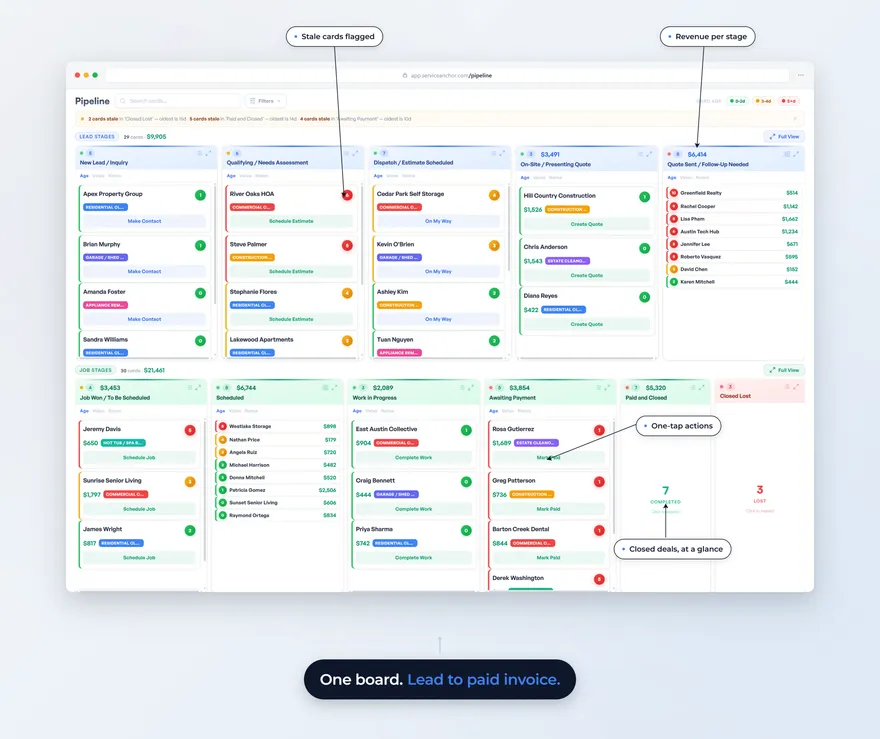
Weight-sensitive quoting only works if the quote, the job, and the final weight adjustment stay on one record, because the overage you cannot tie back to a specific job is the one you eat. Service Anchor keeps each job on one board, from quoted to scheduled to invoiced, with the dumpster rental price book preset on the general pipeline, so the tonnage you planned and the tonnage you billed live in the same place. It runs the pipeline and the paperwork; the weighing and the tonnage limits are yours to set. What it makes sure of is that the adjustment gets billed instead of forgotten.
FAQ
How much does an empty dumpster weigh?
An empty roll-off dumpster weighs about 3,500 to 4,000 pounds for a 10-yard and up to 7,000 to 9,000 pounds for a 40-yard, with the exact figure depending on the manufacturer and steel gauge. This tare weight matters for the hauling truck’s total road weight but does not count against the customer’s tonnage limit. The weight that bills the customer is the debris loaded inside, not the container itself.
What is the weight limit on a 20-yard dumpster?
A 20-yard roll-off dumpster typically includes 2 to 3 tons of debris in the rental price, with a per-ton overage fee above that. The exact included tonnage varies by rental company and by what the local landfill charges, so confirm the number on your specific rental. For heavy material like concrete or dirt, a 20-yard will hit its weight limit long before it is physically full.
How much does a yard of concrete weigh in a dumpster?
A cubic yard of broken concrete weighs roughly 3,500 to 4,200 pounds as loaded into a dumpster, and solid concrete is about 4,050 pounds per cubic yard. That density means concrete reaches a roll-off’s tonnage limit at a small fraction of the container’s volume: about 5 cubic yards is already 10 tons, the truck’s legal haul ceiling. Concrete and dirt jobs should always be quoted by weight, not by how much space they take.
What happens if you go over the dumpster weight limit?
If you go over the dumpster’s included tonnage, the rental company charges a per-ton overage fee, typically $40 to $200 per ton and most often $50 to $100, on the weight above the limit. The load is weighed at the landfill or transfer station, and the overage is added to your bill. For an operator, the fix is to build the expected weight into the flat quote so the overage does not come out of your margin.
How is dumpster overage calculated?
Dumpster overage is calculated by subtracting the included tonnage from the actual weighed tonnage and multiplying the difference by the per-ton overage rate. For example, a load that comes in at 4.2 tons on a 3-ton limit is 1.2 tons over, and at $65 per ton that is a $78 overage charge. The actual weight comes from the certified scale at the disposal site, which is why photo-documenting fill level at pickup helps.
Contra Costa County, Volume-to-Weight Conversion Table for Construction and Demolition Debris: source for the government-reported loose commingled-bin densities of concrete, roofing, drywall, soil, and yard waste referenced as the loose-measurement baseline. https://www.contracosta.ca.gov/DocumentCenter/View/49316/Volume-to-Weight-Conversion-Table
Roll-Off Dumpster Direct, Debris Weight Guide: source for the as-loaded broken-material densities (concrete, shingles, dirt, drywall, yard waste, household debris) used in the material-weight table, the figures that actually determine tonnage in a roll-off. https://www.rolloffdumpsterdirect.com/debris-weight-guide/
Last updated: July 2026. First publication: the operator’s roll-off weight guide unifying empty weights, tonnage limits, as-loaded material densities by debris type, and the overage math, framed for quoting weight-sensitive loads.