The best truck for a junk removal business depends on your stage: a dump trailer behind a three-quarter-ton pickup is the cheapest way to start, a dedicated dump truck is the volume upgrade, and a box or cabover truck maximizes cubic yards per trip. This guide is for the operator choosing a first truck or a second one, who wants to move real loads without sinking the whole startup budget into steel. The spec that matters is not the badge on the hood. It is cubic-yard capacity, how easily the truck dumps, and whether the loaded weight keeps you under the 26,001-pound line that triggers a commercial driver’s license. Below are the four truck types with real cost ranges, how to size the box to your job mix, the licensing weight rules, and the year-one buy that keeps your cash where it belongs.
- Start with a dump trailer behind a pickup you may already own. It is the lowest-capital way into the trade, usually $6,000 to $14,000 for the trailer versus $20,000-plus for a dedicated dump truck.
- The industry benchmark for a “full truck” is about 15 to 16 cubic yards. Size your rig to the jobs you actually run, not the biggest one you can imagine.
- A hydraulic dump (trailer or truck) is worth the premium over a manual bed. It turns a 20-minute unload into a 2-minute one, and that time is billable jobs.
- Watch the weight. A gross vehicle weight rating of 26,001 pounds or more triggers a commercial driver’s license, and most single-truck junk setups are built to stay just under it.
- Buy used for the first truck. A clean used dump trailer or dump truck does the same work as new at a fraction of the capital, and junk hauling is hard on equipment anyway.
What kind of truck do you need to start a junk removal business?
To start a junk removal business you need a dump trailer towed by a three-quarter-ton or one-ton pickup, which is the lowest-capital rig that still hauls real loads. If you already own the pickup, a dump trailer gets you working for the price of the trailer alone, and it dumps hydraulically so you are not shoveling a load out by hand at the transfer station. This is the setup most operators we talk to actually start on, and it is the one the junk removal startup sequence recommends for year one, because it keeps your capital in marketing and dump fees instead of a truck payment.
You do not need a dedicated dump truck on day one, and buying one before your volume justifies it is the most common first-year money mistake in this trade. A dump truck earns its keep once you are running multiple full loads a day and the trailer’s hitch-and-tow cycle slows you down. Until then, the trailer does the same job for a fraction of the monthly cost. The rest of your first-year kit (straps, dollies, tarps, bins) is covered in the junk removal equipment guide.
What are the main junk removal truck types?
The main junk removal truck types are the dump trailer, the dump truck or dovetail, the box or cabover truck, and the stake-bed or flatbed, and each trades capital for capacity and convenience. Here is how they compare for a 1-to-5-truck operation:
| Truck type | Rough capacity | Typical cost (used) | Best for |
|---|---|---|---|
| Dump trailer + pickup | 6 to 12 cu yd | $6,000 to $14,000 (trailer) | Starting out; lowest capital; hydraulic dump |
| Dump truck / dovetail | 12 to 16 cu yd | $20,000 to $45,000 | Volume upgrade; no trailer to hitch |
| Box / cabover truck | 15 to 20 cu yd | $25,000 to $55,000 | Max cubic yards per trip; weather-protected load |
| Stake-bed / flatbed | 8 to 14 cu yd | $15,000 to $35,000 | Bulky items; easy side loading; no dump (manual) |
The dividing line is the dump mechanism. A dump trailer, dump truck, and dovetail all lift the load out hydraulically, which is the single biggest labor saver in the trade. A stake-bed or flatbed is cheaper and easier to load from the side, but you unload it by hand, and that manual unload is time you could have spent on the next job. For a business where speed per stop is the whole margin, the hydraulic dump usually pays for itself fast.
How big should a junk removal truck be?
A junk removal truck should hold about 15 to 16 cubic yards to match the industry benchmark for a “full truck,” but the right size for you is the one that fits your actual job mix. Residential cleanouts, the bread and butter of the trade, rarely fill a 16-cubic-yard box on a single stop, so many operators run a 10-to-12-cubic-yard dump trailer and simply make a second dump run on the rare oversized job. That is cheaper than owning a giant truck that runs half-empty most days.
Size up when your data says to. If you are routinely turning away or splitting loads because your rig is too small, the next truck should be bigger. If you are dumping half-full most days, you bought too much truck. The junk removal business plan is where you run this math against your expected job mix before you buy, so the truck matches the work instead of the ambition.
Do you need a CDL or USDOT number for a junk removal truck?
You usually do not need a commercial driver’s license for a junk removal truck, because a CDL is only required when the vehicle’s gross vehicle weight rating is 26,001 pounds or more, and most single-truck junk setups are built to stay under that line. Per the Federal Motor Carrier Safety Administration, the 26,001-pound GVWR threshold is what separates a standard license from a required CDL, so a three-quarter-ton pickup with a dump trailer, or a light dump truck, typically keeps you in standard-license territory. Check the GVWR on both your truck and your loaded trailer, because a heavy combination can cross the line even when each piece looks modest.
Whether you need a USDOT number depends on weight and whether you cross state lines. The FMCSA requires a USDOT number for commercial vehicles operating in interstate commerce above certain weight thresholds, and a growing number of states require one for intrastate operation too. Most local junk removal stays intrastate, so the federal trigger often does not apply, but this is a state-by-state check you make before you run loads for pay. Bundle it with the rest of your paperwork in the junk removal business license checklist, because the licensing and the vehicle rules travel together.
New or used, and what does a junk removal truck cost?
A junk removal truck costs roughly $6,000 to $14,000 for a dump trailer, $20,000 to $45,000 for a used dump truck, and $60,000 or more for a new dedicated rig, so the new-versus-used decision is really a capital decision. For a first truck, used is almost always the right call. Junk hauling is hard on a bed, a load of demolition debris does not care whether the paint is new, and the depreciation on a new truck is money that could be buying leads instead.
The buy that keeps your first year healthy is a clean used dump trailer paired with a pickup you own or finance modestly, with the bulk of your budget going to customer acquisition. Upgrade to a dedicated dump truck when your volume, not your ambition, tells you the trailer is the bottleneck. The operators who scale fastest tend to be the ones who kept their equipment lean early and put the saved capital into getting the phone to ring, which is exactly what the junk removal industry setup is built to help you do once the truck is handling the loads.
What to do next
Match the truck to your stage: if you are starting, price a used dump trailer and confirm your pickup can tow it legally and comfortably; if you are scaling, run your real job data to decide whether a dedicated dump or box truck earns its payment. Check the GVWR math before you buy so you know whether you are in standard-license or CDL territory, and confirm your state’s USDOT-number rule for the weight class you land on. Then keep the rest of your capital lean and pointed at demand.
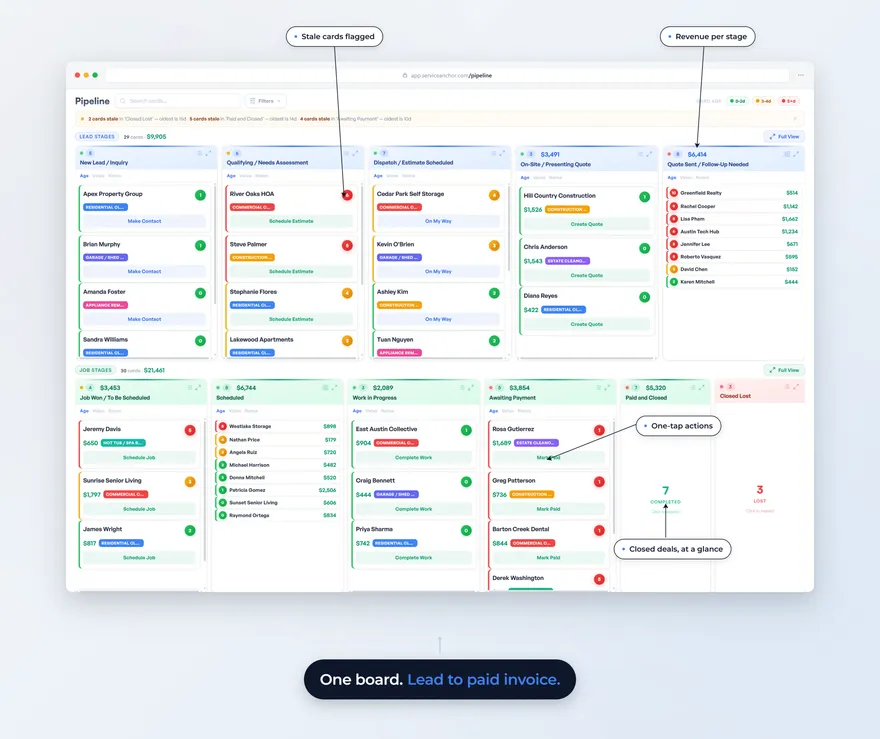
Once the truck is hauling loads, the job that actually decides whether you grow is booking and following up on the leads that call. Service Anchor is the lead-to-paid pipeline that books, quotes, and chases each junk job automatically on one board, preloaded for junk removal, so the truck stays full and the office keeps up with you. The truck moves the junk; the pipeline makes sure there is a next job for it to move.
FAQ
What truck is best for junk removal?
The best truck for junk removal for most operators is a dump trailer towed by a three-quarter-ton or one-ton pickup, because it hauls real loads, dumps hydraulically, and costs a fraction of a dedicated dump truck. As volume grows, a dump truck or box truck that holds 15 to 16 cubic yards becomes worth the payment. The right choice is the smallest rig that comfortably handles your typical job, not the biggest one you can finance.
How many cubic yards is a junk removal truck?
A full-size junk removal truck holds about 15 to 16 cubic yards, which is the industry benchmark for a “full truck.” Dump trailers commonly run 6 to 12 cubic yards, and box or cabover trucks reach 15 to 20. Since most residential cleanouts do not fill a 16-cubic-yard box, many operators run a smaller trailer and make an extra dump run on the rare oversized job.
Do you need a CDL for junk removal?
You usually do not need a commercial driver’s license for junk removal, because a CDL is only required when the vehicle’s gross vehicle weight rating is 26,001 pounds or more. Most single-truck setups, like a three-quarter-ton pickup with a dump trailer or a light dump truck, are built to stay under that line. Always check the GVWR of your truck and loaded trailer together, since a heavy combination can cross the threshold.
How much does a junk removal truck cost?
A junk removal truck costs about $6,000 to $14,000 for a dump trailer, $20,000 to $45,000 for a used dump truck, and $60,000 or more new. For a first truck, a used dump trailer paired with a pickup is the lowest-capital way to haul real loads. Buying a new dedicated truck before your volume justifies it is the most common first-year money mistake in the trade.
Can you start a junk removal business with a pickup and trailer?
Yes, a pickup and a dump trailer is the most common way to start a junk removal business, and it is the setup most operators begin with. A three-quarter-ton or one-ton pickup can tow a hydraulic dump trailer that holds 6 to 12 cubic yards, which handles the majority of residential cleanout jobs. Confirm your truck’s towing capacity and the combined weight rating so you stay within your license class.
U.S. Federal Motor Carrier Safety Administration, Commercial Driver’s License: source for the 26,001-pound gross-vehicle-weight-rating threshold that determines when a CDL is required. https://www.fmcsa.dot.gov/registration/commercial-drivers-license
U.S. Federal Motor Carrier Safety Administration, Do I Need a USDOT Number?: source for the weight and interstate-commerce triggers that determine when a commercial vehicle needs a USDOT number. https://www.fmcsa.dot.gov/registration/do-i-need-usdot-number
Last updated: July 2026. First publication: an operator’s guide to junk removal trucks covering the four truck types with cost ranges, cubic-yard sizing, the CDL and USDOT weight lines, and the dump-trailer year-one buy.