Yes, a junk removal business almost always needs a license, and in most states it is three separate filings, not one: a general business license, a waste hauler permit, and a solid-waste transport permit. This is for someone standing up a hauling business this month who has registered the entity and now needs to know which permits actually apply to hauling and disposing of other people’s stuff. A general business license commonly runs a few hundred dollars a year, and a waste hauler permit typically runs $100 to $500 a year, but the one that trips people up is the solid-waste transport permit issued by your state environmental agency. This guide lays out the full stack, what each filing costs, the order to file them, and three real state walkthroughs (New York, Texas, and California) so you know what to do this week instead of reading one more page that says “requirements vary.” Treat it as operator education, not legal advice, and verify your own jurisdiction against the official sources linked below.
- A junk removal business usually needs three filings: a general business license (city or county), a waste hauler permit, and a solid-waste transport permit (state environmental agency). A general business license alone is not enough to legally haul waste.
- Rough costs: a general business license commonly a few hundred dollars a year, a waste hauler permit $100 to $500 a year, and the solid-waste transport permit varies by state.
- The state agency is the part that varies most: New York uses the NYSDEC Part 364 transporter permit (plus a separate NYC trade-waste license), Texas uses TCEQ registration, and California regulates hauling mostly through city and county franchise agreements.
- Hauling construction and demolition (C&D) debris is a separate waste stream that can trigger extra local permits, and a truck or trailer rig rated over 10,001 pounds needs a USDOT number.
- File in order: entity and EIN, then general business license, then waste hauler and solid-waste transport permits, then insurance, then vehicle and DOT registration if your rig crosses the weight threshold.
Do you need a license for junk removal?
Yes, you almost always need a license for junk removal, and the honest answer most pages avoid is that it is usually three filings rather than one. Hauling and disposing of other people’s waste is a regulated activity, so a general business license (which just lets you operate a business at all) does not by itself authorize you to collect and transport waste. On top of the business license, most operators need a waste hauler permit and a solid-waste transport permit, and the exact names and agencies vary by state and county.
The generic startup guides bury this inside step six of a ten-step listicle or wave it off with “requirements vary by location,” which is true but useless to someone about to file. The rest of this guide names the actual filings, gives real cost ranges, and works three states so you can see the pattern. Licensing is one step in the larger setup, and our full walkthrough of how to start a junk removal business puts it in sequence with the rest.
What licenses and permits does a junk removal business need?
A junk removal business typically needs a stack of licenses and permits, not a single license, and each layer authorizes a different part of the operation. Here is the full stack with typical costs and who issues each.
| Filing | Typical cost | Who issues it |
|---|---|---|
| General business license | A few hundred dollars a year (varies widely by city) | City or county |
| Waste hauler permit | $100 to $500 a year | City, county, or state |
| Solid-waste transport permit | Varies by state | State environmental agency |
| C&D debris permit (if you haul construction debris) | Varies by county | County solid-waste department |
| USDOT number (rig rated over 10,001 lbs) | Free to register | FMCSA |
| Employer registrations (if you hire) | Varies | State labor and tax agencies |
The waste hauler and solid-waste transport permits are the two that catch operators who assumed a business license was enough. The construction-and-demolition wrinkle is the next one: C&D debris is a distinct waste stream, and hauling renovation or demolition material can require a separate local permit and fee on top of your household-junk permit. If you plan to carry heavy loads, the vehicle side matters too, which ties into your junk removal equipment decisions and the DOT threshold below.
What licenses do you need to haul junk by state?
The licenses you need to haul junk vary most at the state level, specifically in which agency issues the waste-hauler and solid-waste-transport permits. Here are the three states the searches ask about most, and these are illustrative: your city and county rules layer on top of the state requirement.
| State | The state waste layer | Issuing agency | Notes |
|---|---|---|---|
| New York | Waste Transporter Permit under 6 NYCRR Part 364 | NY State Department of Environmental Conservation (NYSDEC) | Proof of workers’ comp required; NYC adds a separate trade-waste license through the Business Integrity Commission |
| Texas | Solid-waste transporter registration | Texas Commission on Environmental Quality (TCEQ) | Annual fee $100 to $500 based on tonnage hauled, plus a per-vehicle authorization sticker |
| California | No single state hauler permit; hauling is governed locally | CalRecycle permits disposal facilities; hauling authority comes from city and county franchise agreements | Often non-exclusive franchises; check the specific municipality you operate in |
California is the one to get right, because it is the most misreported. CalRecycle permits solid-waste facilities, but it does not issue a statewide junk-hauler license; the authority to haul comes from the city or county, usually through a franchise agreement. New York stacks a state permit (NYSDEC) and, inside the city, a separate NYC license. Texas centralizes the waste layer at TCEQ. The pattern across all three: there is a state environmental layer and a local layer, and you need both.
How do you find your local junk hauling requirements?
You find your local junk hauling requirements by checking four sources in order, because no single page can list every county’s rules. This is the repeatable method that works for any location, not just the three states above.
First, your state or city business-licensing portal, for the general business license. Second, your city or county business-license office, since many hauler permits are issued locally. Third, and most important, your state environmental or natural-resources agency (the DEC, DEQ, TCEQ, or equivalent) for the waste-hauler and solid-waste transport permits, which is the layer the listicles skip. Fourth, your county solid-waste department if you plan to haul C&D debris. When the answer is genuinely unclear, a short call to the county clerk or a local CPA resolves it faster than another search. The U.S. Small Business Administration’s guide to business licenses and permits is the plain-language starting point for how the federal, state, and local layers fit together.
What to do next
File in the order that avoids rework, because getting the sequence wrong means redoing paperwork. The checklist: form your entity and get your EIN first, then your general business license, then your waste hauler permit and solid-waste transport permit, then your insurance, and finally your vehicle and DOT registration if your rig crosses the weight line. The insurance pairs with the permits, and if you are weighing an independent shop against a franchise, know that a junk removal franchise often handles some of this licensing centrally while an independent files it all directly. Write these costs into your junk removal business plan so they are line items, not surprises.
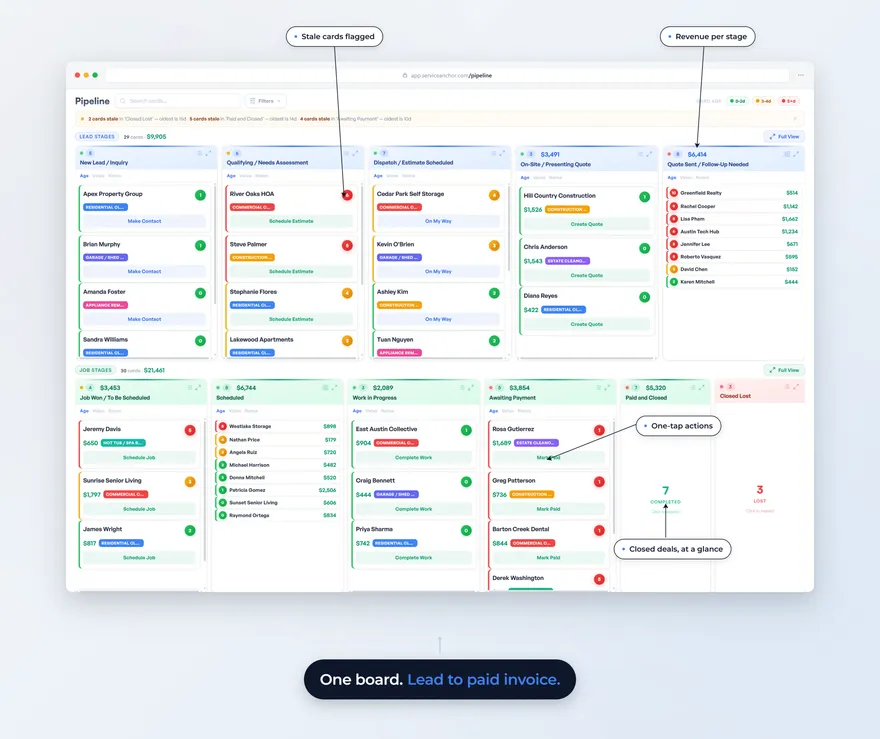
Licensing is the paperwork, and it is worth doing right, because an unlicensed hauler has no standing when a job goes sideways. Once you are legal, the operating side is the part you can stand up in an afternoon. Service Anchor preloads the junk removal pipeline so the first job is bookable the day your permits clear, from the first call to the paid invoice on one board, built for junk removal. It does not file, track, or guarantee your licensing; that is between you and your state and county. What it does is make sure that the moment you are cleared to haul, you are also ready to book, quote, and get paid.
FAQ
Do you need a license to start a junk removal business?
Yes, you almost always need a license to start a junk removal business, and usually more than one. Beyond a general business license, most operators need a waste hauler permit and a solid-waste transport permit, because hauling and disposing of waste is a regulated activity that a general business license does not by itself authorize. The exact filings and agencies depend on your state, county, and city.
What is a waste hauler permit?
A waste hauler permit is a license that authorizes you to collect and transport waste for others, separate from a general business license that just lets you operate a business. It is typically issued by a city, county, or state agency and commonly costs $100 to $500 a year. Many junk removal operators also need a state-level solid-waste transport permit on top of the local hauler permit.
How much does a junk removal license cost?
A junk removal license costs a few hundred dollars a year for a general business license, plus roughly $100 to $500 a year for a waste hauler permit, with the state solid-waste transport permit varying by state. Exact costs depend heavily on your city and county, and hauling construction debris or hiring employees adds further registrations. Budget for the stack, not a single fee, and verify current amounts on your state and local portals.
Do you need a special license to haul construction debris?
Yes, hauling construction and demolition (C&D) debris often requires a separate permit beyond a standard junk hauler license, because C&D is a distinct waste stream. Many counties require a specific C&D hauler permit and charge a disposal fee for that material. If you plan to take renovation, roofing, or demolition debris, check your county solid-waste department’s C&D rules before you quote those jobs.
Do you need a DOT number for junk removal?
You need a USDOT number for junk removal if any truck or truck-and-trailer combination you use for hire has a gross vehicle weight rating of 10,001 pounds or more. The rating controls, not the actual weight you are carrying that day, and many junk rigs with a loaded trailer cross that line. In addition, 37 states require a USDOT number for intrastate for-hire operation, so check your state’s rule even if you never leave it.
U.S. Small Business Administration, Apply for Licenses and Permits: source for the framework that most businesses need a combination of federal, state, and local licenses and that requirements and fees vary by activity and location. https://www.sba.gov/business-guide/launch-your-business/apply-licenses-permits
New York State Department of Environmental Conservation, Waste Transporters (6 NYCRR Part 364): source for the New York state waste transporter permit requirement for companies that transport regulated waste, used as the state-layer example. https://dec.ny.gov/environmental-protection/waste-management/waste-transporters
Last updated: July 2026. First publication: the operator’s ordered junk removal licensing checklist, naming the three-filing reality (business license, waste hauler permit, solid-waste transport permit), with real cost ranges and worked state examples for New York, Texas, and California.